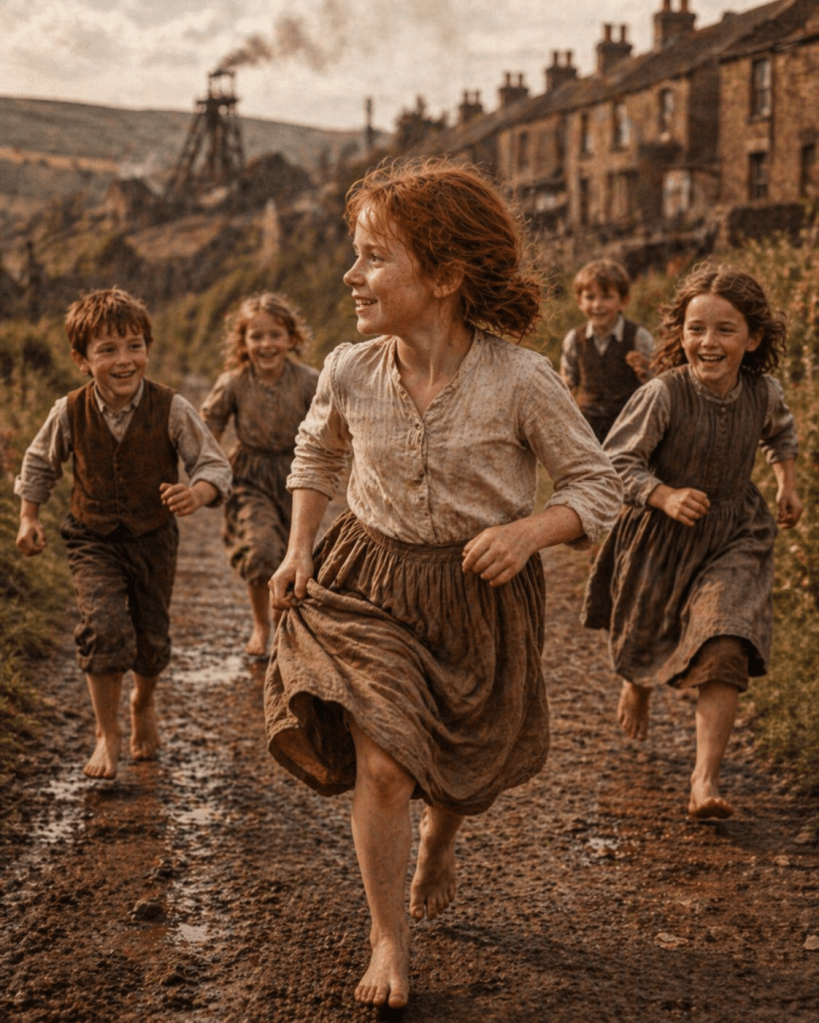
Margaret McDonald Bruce entered the world on 4 November 1874 in the small settlement of Bryans, a scatter of cottages lying in the long shadow of Bryan’s Pit. Though the pit dominated the landscape, her father, William Bruce, himself the son of a miner, had chosen a different path. He worked the fields rather than the seams, earning his living as an agricultural labourer on land shaped, interrupted, and often scarred by the industry around it.

In Newbattle, farming meant crops rather than cattle. Mine shafts cut across the fields, fences were trampled by the daily tide of men heading for the pits, and the roads were churned into ruts by the endless passage of coal carts. Families like the Bruces lived where work allowed, renting rooms or cottages as seasons and employers required. At the time of Maggie’s birth, Bryans offered both shelter and proximity to the farms that needed hands.
Coal had been part of Newbattle’s story for centuries. The monks of the Abbey had first dug into the seams in the thirteenth century, and by the nineteenth the district had become a patchwork of pits, spoil heaps, and tight rows of stone cottages built for the men who worked below ground. Maggie’s childhood unfolded at the edge of this world. Her father’s work tied the family to the fields, yet the sounds of mining shaped her earliest memories: the tramp of boots before dawn, the distant whistle marking the change of shift, the fine grit that settled on window ledges no matter how often her mother wiped them clean.
By the time she was old enough to notice the world around her, Newbattle and nearby Newtongrange were swelling with new arrivals. The great Lady Victoria Colliery, soon to become one of Scotland’s most important pits, would open in the 1890s, transforming the landscape Maggie had known as a child.
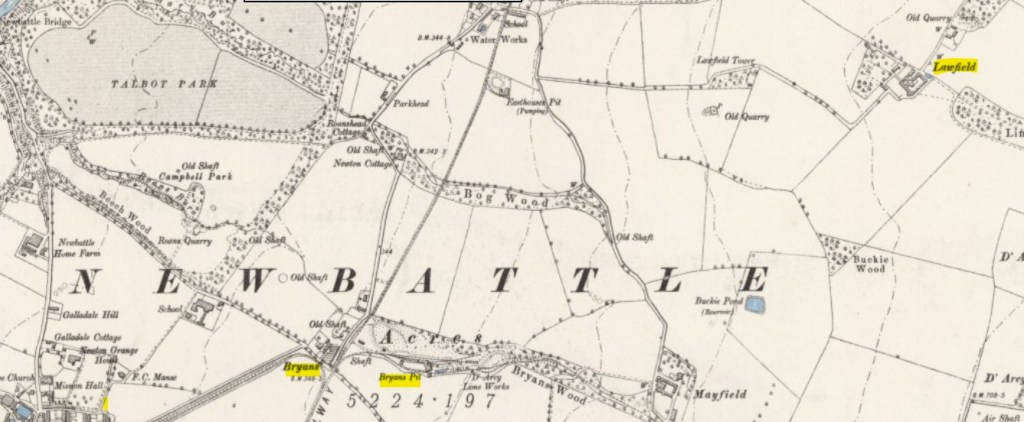
In the spring of 1881, the census taker found the Bruce family living at Lawfield, a little further to the north of Bryans. Their cottage was one of several occupied by agricultural labourers whose days began and ended with the fields. Inside lived William and Margaret Bruce, both in their thirties, raising three young children in the modest rooms allotted to them. Six-year-old Maggie was beginning her school days, while little William and baby Mary Jane, born during a brief stay in Crichton, filled the house with the noise and unpredictability of early childhood. Sharing their home was four-year-old Andrew Currie, a boarder from her mother’s native Melrose, a reminder of the informal networks of care that working families relied upon. The census captured them in a moment of ordinary life, rooted in place yet unaware of the moves and hardships that lay ahead.
1881 Census — Lawfield, Newbattle, Midlothian
Registration District: Newbattle Registration Number: 695/3 Schedule Number: 38 Page: 8 Address: Lawfield
| Name | Relationship | Age | Sex | Occupation | Birthplace |
|---|---|---|---|---|---|
| William Bruce | Head | 33 | M | Agricultural Labourer | Newbattle, Edinburghshire |
| Margaret Bruce | Wife | 35 | F | — | Melrose, Roxburghshire |
| Margaret Bruce | Daughter | 6 | F | Scholar | Newbattle, Edinburghshire |
| William Bruce | Son | 4 | M | — | Newton, Edinburghshire |
| Mary Jane Bruce | Daughter | 1 | F | — | Crichton, Edinburghshire |
| Andrew Currie | Boarder | 4 | M | — | Melrose, Roxburghshire |
In 1891, the Jardine household at 64 St Clerk Street stood at the heart of a bustling Newington streetscape, where grocers, clerks, and small shopkeepers lived above and behind their businesses. At its centre was fifty‑year‑old widow Mary Jardine, running her grocery on her own account, supported by a close‑knit family of grown and nearly‑grown children. Her eldest son Thomas, worked beside her as a grocer, while Robert and William had found clerical positions in the expanding commercial life of Edinburgh. Younger sons Alfred and Ernest were still scholars, their futures not yet fixed. A nephew, also named William, contributed to the household as a confectioner. And in the midst of this busy, respectable home was seventeen‑year‑old Maggie Bruce of Dalkeith, employed as a general servant, a young woman far from her mining‑village roots, navigating the rhythms of urban domestic service.
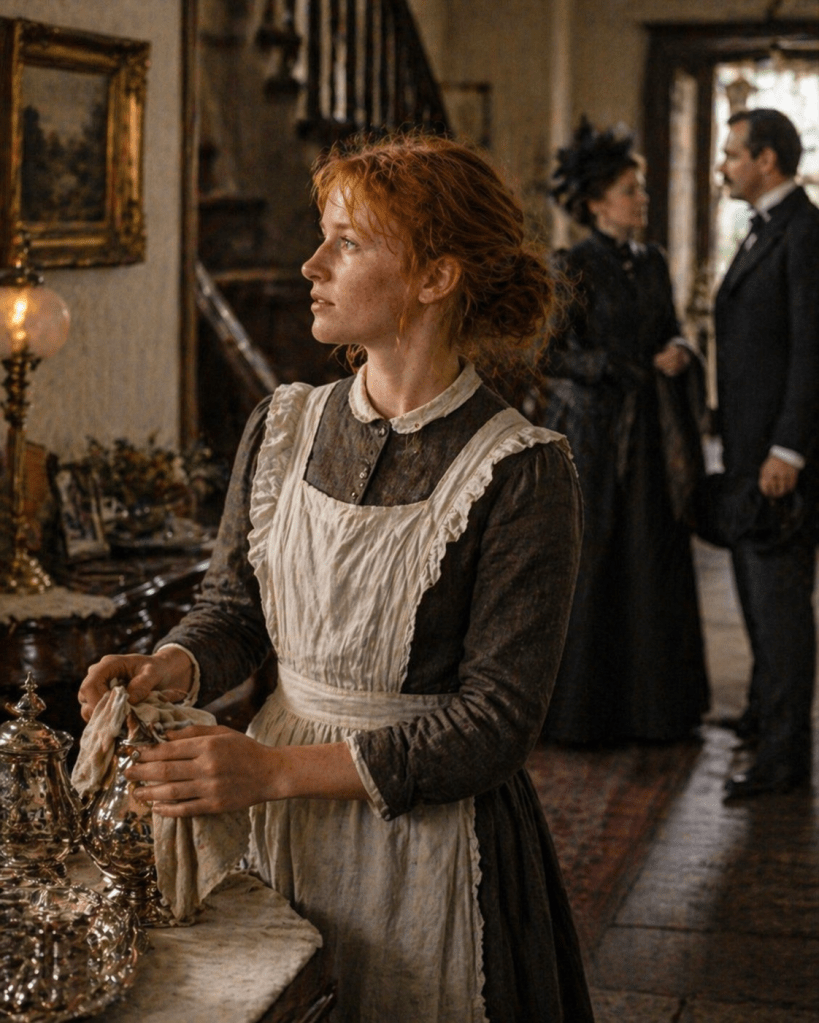
Perhaps it seemed to Maggie, at seventeen, that her life was opening into something entirely new. For the first time, she was living in a city, not the tight weave of fields and pit villages she had known in Newbattle, but Edinburgh, with its stone tenements, bright shopfronts, and the constant movement of people who seemed to belong to a different world. From the windows of South Clerk Street, she would have seen fashions she had only glimpsed in newspapers or on market days: women in tailored jackets and bustled skirts, clerks in neat collars, students carrying books under their arms. Even the rhythm of the streets must have felt like a revelation, a reminder that life could be larger, more varied, than the coal dust and churned farm tracks of her childhood.
Yet inside the Jardine household, the reality was more demanding. She was the only servant in a home of five adults and two older children, each with their own needs, habits, and expectations. The work was constant, fires to light, meals to prepare, rooms to tidy, errands to run, and the house itself was a busy one, shaped by the energy of a family who lived above their shop and worked long hours to keep it going. Whatever glimpses Maggie caught of the city’s wealth and refinement, her own days were governed by duty, routine, and the quiet discipline expected of a young domestic servant.
Household Table — 64 South Clerk Street, 1891
| Name | Relationship | Age | Sex | Occupation | Birthplace |
|---|---|---|---|---|---|
| Mary Jardine | Head | 50 | F | Grocer, own account | Edinburgh |
| Thomas Jardine | Son | 21 | M | Grocer | Edinburgh |
| Euphemia Jardine | Daughter | 19 | F | — | Edinburgh |
| Robert Jardine | Son | 18 | M | Clerk | Edinburgh |
| William Jardine | Son | 17 | M | Clerk | Edinburgh |
| Alfred Jardine | Son | 15 | M | Scholar | Edinburgh |
| Ernest Jardine | Son | 9 | M | Scholar | Edinburgh |
| William Jardine | Nephew | 19 | M | Confectioner | Edinburgh |
| Maggie Bruce | Servant | 17 | F | General Servant (domestic) | Dalkeith |
And all the while, her own family had moved on. The Bruces were now in Ayrshire, far from the familiar lanes of Newbattle and even farther from the life Maggie was carving out in Edinburgh. She was no longer a daughter under her mother’s roof but a young woman standing on the threshold of adulthood, learning to navigate a world that was both wider and lonelier than she had imagined. For a time, she may have believed this new path would carry her further still, away from the coalfields, away from the uncertainty of agricultural work, toward something new, perhaps even gentler.
And so her life turned again, as it so often did for young women in service. Whatever hopes Edinburgh had briefly stirred in her, the sense of possibility, the glimpses of a wider world beyond the coalfields, they were soon overtaken by the pull of family and necessity. In her early twenties, Maggie left the city and travelled west to rejoin her parents in Kilmarnock. Her father had found work there as a general labourer, and the move was likely eased by the presence of her maternal grandfather, already settled in the town and employed as a cotton weaver. For Maggie, it meant stepping away from the bustle of South Clerk Street and returning to a more familiar rhythm, one shaped not by the expectations of an employer but by the shifting fortunes of her own family.
It was in this new landscape of mills and mining villages that Maggie met Matthew Robertson, a coal miner from New Cumnock. He was a widower; his first wife, Sarah Allison, had died of heart failure only two years after their marriage in 1892. Their union had not produced children.
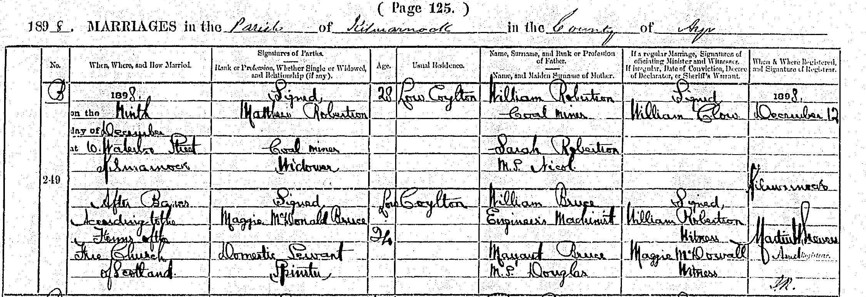
When Maggie married Matthew in 1898, she stepped into the life of a miner’s wife. At the time of their marriage, he worked as a Bencher, a skilled underground role that required strength, precision, and a steady nerve. Benchers cleared coal from the working face, loaded it into hutches, and kept the passages open for the miners who followed. It was demanding, dangerous work, the kind that left a man bone-tired at the end of a shift, his clothes thick with dust, his body marked by the constant strain of labour below ground.
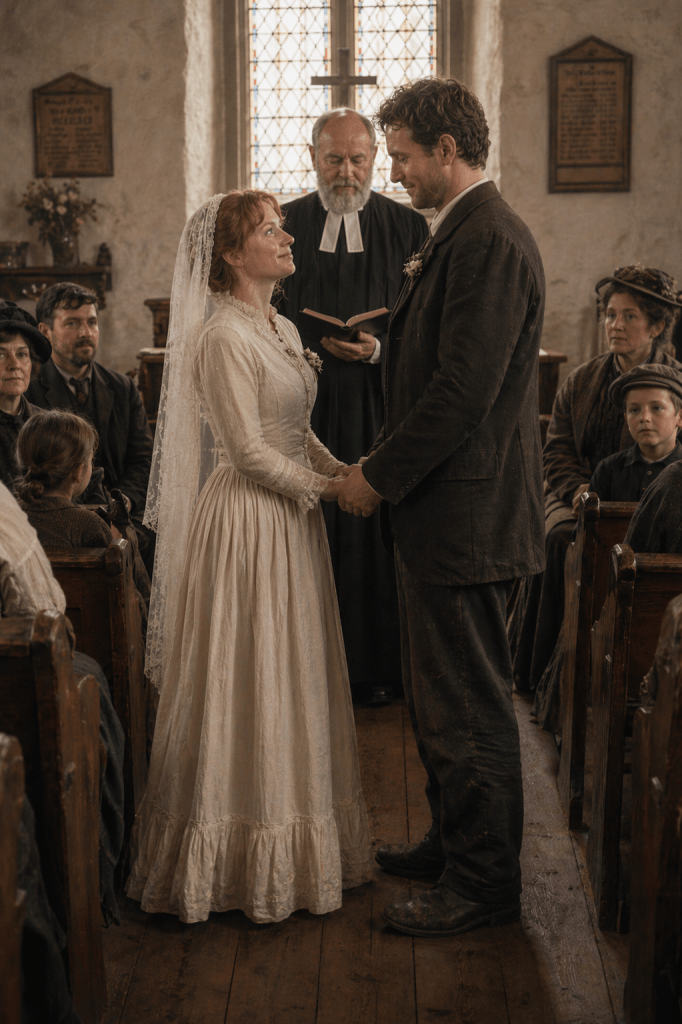
Their first home together was in Drongan, a small mining village in the parish of Ochiltree. Life there was close-knit and practical: women shared washing lines and news, children played on the cinder paths between the rows, and men walked to work in groups before dawn, their lamps swinging in the half-light.
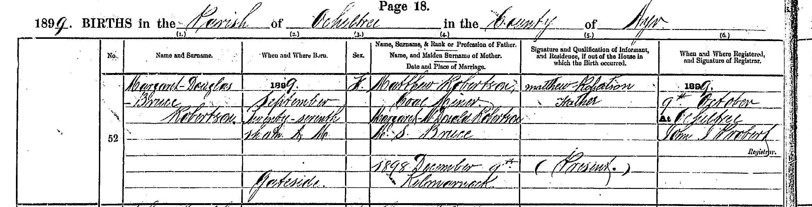
It was in Drongan, in September 1899, that Maggie gave birth to her first child, a daughter she named Margaret Douglas Bruce Robertson, honouring her mother’s family. A year later, in 1900, she delivered a son, William Robertson, named for both grandfathers. With two babies under two, Maggie’s days were full, her world bounded by the cottage, the washhouse, and the needs of her growing family. Yet she was not alone. By then, her parents lived only a mile north in Pottery Row, and it was to them that little Margaret was sent while Maggie recovered from William’s birth.

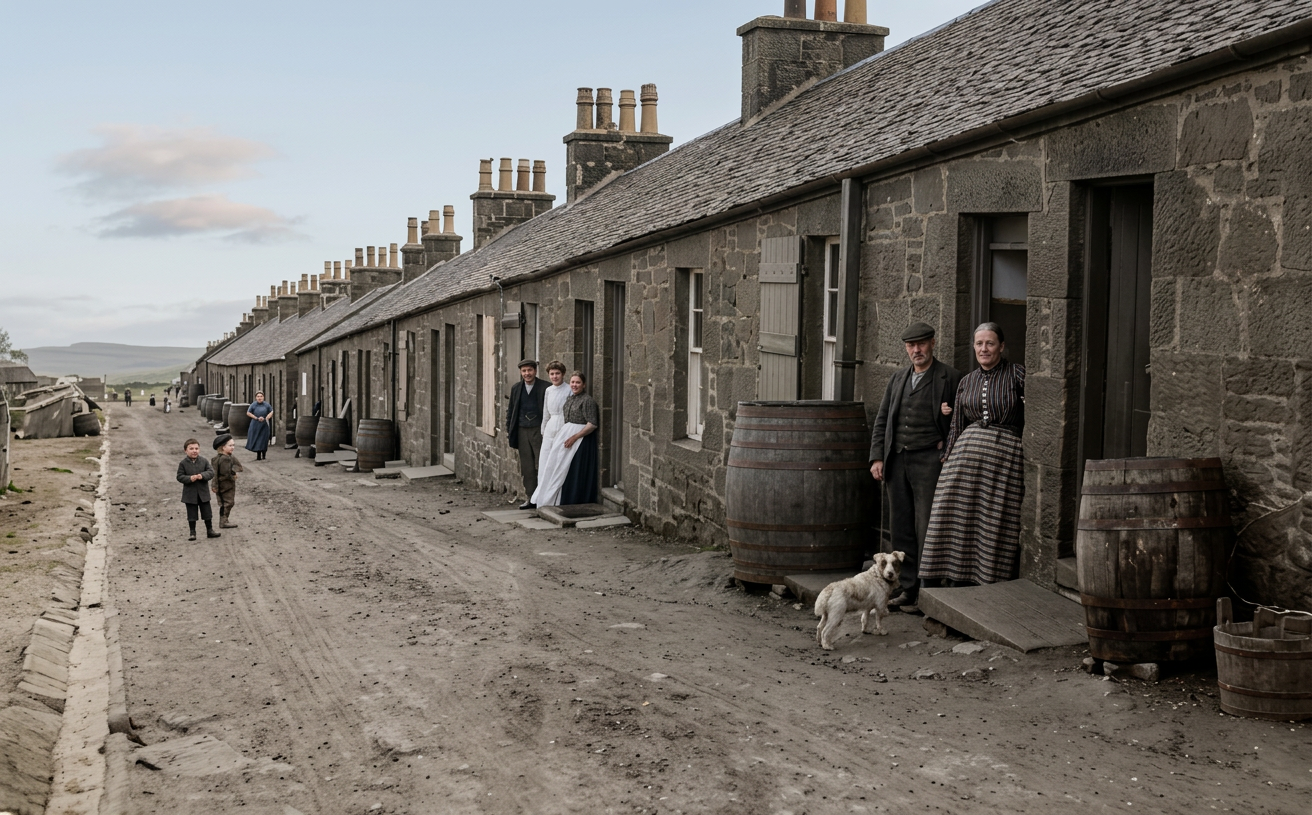
By 1903, the Robertsons had moved once more, this time to Rankinston, a village perched on the high ground south of Drongan. Rankinston was smaller, more exposed to the wind that swept across the Ayrshire moorland, but it offered work at the Polquhairn Colliery, where Matthew had taken a position. The miners’ rows there were basic: a coal hearth for heat, a shared earth closet outside, a washhouse and coalhouse at the end of the row, and no running water indoors. Life was hard, but it was the life most mining families knew.
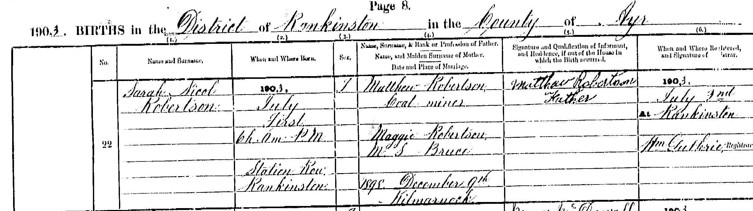
There, Maggie gave birth to her third child, Sarah Nicol Robertson, in 1903, named for Matthew’s mother and perhaps also in quiet remembrance of his first wife. With three children under five, Maggie’s responsibilities multiplied. She managed the household with the resourcefulness expected of a miner’s wife.
Yet there was warmth in that life too, neighbours who watched out for one another, children who grew up in packs, and the steady companionship of a community bound by shared labour and shared hardship. Maggie and Matthew were building a family in the only way working people could: one day at a time, one child at a time, one shift at a time.
Matthew’s position as Dook Runner at Polquhairn offered a chance to settle their young family in a village where work, though hard, was reliable. Maggie arrived carrying the early, secret signs of another child, her fourth in five years, and she set about making the bare miners’ cottage into a home while Matthew walked each day to the pit on the high moor.
The winter was sharp, the wind unrelenting, but they were hopeful in the way young families often are, measuring life not in comforts but in the promise of wages and the nearness of kin. By the spring of 1904, as Maggie’s pregnancy began to show. Neither of them could have imagined how swiftly that fragile stability would shatter.
The morning of 21 June 1904 began like any other. Matthew rose before dawn, moving quietly so as not to wake the children. Maggie stirred only long enough to hear the familiar sounds of him readying for his shift, and the soft click of the door as he stepped into the grey Ayrshire morning.
At the Polquhairn Colliery, Matthew descended with the others, lamps bobbing in the dark like a string of small stars. As a Dook runner, he worked underground. His job to send the waggons along an inclined roadway and travels with them. At the coalface, the freshly cut coal was loaded into the hutches that rattled along the track. It was a dangerous job. A moment’s misjudgment, a slipped prop, a runaway hutch, any of these could change a life.
That morning, it did.
Down on the dook, where the air was close and the lamps threw long shadows, a set of hutches began to run before their time. No one could later say exactly why, a slipped brake, a moment’s error, the small, ordinary failures that become catastrophic underground. The incline was steep, the rails slick with damp, and the weight of the moving hutches gathered speed in seconds. Matthew had no space to escape. The men heard the thud before they saw him, pressed hard against a pit prop, his lamp swinging wildly in the dark. When they reached him he was unconscious, his breath thin and ragged. The doctor was called, but the men already understood what the injury meant. They had seen it before.
They carried Matthew to the surface on a stretcher, his face grey beneath the coal dust, his body unnaturally still.

Maggie sensed something was wrong long before anyone spoke a word. It was the stillness that reached her first, the way the usual sounds of the row seemed to thin out as the morning wore on. She was peeling potatoes at the table, Sarah fussing in her cradle, when she noticed the children from two doors down standing in the lane, watching the bend in the road with an uneasy, expectant silence. Women in mining villages knew how to read the air; they felt trouble before it arrived.
When the men finally appeared at the far end of the row, walking slowly, without the easy stride of men coming off shift, Maggie’s blood ran cold. She stepped outside before they reached her door, her heart thudding in her throat. Only when one of the men removed his cap and held it against his chest did she understand.
Matthew was brought home not to recover, recovery was impossible, but to be cared for. His spine was fractured; he could not walk, could barely move, and the pain was constant. The miners’ rows were never built for such needs. The cottage had no running water, only a coal fire for heat, and the earth closet stood outside, shared by the row. Maggie had to improvise everything: bedding, washing, feeding, lifting, tending.
She learned to move him with a strength she did not know she possessed. She carried water from the pump, heated it in the blackened kettle, and bathed him as best she could. She kept the children quiet when the pain was bad, and when he slept, she sat beside him simply watching the rise and fall of his breath.
Neighbours helped where they could, a pot of broth, a morning of childcare, a strong back to shift Matthew when needed. Her parents came from Drongan when they were able, her mother taking the children so Maggie could rest or tend to Matthew without interruption.
But the burden was hers. Day after day, night after night.
The weeks after the accident passed in a blur of exhaustion and dread. Maggie moved through each day with the mechanical steadiness of someone who had no choice but to keep going. She was still carrying the child she had been expecting when they came to Rankinston, a small, fluttering hope she held close even as she tended to Matthew’s broken body. But grief has a way of gathering its own momentum. One morning, weeks after the accident, the pains began too soon. The midwife could do little. The baby, a boy they named Matthew, lived only minutes. Maggie held him long enough to memorise the weight of him, the stillness, the terrible quiet. Then he was gone.
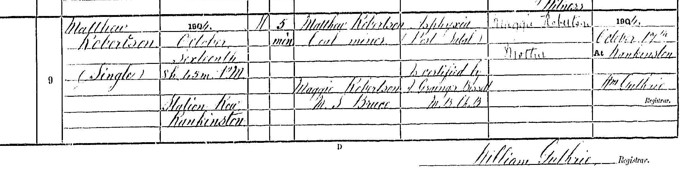
The months that followed brought no relief. With Matthew unable to work, the household income vanished overnight. The pits offered no compensation in those days; a man injured underground was simply a man who could no longer earn. Rent became a monthly dread. Food grew scarce. Maggie stretched every coin, every loaf, every kindness offered. Her parents helped where they could, bringing broth, coal, or a few shillings saved from their own tight budget. Neighbours rallied too, a pot of soup left on the doorstep, a morning of childcare, a bundle of hand-me-down clothes for the children. It was the kind of quiet solidarity they all depended on, the unspoken understanding that misfortune could strike any family without warning.
There were moments when she stood at the doorway, looking out across the moorland, the wind tugging at her hair, and wondered how a life could change so swiftly. Only a year earlier she had been carrying Sarah beneath her heart, watching Matthew stride home from the pit, blackened and weary but whole. Now she watched him struggle to lift a cup.
Yet she did not falter. Maggie had been shaped by the fields of Newbattle, the service rooms of Edinburgh, the close-knit rows of Drongan. Hardship was not new to her. What was new was the weight of it, the unrelenting nature of caring for a man who would never again stand on his own feet.
Then winter came, a Scottish winter, bleak and unyielding. The wind swept across the moor with a bitterness that seeped into the bones, and the days closed in early, leaving long nights lit only by the glow of the hearth. Maggie kept the fire burning as best she could, rationing the coal, wrapping the children in blankets, and tending to Matthew through the dark hours when pain kept him from sleep.
She watched as Matthew, the strong man she had married just five years earlier, wasted away before her eyes. Unable to move from the bed that had become his prison, relying on his wife for even his most basic needs, his spirit diminished. He grew thinner each day. He became quiet. Maggie tried to encourage him, but she too was in despair. Their children were hungry; the future they had imagined together had vanished.
There were nights when she sat by his bedside, listening to the wind batter the row, wondering how much more they could endure. Yet each morning she rose again, because there was no alternative. Survival, in those months, was not a triumph but a quiet, stubborn refusal to give in.
As the new year rolled in with bitter winds carrying snow, Matthew’s strength failed. For six months he had lain bedridden and paralysed. His muscles had wasted, his weight had dropped, and he felt the cold more than others. Maggie tried to keep him warm, even scouring the nearby coal bings for cinders to keep the fire going, but the vicious winter took its toll.
The official record of Matthew’s death is stark in its language, but for Maggie it marked the end of a long, slow unravelling that had begun the previous summer. On 14 January 1905, at one o’clock in the morning, Matthew Nicol Robertson died in their small cottage on Station Row. The registrar wrote the details in a steady hand, male, thirty-four, married to Margaret Bruce, cause of death: fracture of spine, six months’ duration, but the words could not capture the months of pain, fear, and quiet endurance that had preceded that moment. His brother Andrew travelled from Drongan to give the information, sparing Maggie the ordeal of standing before the registrar herself.

Weeks later, the Register of Corrected Entries added a colder, more forensic layer to the story. The Procurator Fiscal’s inquiry confirmed what the village already knew: that on 21 June 1904, Matthew had been crushed between a moving hutch and a pit prop in the underground workings of Polquhairn Colliery. A jury recorded the circumstances; officials signed their names; the correction was entered on 6 March 1905. It was all precise, tidy, and final.
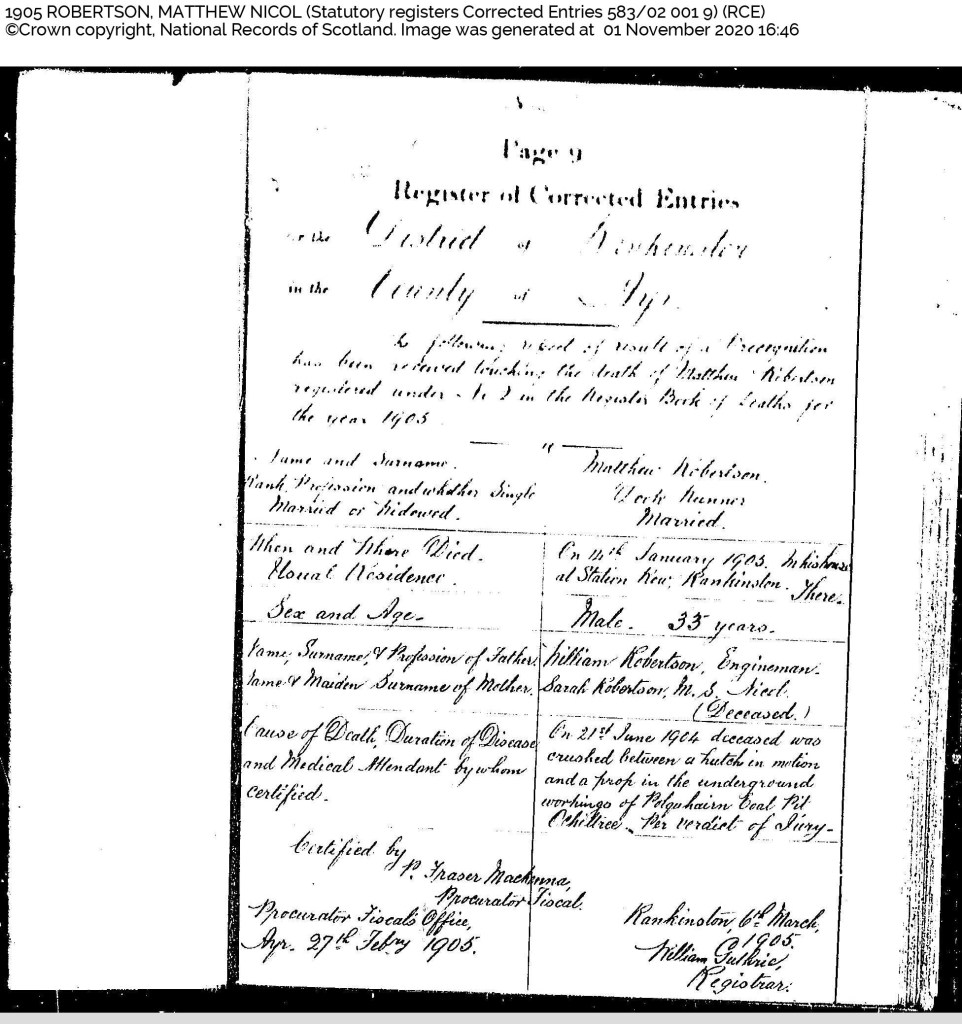
But for Maggie, these entries were not just bureaucratic facts. They were the formal acknowledgement of the life that had slipped away in her arms, the husband she had tended through pain, the father her children would barely remember, the man whose wages had once kept their household afloat. The documents told the story of how he died. Maggie carried the story of how he lived, and how she had cared for him, into the years that followed.
In the years that followed, Maggie rarely spoke of the winter of 1904–05, yet it lived beneath everything she became. Matthew’s death at thirty-four marked not just the end of his life but the end of the future they had imagined together. She was left with three young children, an empty cradle, and a grief that settled into the corners of the house like coal dust.
In time, the sharpness of loss softened, and the years drew her onward, to new places, new work, and the long, hard-won resilience that would define the rest of her life.
Her life did not end with Matthew’s passing, though for a time it must have felt as though the world had narrowed to grief, hunger, and the daily struggle to keep her children warm. Yet where sorrow had settled heavily over her small cottage on Station Row, life continued. It was there, in the months after Matthew’s death, that she came to know Alexander McCulloch, a neighbour and miner who had been present during the months of Matthew’s suffering. He was steady, dependable, and kind in the unspoken ways that mattered. In him, Maggie found not a replacement for what she had lost, but the possibility of a future that did not end in widowhood and want. They married in 1906, giving her and the children a stability and a future that had seemed impossible.
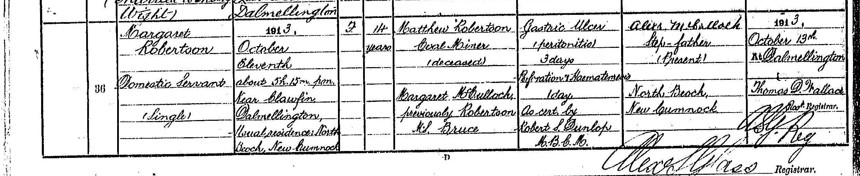
But life did not spare her further sorrow. In 1913, her eldest daughter, Margaret, the child she had borne in her first year of marriage to Matthew, died from a perforated ulcer at only thirteen. It was a loss that reopened every old wound, a grief no mother ever fully recovers from. Yet Maggie carried on, as she always had, because there were other children who needed her, and because endurance had long ago become the quiet thread running through her life.
With Alexander, she went on to raise six more children, building a large, bustling household that moved in time with the demands of work, weather, and the shifting fortunes of mining families. Eventually the McCullochs left Ayrshire behind and settled in Ferniegair, near Hamilton, where her parents had already resettled. It was in that little mining village that Maggie spent her final years. By then she had lived through more than most, poverty, widowhood, childbirth, loss, and the relentless effort of keeping a family together. When she died in 1927 at the age of fifty-two, taken by breast cancer, she left behind not just a long line of children and grandchildren, but a legacy of quiet resilience. Her life, marked by hardship and renewal, stood as a testament to the countless working women whose strength shaped their families’ survival, even when the world recorded little more than their names.

In the end, her life was not defined by the single winter that nearly broke her, nor by the losses that marked her path, but by the way she kept moving through them. She was one of the countless women whose names rarely appear in history books, yet whose labour, endurance, and quiet courage held families and communities together. Her story was not extraordinary in the eyes of the world, but it was extraordinary in the ways that matter: in the children she raised, the homes she made from bare rooms, the strength she found when strength was the only thing left to give.
She left no grand monuments, only the enduring proof that survival itself can be a kind of legacy. And in that, she was remarkable.

