The Forgotten Uncle – Clark Thomson

When I started researching my family history, my main aim was to learn more about my dad’s early life and find out about my grandparents.

In the process, I began to realise just how many lives are attached to my family tree. Each branch that I looked at uncovered long-forgotten great aunts and uncles and distant cousins. I decided there were just too many for me to investigate fully, so I decided I would set them aside and come back to them later.

However, one name caught my attention right from the start, Clark Thomson. Initially, I was intrigued by the name. Clark is not a common first name in Scotland. I wondered why I wasn’t aware that my Dad had an Uncle Clark. Surely, I would have remembered hearing that name. I found myself wondering where it had come from and why no one seemed to have heard of him.

As I looked more closely at Clark, I found his story both interesting and poignant. It brought to light a feature of the First World War which I had not considered before, the role of the Royal Medical Corps.

It also revealed a possible solution to the mystery of why no one seemed to know about him.

In the end, I was glad I took a closer look at Clark. Here is his story.

Clark Thomson was born on the 3rd of September 1891, at 10 India Street, Rutherglen. His parents were Archibald Thomson, a potter, and Agnes Simpson. I believe Clark was named after his paternal grandmother, Mary Clark.
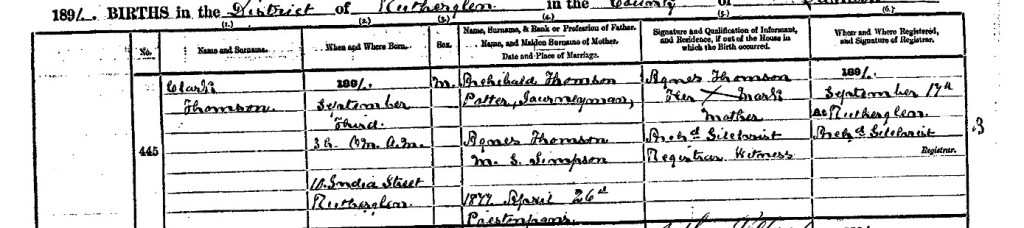
He appears in the 1901 Census living at 15 Mitchell Street, Rutherglen with his parents and siblings. At the age of 9, he was the second youngest child. His brother, Thomas, my grandfather, was three years younger.

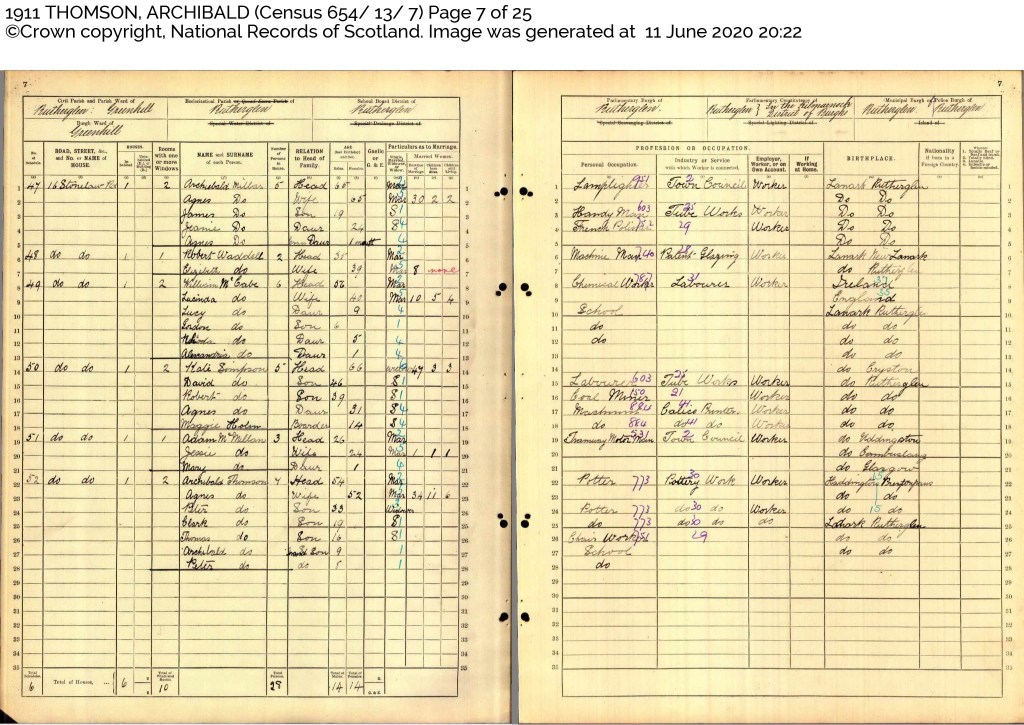
In the 1911 Census, he is recorded as residing with the family at 16 Stonelaw Road. This Census entry reveals that Clark, and his older brother, Peter, were both potters. They would have worked beside their father in the Caledonia Pottery in Rutherglen. Clark was 19 years old.

It seems Clark was a slightly built young man. He was 5’7” and weighed only 123 lbs or 55.7 kg.

When war broke out in 1914, Clark’s younger brother, Tommy, was enlisted and departed in 1915 with the Mediterranean Expeditionary Force.

At first, I wondered why Clark, who was three years older than Tommy, was not also recruited at the outset of the war. Then, I realised that he had an upper denture and a partial lower denture. For a young man, this indicated that he had bad dental problems.

Most people at the end of the 19th Century could not afford dental treatment and I discovered that at the outbreak of war many men were being rejected for recruitment due to deficient teeth.

It was soon realised that many of these men would otherwise not have been rejected. The British Dental Association and the Scottish Dentists’ Association volunteered to treat these men if treatment would make them fit for service. By January 1915, any man with defective teeth could be attested if he were otherwise fit and was willing to get dental treatment.

Often this dental work would be carried out by civil dentist many of whom were unqualified. This resulted in many men having their teeth removed unnecessarily. They would then have to wait until their mouths had recovered enough for them to be fitted with dentures.

As Clark was not recruited until April 1915, I believe the delay may have been because he was having this dental work carried out.
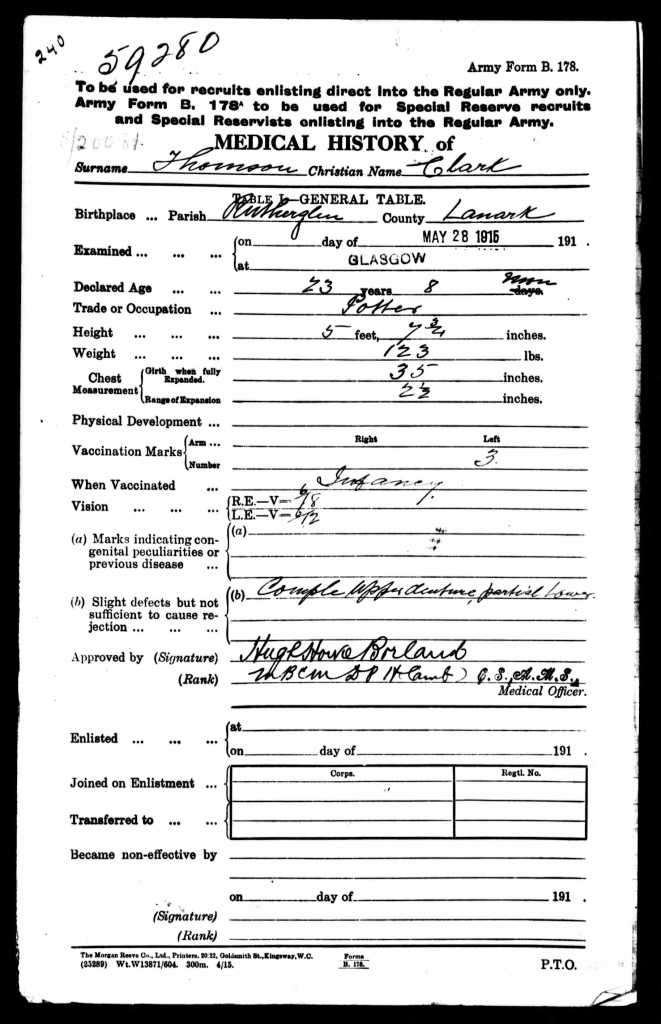
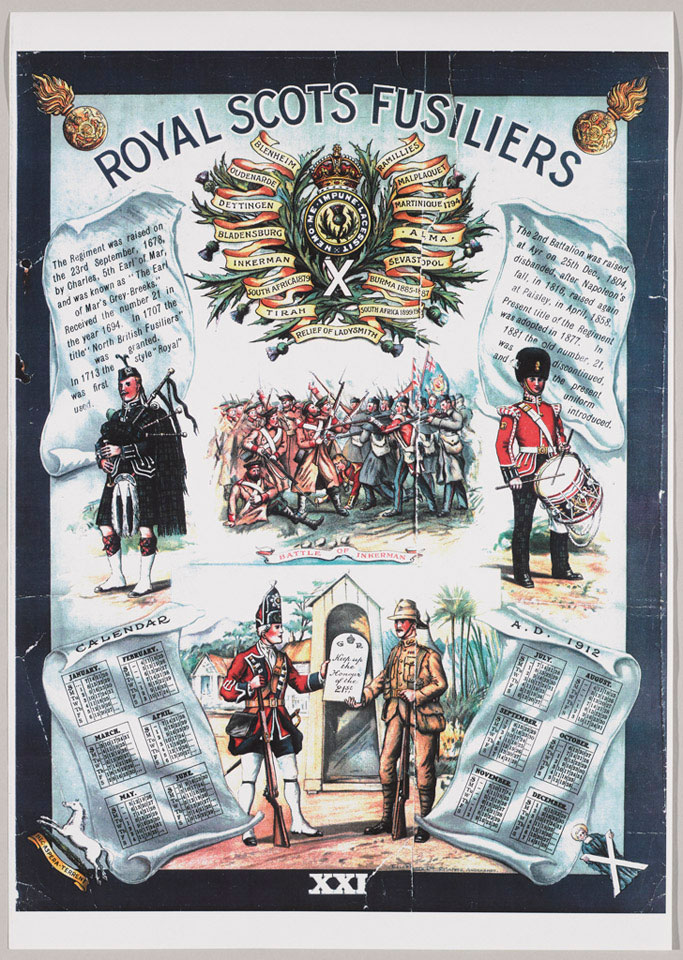
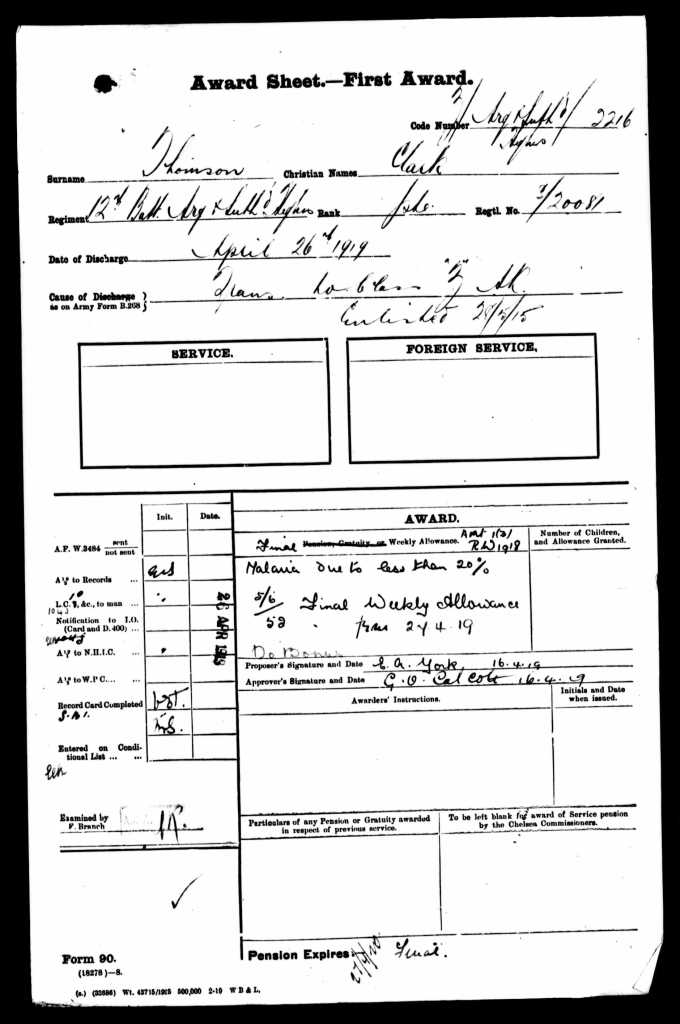
Eventually, however, he became Private S/20081 with the Argyll and Southern Highlanders on 26th April 1915. He was immediately sent to Malta where he spent 9 days before being transferred to the Royal Army Medical Corps as Private 59280.

The RAMC was a non-combatant branch of the Armed Forces. Although they were sometimes given weapons, they could only be used for self-defence under exceptional situations.

WW1 was the first war in which it was fully realised that a soldier’s chance of survival depended on how quickly his wound was treated. The use of heavy artillery and machine guns was resulting in vast numbers of casualties, all needing treatment at the same time. Doctors could not perform efficiently on the front line, and efficient transportation of casualties to places where they could be treated more effectively was critical. Of course, the main aim of the entire process was to treat soldiers and return them to the front line as quickly as possible.

As the war progressed, this complex system of mobile treatment stations with its web of transportation became known as the ‘Chain of Evacuation’. The RAMC was to play a significant role in the war by providing quick and efficient triage, emergency first aid, and crucial treatment.

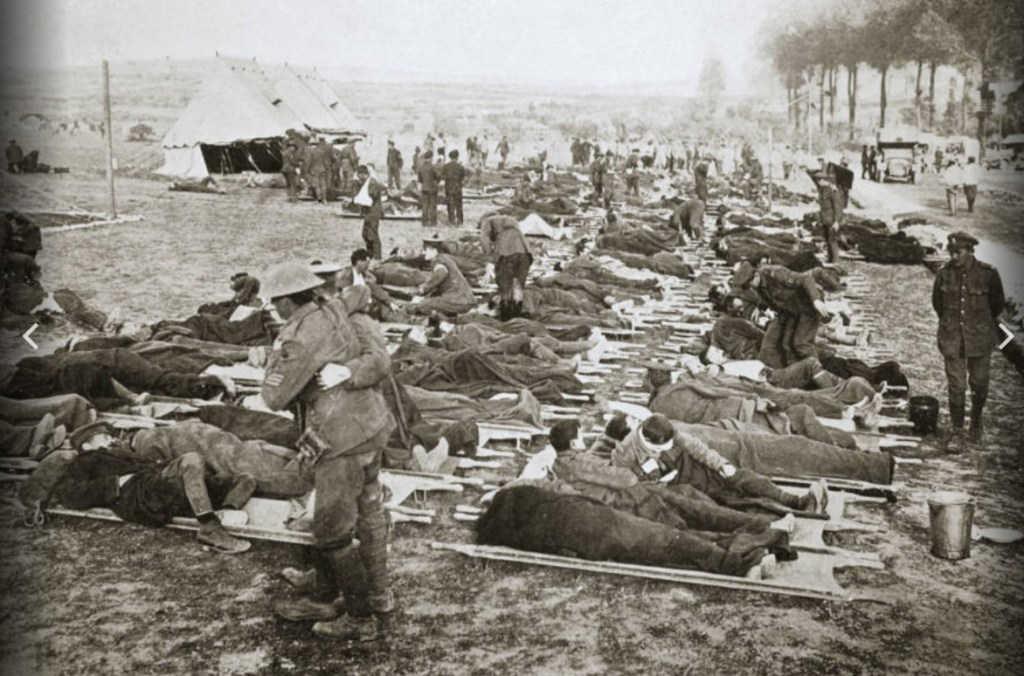
Before any major offensive, the Medical Services planned how the Chain would be implemented. The process was complex. It involved front line medical field units that could move at a moment’s notice. These were made up of Regimental Aid Posts that moved forward with the fighting. The key role of the RAP was to patch up the wounded and return them to duties at the front line. If this were not possible, they would be sent back to the Field Ambulance. Stretcher-bearers would then collect the sick and wounded and take them to the Advanced Dressing Stations. The ADS would provide immediate emergency treatment, assess patients to make sure bandages were adequate and that they weren’t haemorrhaging or going into shock.

The casualties would then be transported to the Main Dressing Station, before going to the Casualty Clearing Station. The CCS was where they could be stabilised, x rayed, prepared for operation, or receive treatment. The main aim of the CCS was to treat casualties and move them on as quickly as possible.

If deemed necessary, the casualty would be taken to a base hospital. Once at the base hospital, the casualty would stay to recuperate or, if too severely injured, would be carried by hospital ship back to Britain.

The men and woman who served in the RAMC played a vital role in maintaining this intricate system of moving and treating the wounded amid bloody and dangerous battles. There was a wide range of jobs involved in the Chain of Evacuation. Staff included doctors and surgeons, nurses, and anaesthetists, as well as an army of stretcher-bearers, orderlies, technicians, and transport workers. Transportation of the injured was carried out by a combination of people, horse and cart, and later on by motorised ambulances, trains and boats.

In Malta, Clark joined the hospital ship, The Glengorm Castle.

The Glengorm Castle was built in Ireland by Harland and Wolff and was originally named The German. She had served as a trooping ship in the Boer War. In August 1914, she was commissioned as Hospital Ship and being renamed. By September 1914, she had been refitted with 423 beds.

Clark spent two years aboard the Glengorm Castle. I do not know what his role was aboard the ship, but it is most likely he was an orderly. He would have been involved in receiving and treating the injured who arrived daily from the fighting taking place in Gallipoli and Salonika.
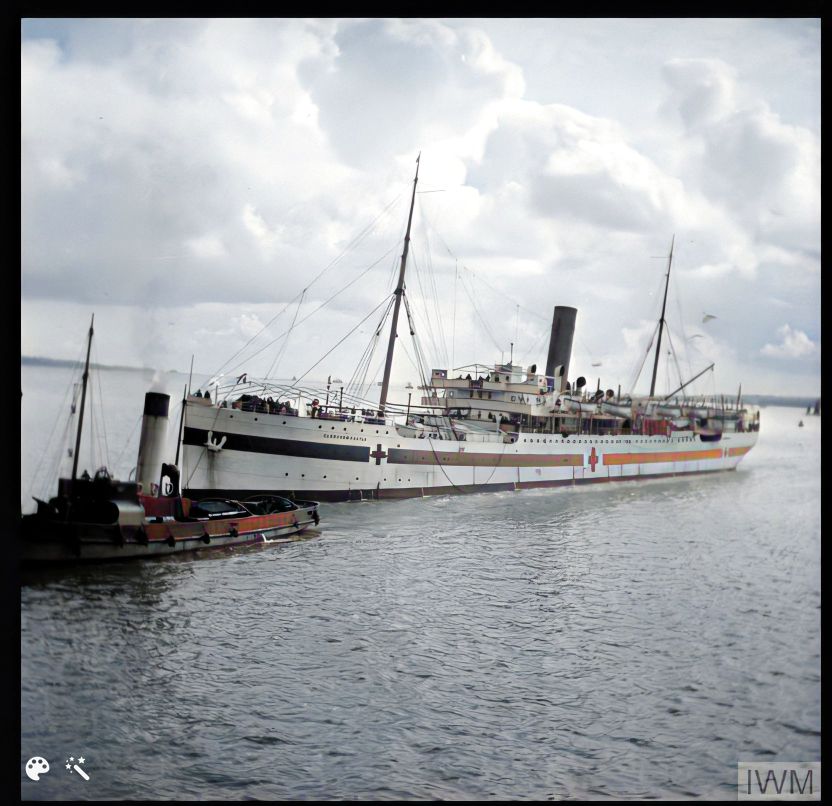
A photo of the HMHS Glengorm Castle
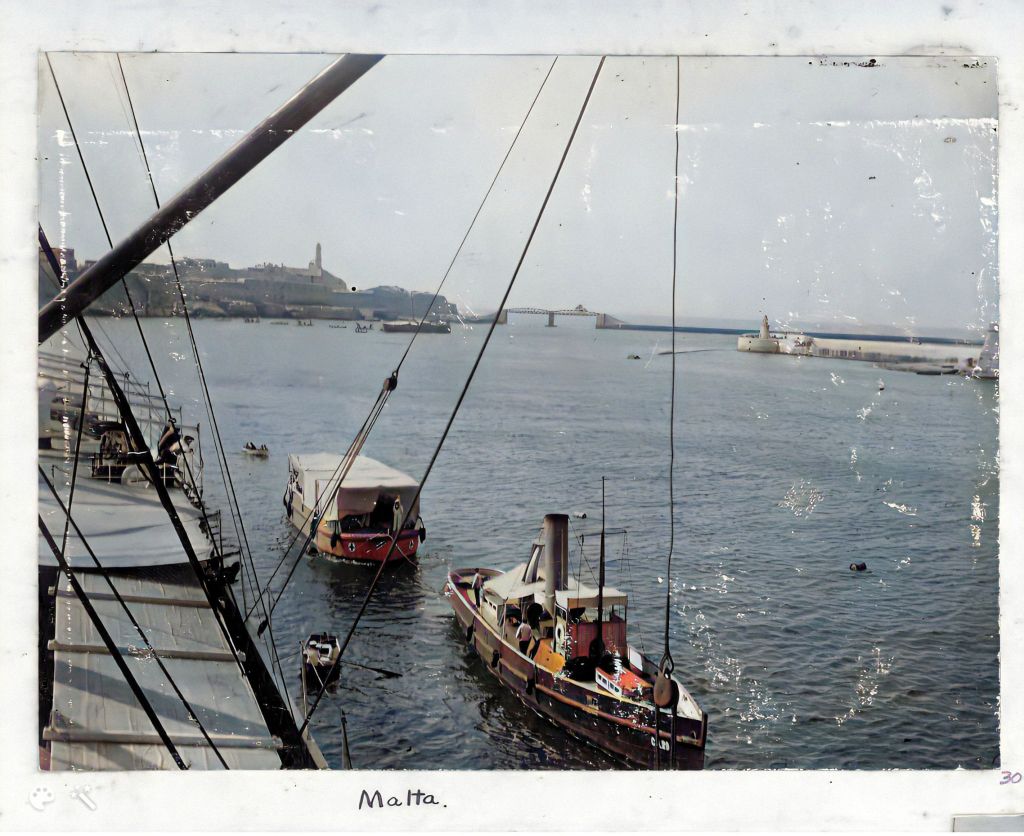
View from the Glengorm castle in Malta.
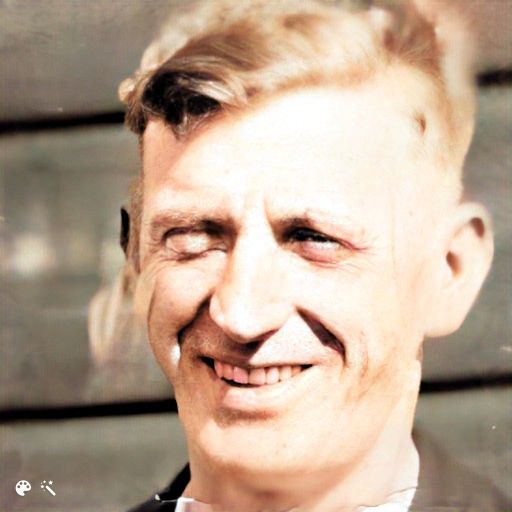
Soldier getting a haircut on the Glengorm Castle. Could this be Clark?

The photos above are copied from an Album collated by 22/74 Sister Mary Eleanor Gould, New Zealand Army Nursing Service Corps. The album covers Sister Gould’s time in Egypt on the Marquette, HS Gascon, HS Glengorm Castle and in England. I have enhanced the photos for clarity and colour.

The Album can be viewed on New Zealand’s National Army Museum Recollect site. https://nam.recollect.co.nz/

In July 1917, Clark left the ship and was transferred to the land-based units serving with the Salonika Campaign.
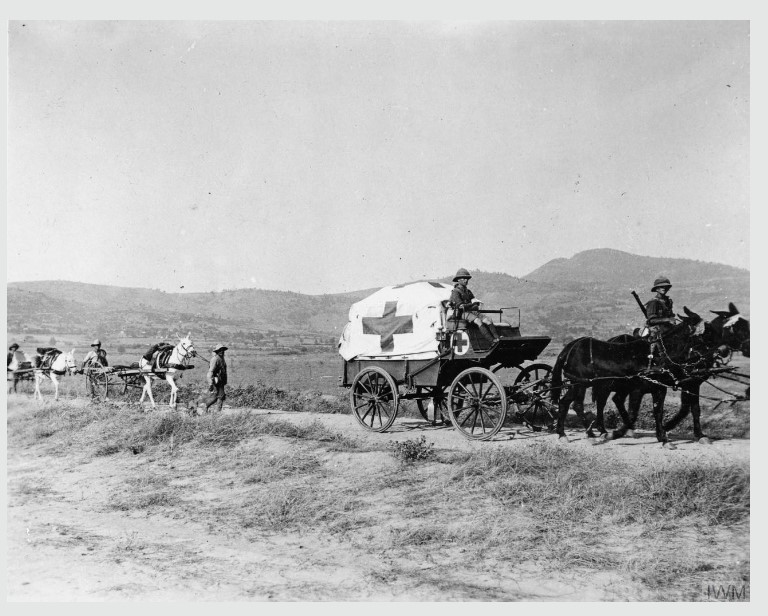
Field Ambulance – Salonika Copyright: © IWM (HU 51960)

He spent the next two years with the RAMC supporting the soldiers fighting at the Greece-Macedonia border. Even after the war ended, in November 1918, Clark continued his service in Salonika until he contracted Malaria.

Malaria had become an unforeseen foe during WW1, infecting at least 1.5 million soldiers and killing thousands. The illness caused nausea, vomiting and diarrhoea and could leave men suffering from jaundice and serious recurrent fevers. The outbreak of Malaria in Macedonia was so bad it immobilised whole armies on all sides for months.

Clark was examined in Bulgaria, before being discharged from the army on the 26th April 1919. He had served almost four years. He was awarded a war pension of 5/6d for a year. He would have received the War Medal and Victory Medal for his service.

After his discharge, Clark returned to his father’s home at 16 Stonelaw Road and found work with his previous employer, The Caledonian Pottery as a Pottery Turner.

Shortly after his discharge, Clark’s mother, Agnes, died from a heart condition. His brother, Tommy, had returned from the Western Front the year before but had since married and was no longer living at the address.

Clark was now 28 years old. He soon met a young woman named Jessie McDonald, and they became betrothed. Jessie, a worker in the carpet mill, was three years younger than Clark. She seems to have been previously married to a man called Aitken.

Clark and Jessie were married on the 29th October 1920, at 16 Stonelaw Road. The ceremony was performed by a minister from the Church of Scotland.

It was probably convenient for the newly married couple to remain at the house, to support his widowed father, Archibald.

Archibald himself died in 1928, and Clark registered his death before taking over the tenancy of the flat.

In 1929, the Caledonian Pot Work closed, and, at some point, Clark found new employment in the dye works. The 1940 valuation roll for 16 Stonelaw Road suggests he was still a potter, but I don’t know where he would have been working at that time.

In the early 1950s, my parents moved into a flat in the same close as Clark and Jessie. I believe Clark had already been admitted to hospital by this time as my mum had no idea of his existence.

He had Pulmonary Tuberculosis the most common form which would have given him a life expectancy of about 5 years. The stigma attached to this condition might explain his mysterious disappearance and the silence surrounding him at this time.

In 1948, someone was dying from this illness every 2 hours. Long considered a disease of the lower classes it was thought to be a ‘dirty’ disease. This perception was exacerbated by the symptoms of the disease the awful cough which often produced blood. It was also recognised that careless spitting, sneezing, and coughing around others spread the illness.
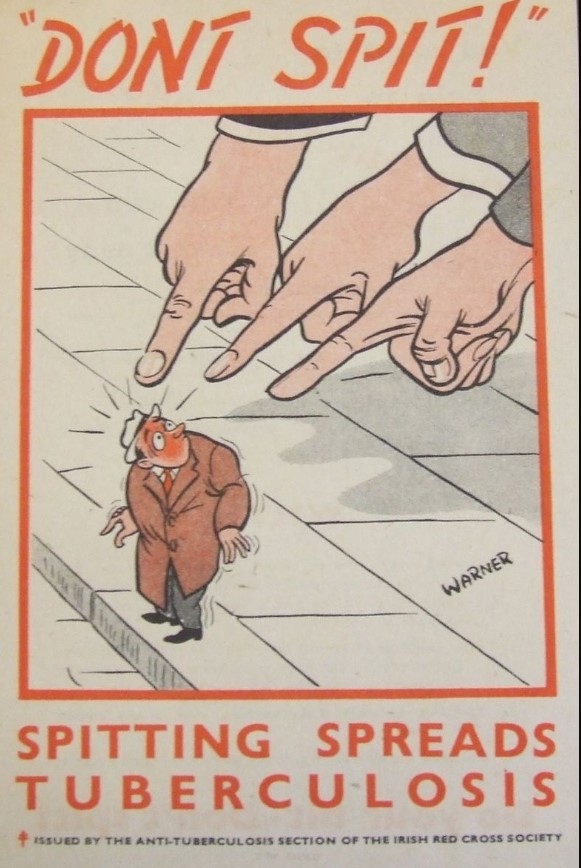
Yet no family, rich or poor, was immune to this disease. A diagnosis of ‘consumption’, as it was commonly known was, in effect, a death sentence.

The treatment of the disease with drugs in the 1950s was still in its infancy and confinement in sanitoriums was still a common occurrence. It had long been believed that fresh air was beneficial for TB sufferers. A practice which also effectively hid the TB patient from society.
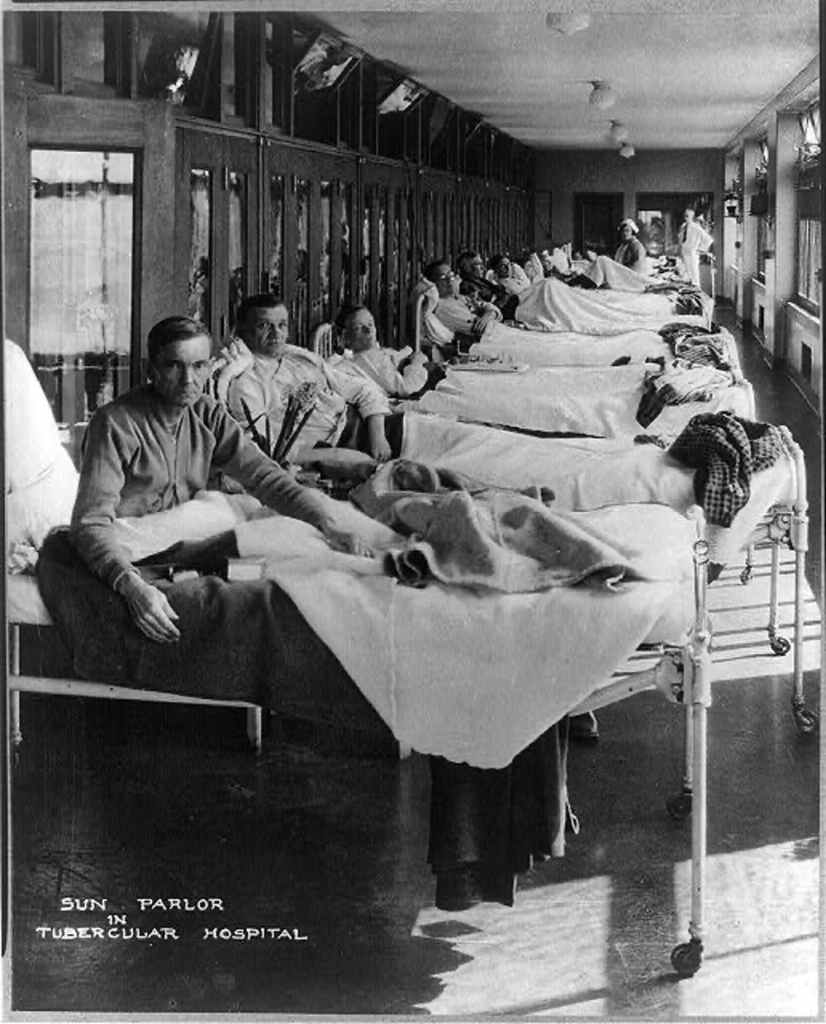
TB Patients in Ohio 1910-1920

Sun parlour in a tubercular hospital in Dayton, Ohio 1910-1920. Library of Congress

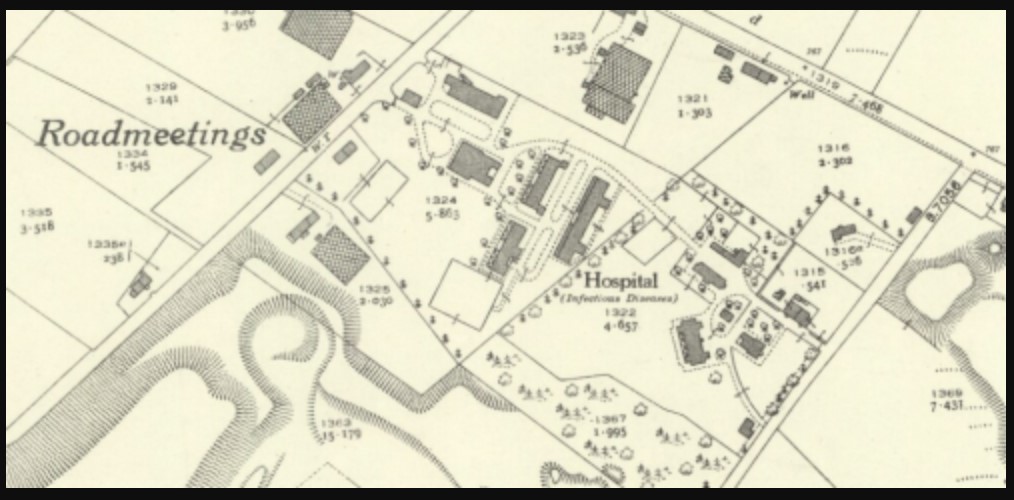
Clark had been admitted to the Roadmeetings Hospital in Carluke. This hospital which had opened in 1928 was dedicated to infectious disease and had 26 TB beds. The single‑storey wards had south facing verandas where the patients could be taken out to enjoy the fresh air.
Despite the introduction of the new drug Streptomycin, Clark died at the hospital on the 11th Feb 1957. Jessie registered his death at Law the next day.

Jessie continued to live at the flat after his death.

I have wondered why my mum couldn’t tell me anything about Clark and Jessie. After all, she had been their close neighbour for several years in the 1950s. She had no recollection at all of Clark and didn’t even recognise the name. I did find this strange as he died in 1957 whilst my parents were living in the same close.

Of course, Mum had not long been married at the time. She had two very young children and was expecting her third baby who was born in May 1957. She was probably too busy, or at least too distracted, to pay much attention to my Dad’s elderly aunt. However, I believe that the fact that Clark was a TB patient was the main reason she didn’t know about him. Could the family have been embarrassed by his illness? This might explain why no one knew anything about him.

Mum did remember Dad’s Wee Auntie Jessie, who continued to live at Stonelaw Road after Clark’s death. She described her as being very small and reserved. She always wore a hat and went to church on Sunday. She also revealed that Jessie appears to have had a bit of a drinking problem as she was once found lying in the back outhouse completely drunk!

Maybe this should have been no surprise, as she was covering up a deep secret!

I hope you have enjoyed reading about my Uncle Clark. I have used my imagination to fill in the gaps in his story. Of course, I may never know exactly what his role was in the RAMC or why he seemed to have disappeared from our family. They are just my interpretation of the facts. If you have other ideas, why not let me know.

Sadly, I have no photos of Clark or Jessie. Maybe someday I’ll come across some.
The Life and Times of Thomas Thomson

Thomas Thomson

My Grandfather

When I began researching my family history after dad died, I knew nothing about my granddad other than the fact that he was dead. Being new to genealogy, I also wasn’t sure where to begin.

I started by asking my mother what she could tell me about her father-in-law. At the time, I thought it seemed very little. I wondered how I could ever get a picture of who this man was almost 40 years after he had died.
Gradually, I began to organise the bits and pieces of evidence and to uncover the story of my grandad, Tommy Thomson.

I was very excited when I received his death certificate through the post. This was the first piece of genealogical data that I had ever looked for and found. From this document, I found his birth information and his story started to write itself.

I discovered that Tommy had been born in Rutherglen on the 21st of November 1894. I remember being struck by the date, the 21st of November is also my sister, Kathleen’s birthday.

He was born at 167 King Street. His father was Archibald Thomson, a Potter, and his mother was Agnes Kerr Thomson, nee Simpson. He was one of eleven children.

This photo shows No. 250 – 284 King Street, Rutherglen. This would have been on the opposite side to the building where Thomas was born. (Photo C. 1930)

I

In the 1901 Census for Scotland, Thomas is shown with his parents and his siblings, living at 15 Mitchell Street, Rutherglen. His siblings were Peter, 23, Mary, 21, Robert, 17, Agnes, 15, and Clark, 9.

I imagine Tommy enjoyed his childhood growing up in Rutherglen, or ‘Auld Ru’glen’, as it was commonly known. Perhaps he and his brothers ventured as far the Cathkin Braes or watched the sale of horses at the famous Rutherglen Horse Fairs held in the Main Street.

The town of Rutherglen is located to the south-east of Glasgow, lying about 3 miles from the city centre. It was a Burgh of Lanarkshire for more than 800 years. In the 19th Century, Rutherglen was a heavily industrialised area. With a total of five collieries, a chemical works, and pottery. It attracted people from all over Scotland looking for work.

Thomas’ father had moved to the area from Prestonpans on the east coast of Scotland to work in the Caledonian Pottery.

Site Plan of the Caledonian Pottery, Rutherglen

The Thomson’s were a working-class family with a strong work ethic. In 1911, all the children who were old enough to work were employed. Tommy’s oldest brother, Peter, worked alongside his father in the Pottery. His oldest sister, Mary, was a paper worker at one of the paper mills. His sister, Agnes, worked in one of the rope works. His other brother, Robert, was a baker.

Tommy appears with his family again in the 1911 Census. The family were still residing in Rutherglen but were then living at 16 Stonelaw Road. Tommy was 16 years old and had started work. At that time he was working in the Eastfield Chair Works. Unlike his older brothers, Peter, and Clark, he had not immediately joined his father in the pot works.

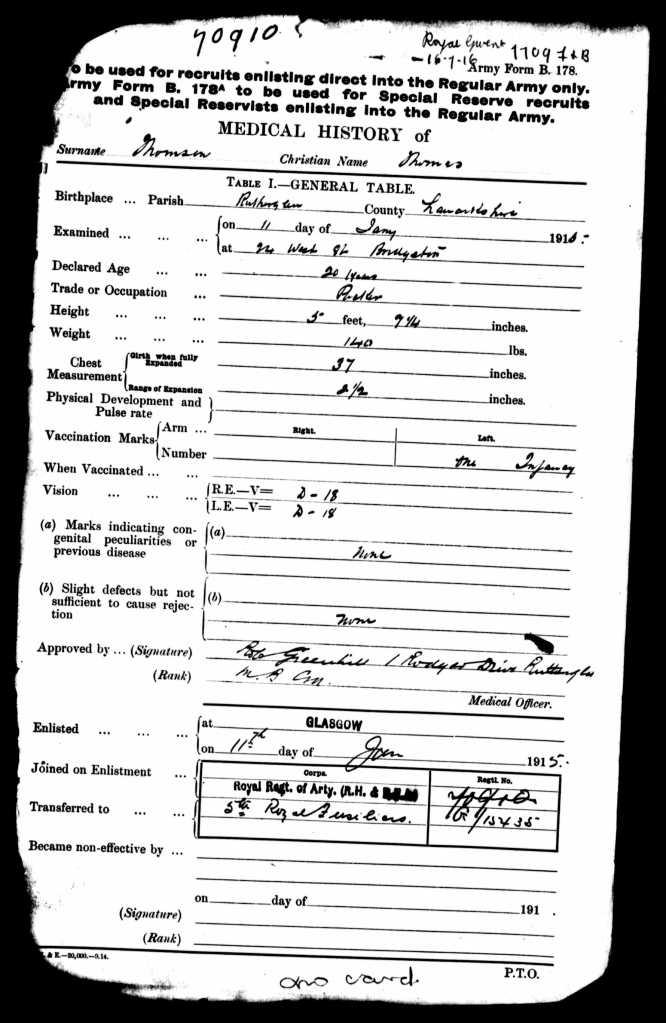
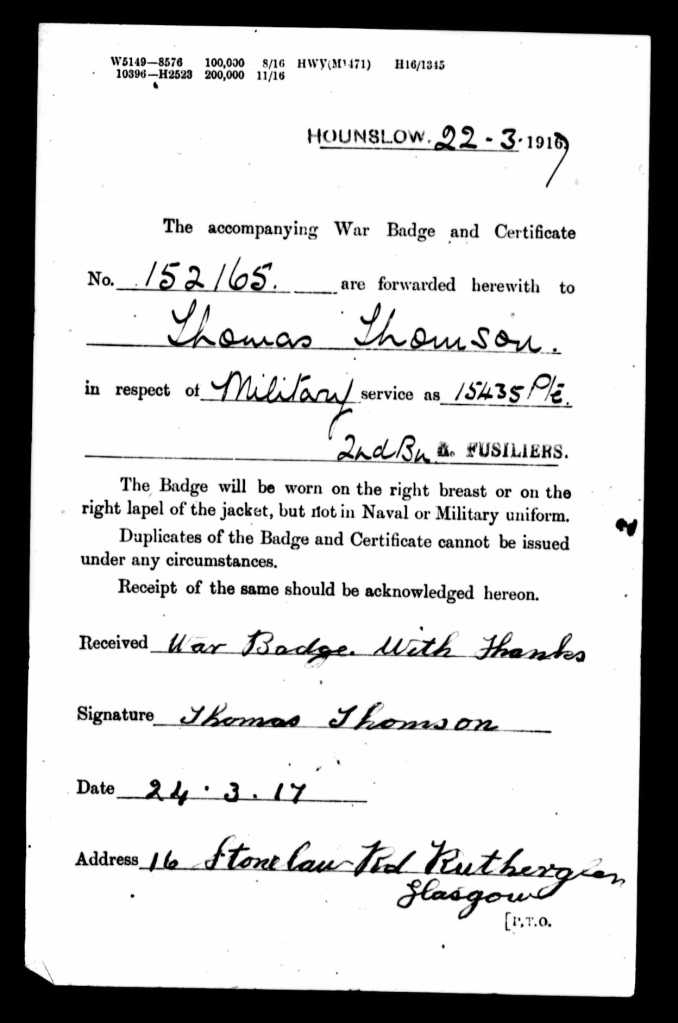
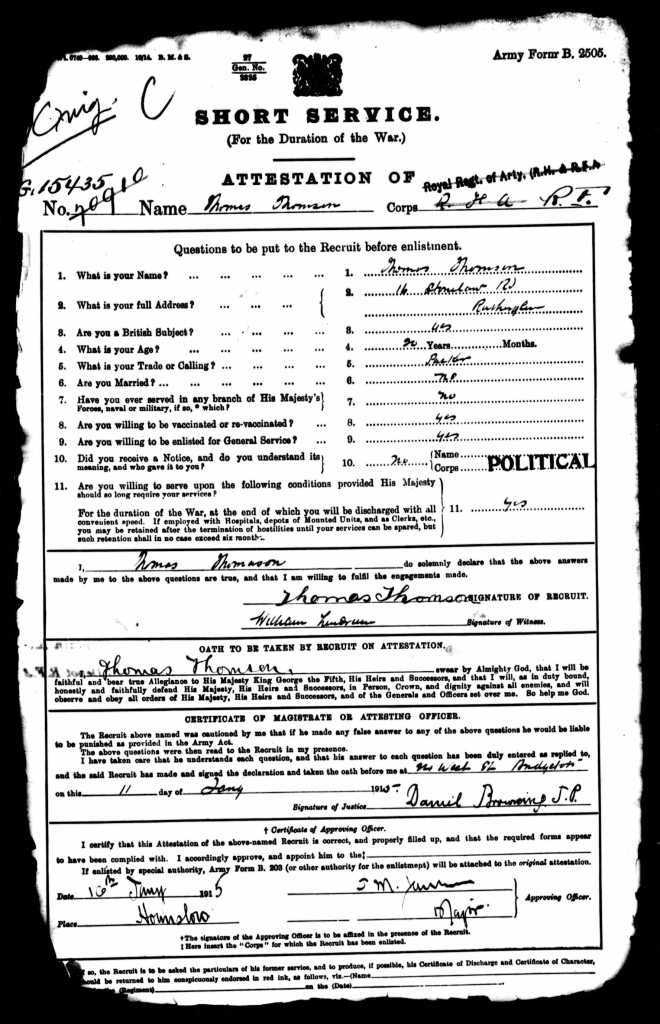
When Wolrl War 1 was declared, just three years later, in 1914, Tommy was a skinny twenty-year-old lad. He weighed 140 lbs and stood at 5”7”. By this time, he was working as a potter. On the 15th January 1915, just two months after his twentieth birthday, he was enlisted into the army at Bridgeton, Glasgow.

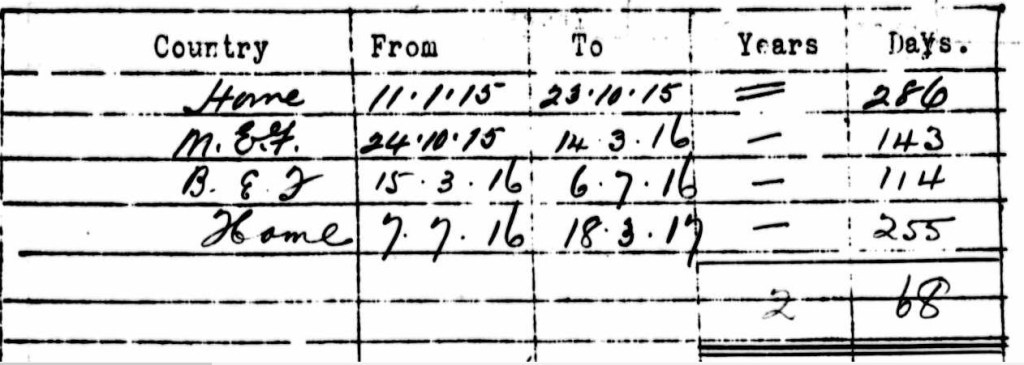
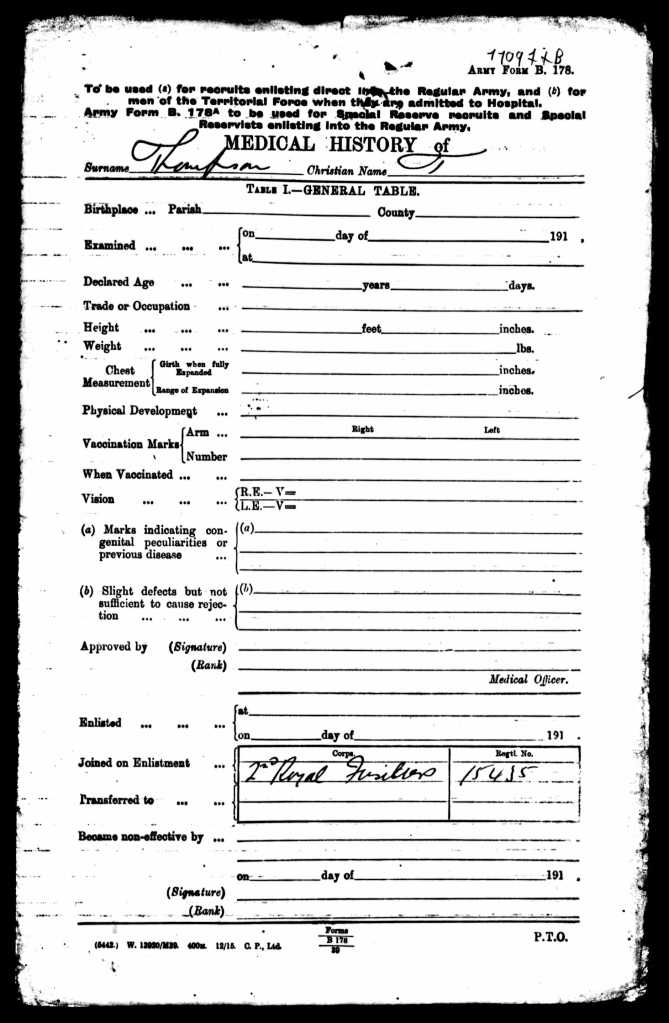
As Private 15435, he first joined the Royal Regiment of Artillery before being transferred to the Royal Fusiliers (London Regiment) 2nd Battalion. He was shipped out in October 1915 and served with the Mediterranean Expeditionary Force or MEF. The MEF had been created in March 1915, to control operations in Gallipoli, under the command of Sir Ian Hamilton.
In January 1916, the 2nd Battalion was evacuated to Egypt before being transferred to the BEF in France.

The soldiers of the British Army fighting on the Western Front was known as the British Expeditionary Force. The BEF had been set up in August 1914 and played a huge part in the early war efforts. Almost the entire force had been killed by the end of 1914. The foot soldiers of the BEF had been no match for the heavy artillery of the German Army. Recruits were constantly needed to supplement the ranks.

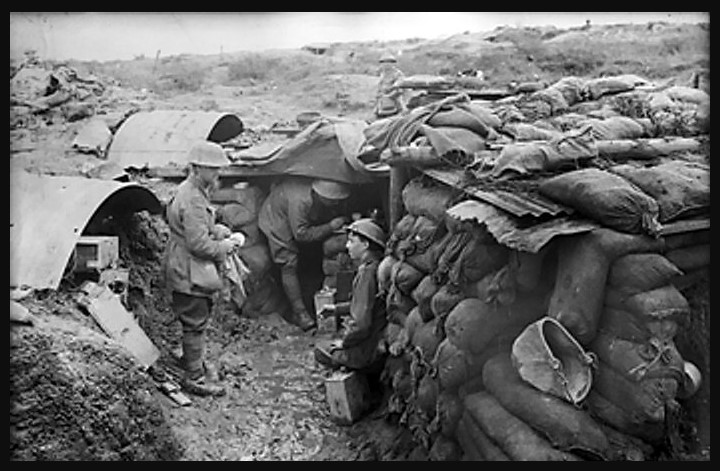
Tommy’s Battalion, which had initially been sent to Gallipoli as part of the Mediterranean Expeditionary Force, had been evacuated to Egypt in January 19116. They were then transferred to France, landing in Marseilles in March 1916. Tommy then spent the next three months in the trenches, fighting at the western front. From the 1st to 13th of July 1917, the 2nd Battalion took part in The Battle of Albert. The Battle of Albert was the official name for the British efforts during the first two weeks of fighting at the Battle of the Somme. The first day of the battle was the most costly single day in British military history. Over the next two days, the extent of the losses from that first day had become clear and, by the fourth day of fighting, the focus had changed to the right of the line where the British forces were pushing the Germans back.

As the Battle of Albert progressed it comprised a series of attacks on the east side of the village of La Boisselle, on the Albert-Bapaume road. This slowly pushed the Germans back towards their second position, on Bazentine Ridge.

From the 1st to 13th of July 1917, the 2nd Battalion took part in The Battle of Albert. The Battle of Albert is the official name for the British efforts during the first two weeks of fighting in the Battle of the Somme. The first day of the battle was to be the most costly single day in British military history, with 57,000 casualties. Over the next two days, the extent of the losses became clear and by the fourth day of fighting, Field Marshall Haig had begun to focus to the right of the line.  This was a more awkward position to fight from but took advantage of the progress that the previous days fighting had created.

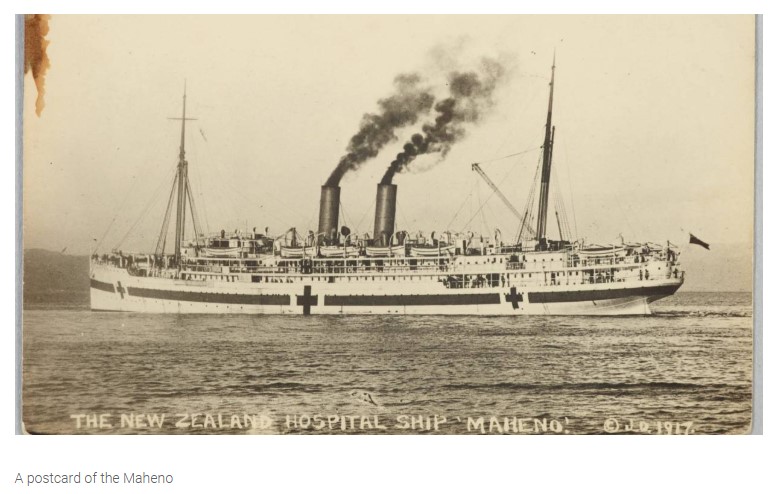
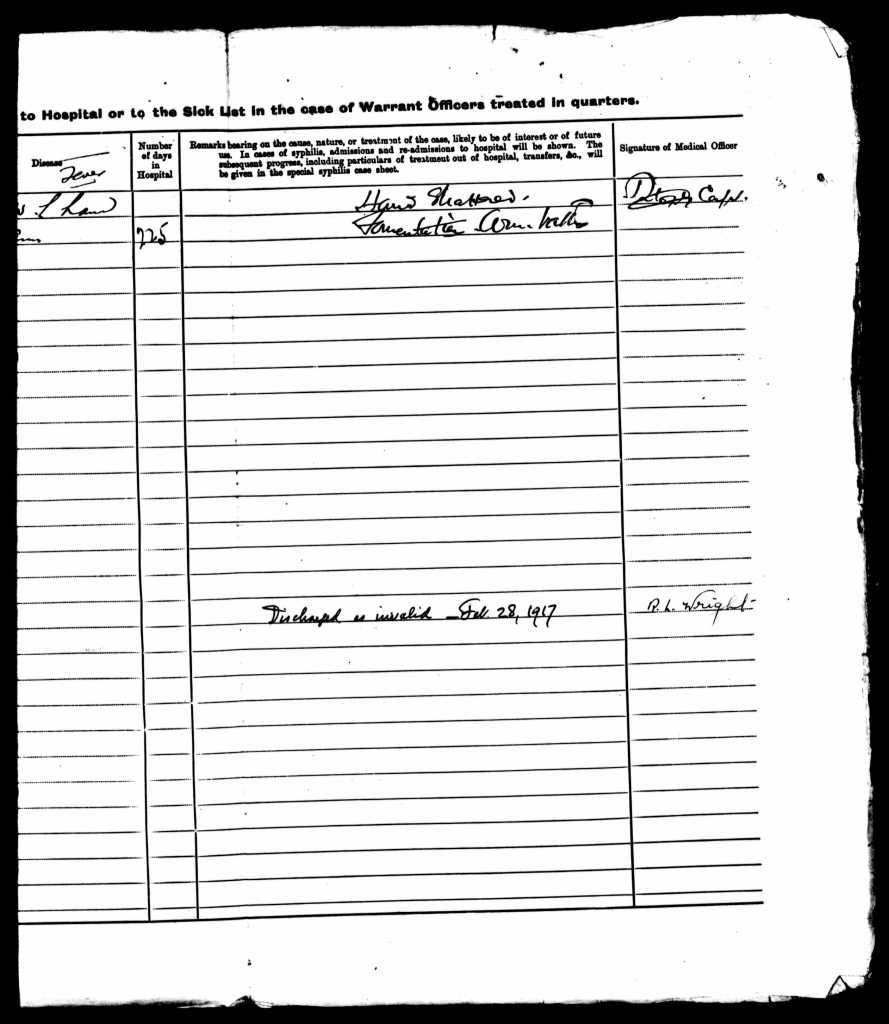
The rest of the fighting in the Battle of Albert involved a series of attacks on the east side of the village of La Boisselle, on the Albert-Bapaume road. This slowly pushed the Germans back towards their second position, on Bazentine Ridge. It was on the fourth day of these skirmishes that Tommy sustained a gunshot wound to the left arm and hand. He was sent to the No. 2 General Hospital at Le Havre before being returned to Britain on the Hospital Ship Maheno.

A postcard showing the Maheno.

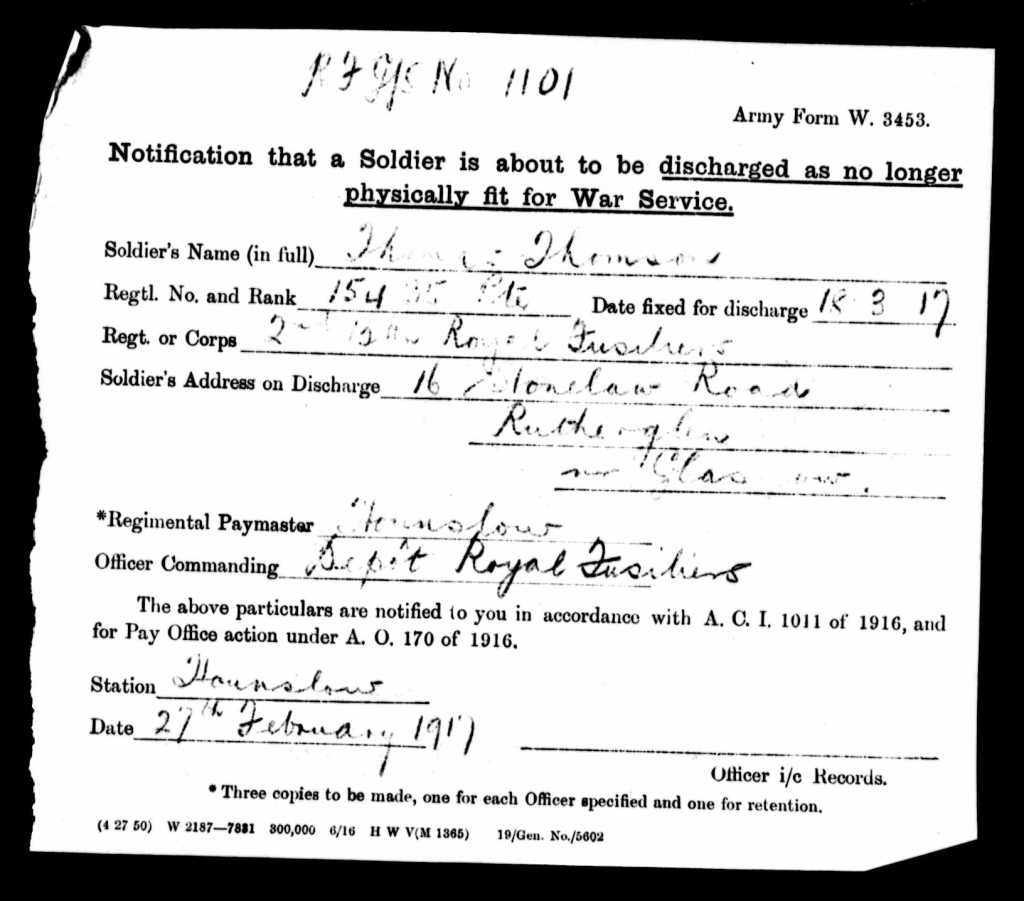
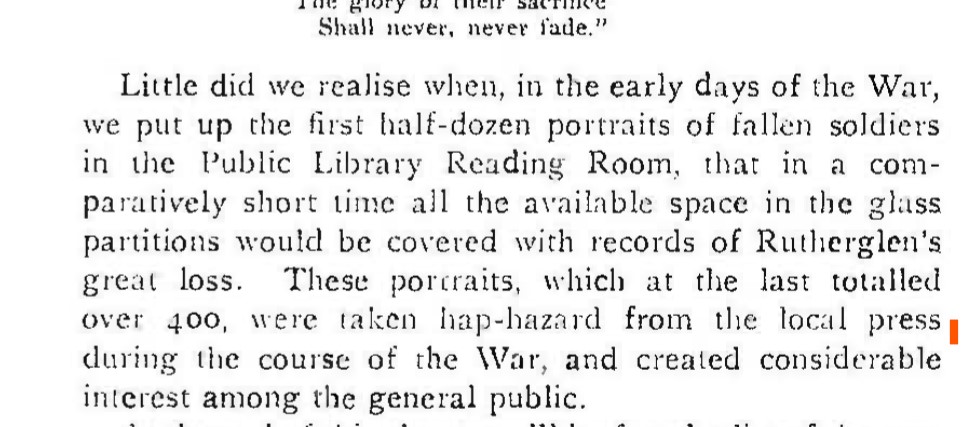
After leaving the hospital, he returned to his home in Stonelaw Road. I do not know how Tommy coped with his return to civilian life. The experience he had been through must have been traumatic, but, I imagine, he was relieved and thankful to be home. Still, I wonder if he ever visited the Reading Room in Rutherglen’s Public Library to stare at the growing number of portraits and notices dedicated to the men of the town who hadn’t returned.

An excerpt from ‘Rutherglen Lore’ by W Ross Shearer printed in 1922

It is not clear whether Tommy had known his future wife, Wilhelmina Jamieson, before the war, but at some point, they decided to get married.
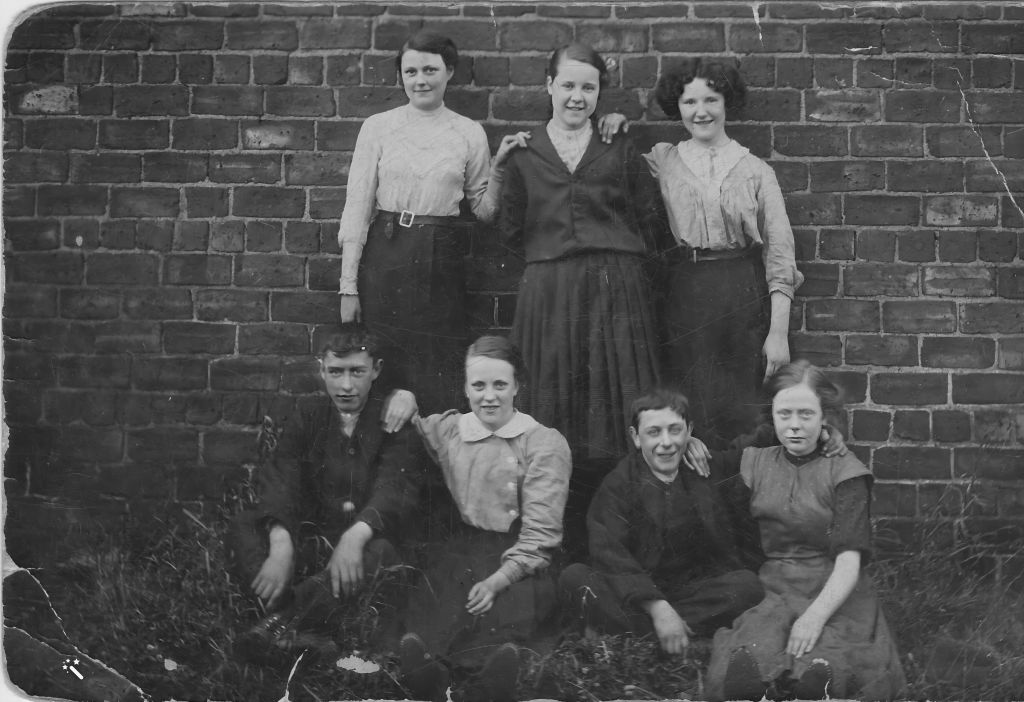
Wilhelmina, known as Minnie, lived in Nuneaton Street, in nearby Bridgeton. She was three years younger than Tommy and worked as a Milling Machinist. Her father, Magnus, was a Gas Work Stoker. Her mother was Mary Ann Bryan, from Girvan.

The Great War ended on the 11th November 1918, just ten days before Tommy’s 24th birthday. Tommy and Minnie set a date for their wedding – New Year’s Eve, 1918.

Minnie aged about 15 is standing on the right in the back row.

I believe this choice of date may have been significant for Tommy. After four years of war, during which he had come close to being killed and had suffered a horrific injury, this must have seemed like a chance for a new beginning. Choosing the last day of 1918, and the eve of a new year seems like a deliberate and optimistic choice.

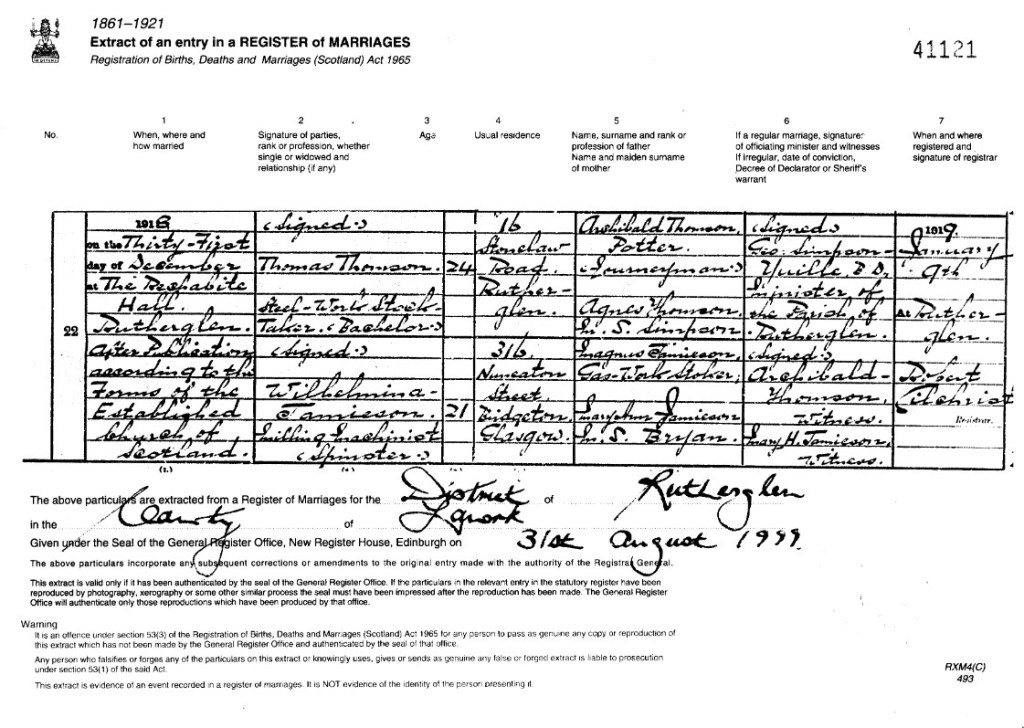
So, Tommy and Minnie were married on the 31st of Dec 1918. Minnie was 21, and Tommy was 24. The wedding took place in the Rechabite Hall, Rutherglen. The ceremony was performed according to the forms of the Church of Scotland, by George Simpson, Minister for the Parish of Rutherglen.

Minnie’s sister, Mary Hunter Jamieson, was the bridesmaid. Tommy’s nephew, Archibald Thomson, the son of Tommy’s older brother, Peter, was the best man. Archie was six years younger than Tommy, and eight years later, almost to the day, he married Minnie’s little sister, Lizzie.

I was intrigued by the venue of Tommy and Minnie’s wedding. It begged the question, was Tommy a Rechabite?

I discovered that the Temperance movement had been growing throughout the 19th century. All across the west of Scotland, societies intending to address the ‘question of drink’, had been springing up. They were “anti-spirits”, or “moderation” societies, and were open to both abstainers and non-abstainers alike. By 1870, temperance societies existed all over Scotland. At the turn of the century, an influential temperance movement was evident in Rutherglen. This resulted in the area to the south side of Main Street, being declared a ‘dry area’. The Temperance Act 1913 (Scotland) gave people in small local areas the capacity to hold a vote to decide if alcohol would be sold in their area. This resulted in the area to the south side of Main Street being declared a ‘dry area’.

Given that, according to my mother, Tommy never drank, and he was married in the Rechabite Hall, I believe he was probably a member of the Temperance Society and had ‘signed the pledge’.

Tommy’s war injury had a lasting effect on his life. His hand had been completely shattered, and years later, he had the habit of hiding it from view. The disability also had an impact on the kind of work he was able to perform. Both of the jobs he had held before joining the army, in the chair works and the pottery, had required manual dexterity. He could no longer do this kind of work.

However, he had to adapt, and by the time of his marriage, he had found employment as a Steel Work Stock Taker, presumably in the nearby Clydebridge Steel Works. In the 1920s, trams and later trolleybuses and buses ran along the Cambuslang Road and onto the London Road then out to Auchenshuggle. This would have provided handy transport to work for Tommy, as it passed the end of Stonelaw Road. Incidentally, it was also the route that, years later, Tommy’s son, James, would drive when he started work on the trams.

In the year 1920, Tommy and Minnie lived at 9 Mitchell Street, a few doors away from the house where the Thomson’s had lived in 1911. Tommy was still working as a Stock Taker when their first child Archibald, was born later that year, on Sept 23rd.

However, Tommy and Minnie did not stay at this address for long and over the next decade or so, they resided at different addresses throughout Rutherglen, Bridgeton and Shettleston.

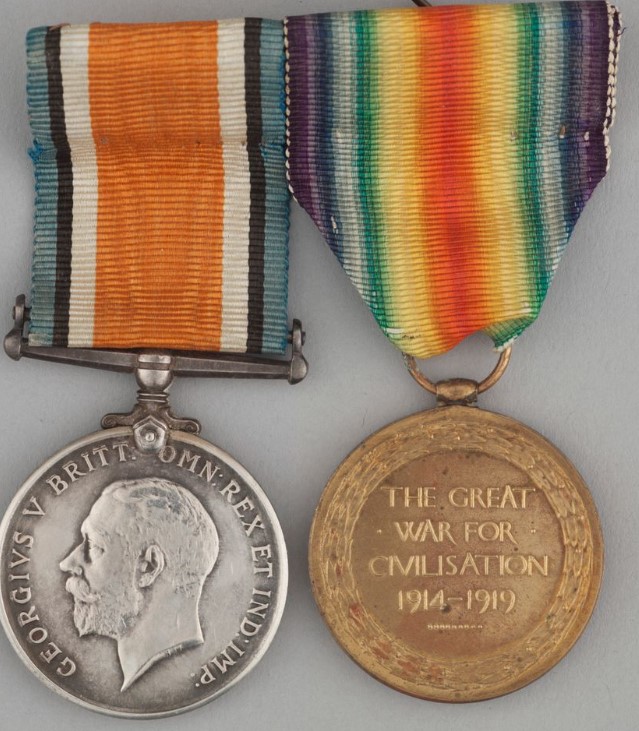
They went on to have six more children. Their second son, Magnus Jamieson, named after Minnie’s father, was born in 1922. That same year Tommy signed for receipt of the 1914-15 Star, the British War Medal and the Victory Medal.

These are the same medals that Tommy earned in WW!. I don’t know what happened to his medals but perhaps are in the family of one of his sons.

Tommy and Minnie moved to 310 Nuneaton Street, where their sons Thomas and James Jamieson were born in 1925 and 1927 respectively.

By 1926 Tommy had finished in the steelworks and, for a while, he became a commercial traveller. This career was shortlived, and by 1929, he had become a master confectioner. My mother once told me that in the 1930’s Minnie and he used to run a sweet shop in Rutherglen.

1929 was also the year the couple suffered a tragedy when Minnie went into premature labour. She was taken to the Maternity Hospital where their only daughter, Mary Ann O’Brien, was born. She survived for only two days.

The child was named after Minnie’s mother who had died in January of the same year. Minnie was always philosophical about the death of the baby. She often said it was a blessing that this little girl never had to grow up in a household full of so many boys. Perhaps there was some truth in this as Tommy and Minnie went on to have another two boys, William Jamieson Thomson, 1931, and Robert Thomson, 1933.

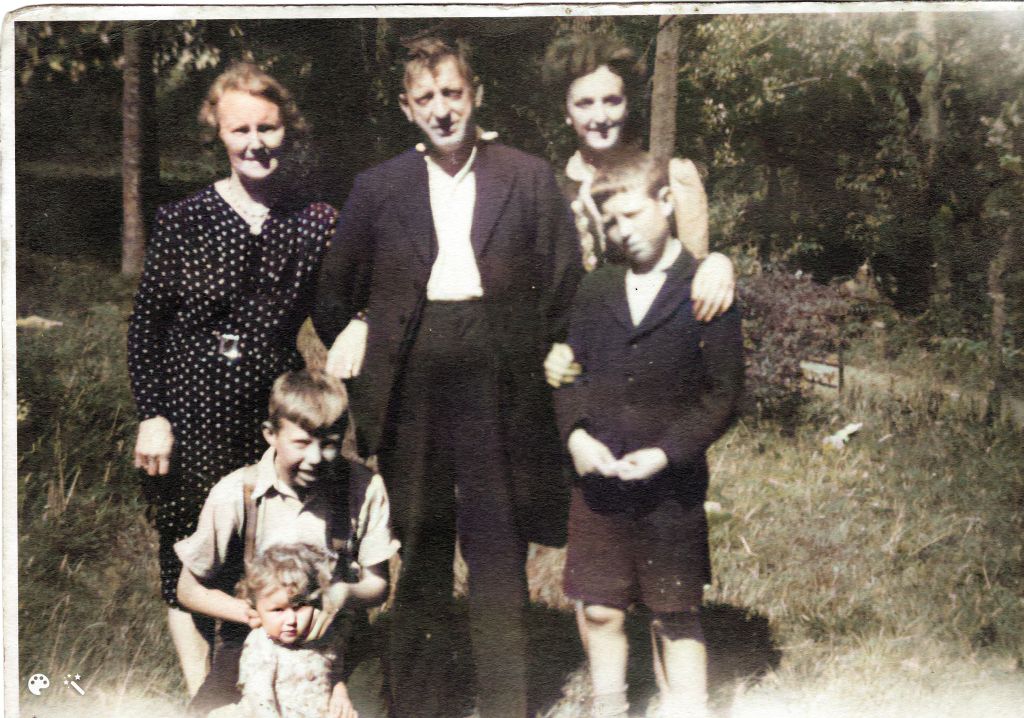
Tommy and Minnie with four of their boys,

By 1933, Tommy was almost 40 years old. His career as a confectioner seems to have ended, and he was now employed as a Lamplighter.
In 1930’s Glasgow, streets and closes were still lit by gaslight. Better known as a ‘Leerie’, the lamplighter went round each night igniting the gas lamps in the streets and stairwells. He carried a long pole with a wick at the end. The pole had a hook that could be used to open the pane of glass on each lantern.

With six boisterous boys to bring up, Tommy and Minnie must have had their hands full. When the boys were young, the family would go on holiday to a cabin in Macrahannish in Argyll. There they could run and climb and fish. This was probably a great change from the smoky streets of Glasgow.

When the Second World War broke out in 1939, Tommy must have felt some anxiety as he watched four of his sons join the army and navy. First Archie, then Magnus and Tommy. Jimmy was too young at the onset of the war but was enlisted in 1944. It must have been a relief for both him and Minnie t see the four young men return unscathed.

After the war, the family went on camping trips together. The trips meant a lot to the boys, and they continued to go camping together even after their marriages. They would often get together with their new wives and families for big family outings to the Highlands.

Minnie, Tommy and Daughter in Law, Betty with Young William and Robert. The wee girl at the front is their grand daughter, Myra.

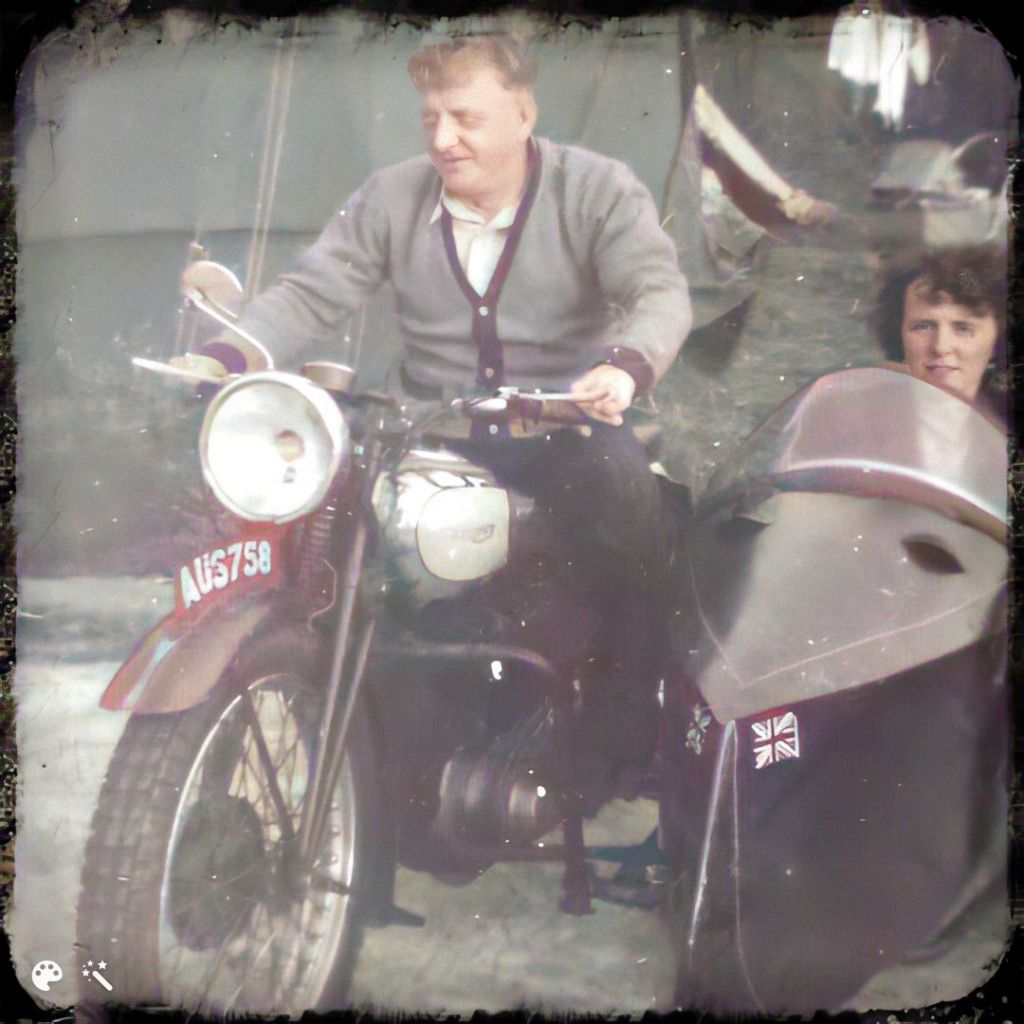
My mother, Cathy, recollected going on these trips. Dad and she, travelled by motorbike to join Tommy and Minnie and other family members at a campsite in Oban called Ganavan Sands. There the big tents would be set up, looking almost like an army base camp. Minnie thought nothing of preparing a big pot of potatoes and mince or stew on the camp stove for her big family.

Tommy on the Ariel with Rosie in the side car.

When the boys were older, the family stayed in a top floor flat in Altyre Street. Tommy was a quiet, unassuming man who was fond of his boys. Minnie was a hard-working woman. She had several jobs to help support her family. On Sundays, she would bake scones and cakes, and when the boys began to marry, they would come to their parent’s home for Sunday dinner. Throughout the week, she would take the washing to the ‘steamie’ to make sure the boys always had clean clothes. Even after they married she was known to help do the washing for her sons’ new wives.

By the 1950s, Tommy was running a little watch repair service from a wee shop across from the Glasgow ‘Briggait’. My sister, Mary, described visiting him there when she was little She watched him open up the watches and clean the gears with feathers. For many years we had a small brass magnifier that he used for working on the watches.  My dad obviously learned how to do this too as I remember him dismantling watches and showing me how the gears worked.

Although Minnie was a heavy smoker, she outlived Tommy for several years. In later life, he suffered from chronic emphysema.

Tommy died from Cardiac Failure, on 22nd January 1956 in Hairmyres Hospital.

Tommy and MInnie at the wedding of their son, Tommy.

Minnie continued to live in Altyre Street. She was often visited by her sons and their growing families, until 1965, when she was admitted to Ruchill Hospital where she died from Cerebral Thrombosis.

Tommy and Minnie were buried at Sandymount Cemetery.

The Beginning

I began my family history research following the death of my father, Jimmy Thomson, who passed away in 1995. He never spoke about his own family history and I had never thought to ask. Suddenly, I realised I’d never get that chance. There was so much I wanted to know. What were my grandparents like? Where did dad grow up? What had his childhood been like? I wanted to know his story. My grandparents were dead and dad’s funeral was the first time to my recollection that I’d met any of my dad’s brothers. I wanted to know their stories.
My mum filled in bits but she couldn’t tell me what age her own mother had been when she had died. I knew I didn’t have a reliable historian there! So my journey began. I have now been researching, on and off, for the last twenty-five years. I hope you will follow me as I share my past, present, and future family history discoveries with you.

Lock Down 2020

I suppose this is where I begin. March 20th 2020, the day the school where I teach closed its doors and life under LockDown became the new normal in Scotland. Like so many others I was shocked, scared and utterly bewildered by the situation. I have been a primary school teacher for almost 30 years. I am used to the chalkface. I know how to deal with a classroom full of 8 and 9-year-olds every day. Now those familiar little faces had become e-pupils inhabiting my laptop. The next couple of weeks was a whirlwind of Zoom meets, Google Teams, emails, webinars and online courses. My classroom became a virtual world where I tried to engage the 22 little people that I had not so long ago had under my wing. The reality of this new digital school room began to sink in. This was how I was going to be teaching for the foreseeable future.
Then my husband, Sam, developed symptoms of the virus. The next two weeks were spent in isolation. I slept in another room. We used different toilets. I wore a mask and rubber gloves and sprayed Dettol like air freshener. Windows throughout the house were left open to lower the viral load. Sam had a high temperature, headache, night sweats, tightness in his chest, and a cough but testing wasn’t available. We were scared. Thousands of people were being hospitalised and the numbers of people dying was rocketing. I won’t get into British political failings or the utter shambles that was the UK Government’s COVID 19 response. That’s not the purpose of this blog.
Fortunately, Sam began to recover. We felt relieved and thankful. I hadn’t shown any symptoms. Or had I been asymptomatic? We would never know. We had been lucky.
Things began to settle down into socially distanced routines. The sun was shining in Scotland. We were having one of the nicest springtimes in quite a few years. We tidied the garden and painted the fences. I cleaned the house and sorted the cupboards. We watched box sets of favourite TV shows – Orphan Black, Modern Family, Outlander and others. We went for walks and spoke to our family members and friends from the mandatory 2 metres distance. I had my horse to look after. The yard was under a strict timetable, so visits were short and riding-time limited. At least I could escape for a brief wander around the fields on a pleasant evening on Bonnie’s back.
Nine weeks passed. How often do we have so much time on our hands to spend at home doing the things we want? I am a woman with a butterfly brain. I have many interests which come and go fleetingly but are never entirely dropped. I began to pick at some of the threads of the little projects that I had been neglecting. The bag of fibres for needle felting was found behind the sofa and I started a model of Jamie from Outlander. My art desk was cleared and the boxes of pastels brought down so I could draw. I looked out my scrapbooking materials.
Then, I opened my Family file on Legacy. I hadn’t touched this for some time. Where had I left off? I had been working on my husband’s line, the McGraws. I was soon off down the rabbit hole. Within a couple of days, I’d filled in some missing blanks. Marriages, births, deaths and census records were scrutinised and matched. I typed the information into the database and updated my files. Then I began to think. Why was I doing this? I’ve been researching my family history on and off for over twenty years. Sometimes I wouldn’t touch it for months, even a year or more, but I always come back to it. Why? Why do I have this need to uncover the past? The dry little facts of some long-forgotten ancestor’s birth or untimely death. Why did it matter? As I looked over the details in front of me, trying to tie each one to the other, I realised I was trying to write a story. A story of someone I could never know, never meet. Yet, I still want to know who they were. I want to know how they lived their lives. What happened to them? I want to know their story. They had a story. Perhaps a sad one, a pitiful one or a joyous, adventurous one. Each tiny fact that I uncover is like a tiny gem to me. A glittering little jewel revealing a secret detail of their story. I want to bring them back for just a second so that I can know them. They are my family.
Yet, each time I closed my file, I wondered if I could do more. My family goes on, growing and changing, leaving imprints on the world around them. They matter in the now but will be forgotten over time. We are writing our own stories. I think these stories matter, whether they are big or little.
So my blog begins. I am not sure how it will develop. I hope it will be a place where I can bring some of these stories to life.