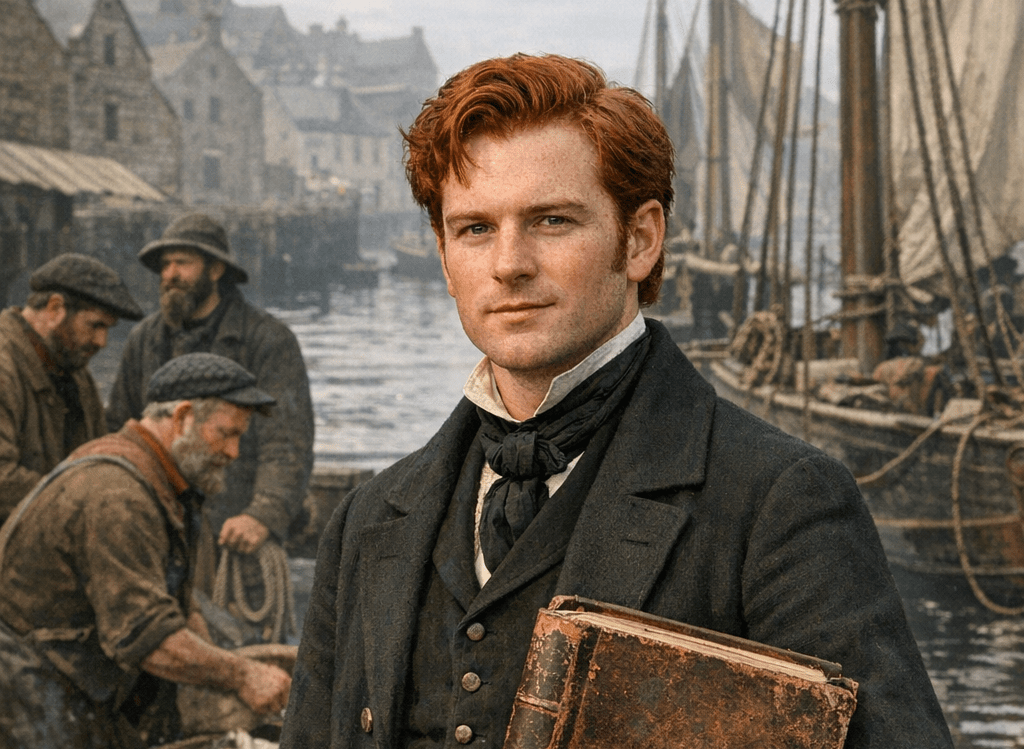
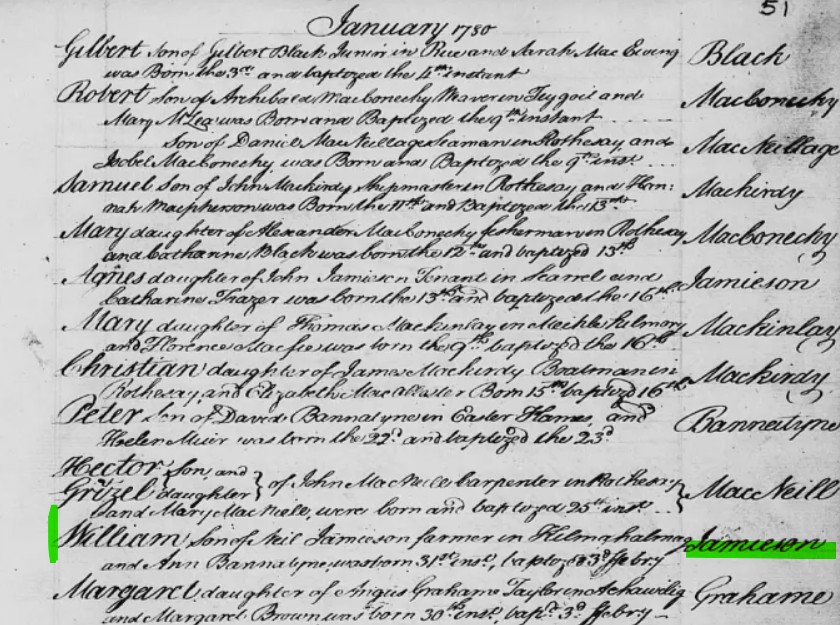
William Jamieson was born on 31 December 1780 in the midwinter of Argyll and Bute. His parents, Neil Jamieson and Ann Bannatyne, lived among the crofts of Kilmahumaig, a landscape of rough pasture, peat smoke, and tidal inlets that shaped the rhythm of daily life. A few weeks later, on 3 February 1781, he was christened at Rothesay after a short crossing of the Firth of Clyde, a small journey that hints at the constant movement linking islands and peninsulas before roads reached them.
Little survives from his earliest years, but the conditions of his upbringing are easily envisioned. He grew up in a crofter’s household where every member of the family had a part to play. Throughout the eighteenth century, agriculture in Scotland was traditionally self-sufficient, combining stock rearing and crop growing. As the eldest son in a family of nine, he would have grown up with a steady expectation to contribute. Carrying water and peat, tending the animals, and helping with the planting and lifting of crops were regular duties essential to the family’s survival. These responsibilities shaped his childhood, teaching him endurance, practicality, and the understanding that every pair of hands mattered. The sea was never far away in Argyll, its tides shaping weather, work, and the movement of people and goods. Even if his earliest tasks kept him close to the croft, the presence of the shoreline, the boats drawn up on the beach, and the constant talk of fishing and trade formed part of the world he grew up in. These early lessons, of land, labour, and the ever‑present pull of the sea, would quietly shape the course of his life.

Gaelic was the language of home and field. Tales of clan forebears, local saints, and the history of the land were carried in memory and voice, giving communities a strong sense of kinship and identity. William’s family valued literacy, and his early education gave him a grounding in reading, writing, and arithmetic. In a community where most knowledge was passed by observation or memory, these skills opened possibilities beyond the narrow margins of crofting life.
Yet the sea was his truest education. Boys learned early to read the sky, the colour of the water, and the behaviour of seabirds. The sea offered fish, driftwood, and seaweed for the fields, but it also carried danger; every family knew stories of storms survived and boats lost. To grow up beside the water was to understand both its generosity and its risks.
Training on the Clyde
Before William ever set foot on a northbound boat, the Clyde estuary became his proving ground. By 1800, the river towns of Greenock, Port Glasgow, and Gourock were alive with the clamour of shipyards and the bustle of cooperages and curing sheds. For William, the Clyde was a different kind of coastline, less wind-scoured than Argyll, but pulsing with industry. The herring trade was already thriving here, and the promise of steady seasonal work drew young men from across the west coast. On the quaysides, he saw barrels stacked high, boats unloading their silver catch, and merchants negotiating prices in a world far removed from the small, scattered labours of crofting life on Bute.
He found work wherever hands were needed: on the quays, in the curing sheds, among the long fragrant rows of barrels. In the cooper’s yards, he learned the bowing of staves over steam, the ring of the adze, the satisfying moment when a hoop settled cleanly into place. A well-made barrel was as essential to the herring trade as any boat, and the men who shaped them were valued for their precision. Fish curing followed. The work was simple in theory, exacting in practice: gutting, salting, packing, all done at speed. The gutter girls worked with astonishing skill, their knives flashing in a rhythm older than any of the new companies rising along the Clyde. William watched, learned, and understood that the trade was an ecosystem, with gutters, packers, coopers, boatbuilders, and merchants, each dependent on the others.
William spent at least ten years working and learning on the Clydeside. The experience hardened him, but it also sharpened him. The long days in the cooperages and curing sheds toughened his hands and his back. The river towns taught him something subtler, too: how to judge a man’s character at a glance, how to sense when a deal was fair and when it was being bent, how to keep his footing in a world where profit and pressure moved as quickly as the tides. Among the clang of iron hoops and the shouts along the quays, he learned to stand his ground without bluster, to listen more than he spoke, and to carry himself with the quiet assurance of someone who understood both the craft and the people who lived by it. By the time the northern fleets began calling for crews, he was no longer a boy from a croft but a young man tempered by work, sharpened by experience, and ready for responsibility.
On the Brink of Change
Beyond the bustle of the river towns, the world was changing. Britain’s long struggle with Napoleonic France strained the nation’s food supply, and attention turned northward to the cold, rich waters around Orkney and Shetland. The great herring shoals, the Silver Darlings, were suddenly of national importance. What had once been a seasonal blessing was now a strategic resource.
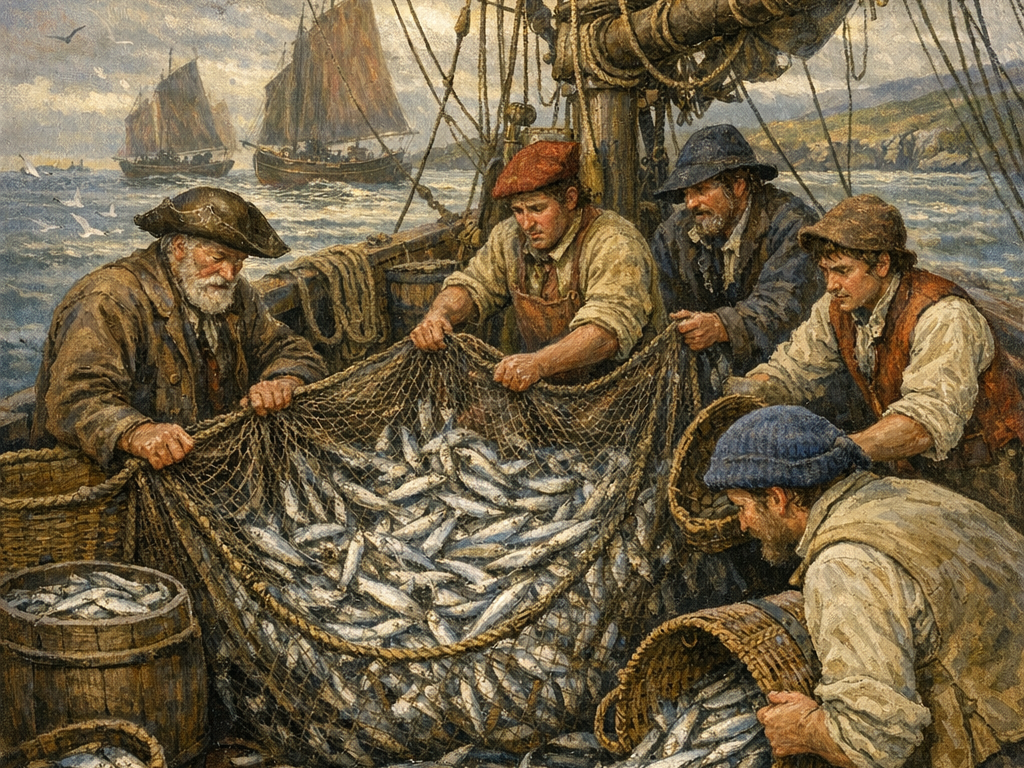
For centuries, these northern waters had been dominated by the Dutch, whose great busses, large, decked vessels built for the herring, sailed into Shetland’s voes each summer like floating factories, catching, gutting, and curing at sea with unmatched efficiency. Their presence was so regular that Shetlanders marked the seasons by their arrival and departure.
By the late eighteenth century, the Dutch grip had loosened. War, shifting markets, and the rise of British naval power eroded their dominance. The mighty fleets dwindled, leaving a vacuum in the northern seas where their bright sails had once crowded the inlets. Into this void Britain stepped, bringing regulation, inspection, and state oversight into places where custom had long ruled. Fishing communities that had operated for centuries by their own rules were now drawn into a wider economic and political system.
The Scottish Fishery Board
In 1808, the Herring Fishery Act created a dedicated Fishery Board for Scotland, charged with steering the rapidly growing industry. One of the quiet dramas of the old herring trade played out in the way the fish were cured. Dutch crews worked fast, salting and packing their catch right on the open water. The British, by contrast, were purists. To them, herring had to reach the shore untouched, no salt, no shortcuts, because early salting softened the flesh and spoiled the quality they prized.
To protect that standard, fishery officers patrolled the curing yards, checking every barrel. Their mark of approval was the Crown Brand, stamped onto uniform barrels that carried the curer’s name, the curing date, and even the officer’s own signature of oversight. It was a small symbol, but it told buyers that the herring inside had met the strict expectations of the Scottish coast.
In those early years, Lerwick remained, in the eyes of Edinburgh officials, a distant outpost, useful, but peripheral. Their focus lay on the established East Coast ports, where curing yards and export networks already thrived. Shetland, with its scattered crofts and modest harbours, scarcely registered in their calculations.
But the Shetland islands were on the cusp of transformation, even if those in Edinburgh had not yet recognised it. The Board’s misjudgement quickly became a source of irritation. Merchants and curers depended on timely inspections to qualify for government bounties, and without a Fishery Officer, no barrels could be branded. Without branding, no bounty could be claimed. In an economy where margins were thin and cash scarce, the absence of a Fishery Officer threatened livelihoods.
In 1809, James Hay, a Shetland merchant and owner of “The Don of Lerwick”, was among the first to protest. He had boldly fitted out his vessel as a buss for the deep-sea fishery, a substantial investment for any Shetland merchant. When he applied for inspection, he was told, almost dismissively, that no officer would be appointed for Lerwick and that he should sail to Leith to have his barrels branded. The suggestion was absurd. Sending a buss to Leith simply for inspection would cost more than the bounty itself, and by the time the vessel returned north, the curing season would be lost.
The outcry grew. Merchants complained of delays, curers fretted over unbranded barrels, and the island’s trading class made it clear that Shetland could no longer be treated as a peripheral concern. Only later that year did the Board relent, granting John Mouat, the local Customs Officer, temporary authority to carry out inspections. It was a stopgap measure, and everyone knew it. Mouat had other duties, and the volume of work during the herring season quickly overwhelmed him.
The message was unmistakable: Shetland needed a permanent officer, someone whose sole responsibility was the island’s fishery and who understood the importance of the work.
Appointment to Lerwick
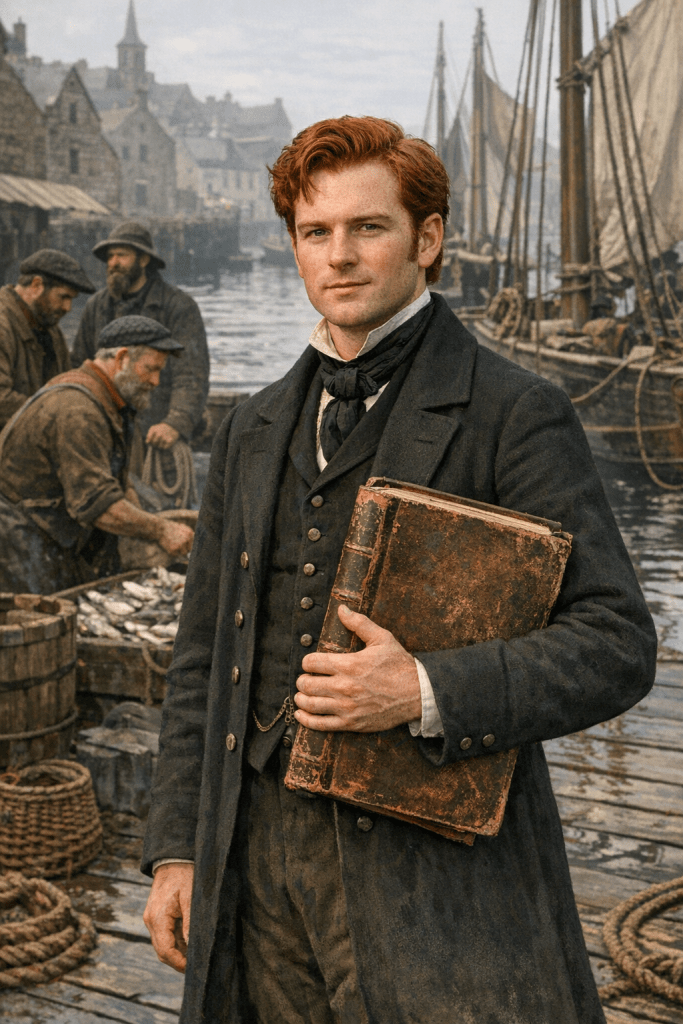
By 1810, the pressure on the Fishery Board could no longer be brushed aside. Shetland’s merchants were growing restless, the northern fishery was expanding, and the makeshift arrangements that had once sufficed were now clearly inadequate. The Board’s hesitation, rooted in distance, uncertainty, and a poor grasp of local realities, finally yielded to necessity. In July that year, they appointed William Jamieson as Herring Fishery Officer for Lerwick. The decision marked a quiet but decisive turning point, not only for the islands’ administration but for William himself, drawing him into the centre of a rapidly changing maritime world.
After taking his oath in Leith, he received the branding irons for the Lerwick station. Heavy, practical tools of iron and ash, they bore the Crown emblem and his own name. In the years ahead, these marks would appear on thousands of barrels shipped from Shetland to the Baltic and beyond. To William, they must have felt like both a responsibility and a promise: the authority of the Board placed in his hands, and the significance of a growing industry resting on his judgment.

The Board recruited its officers exclusively from among experienced fish curers and coopers, men who understood the craft from the inside. William already possessed that practical knowledge: the ability to recognise a well-salted fish, the skill to assess a barrel’s workmanship, and the instinctive understanding of how quickly a catch could spoil if mishandled. Combined with his literacy and numeracy, essential for managing bounties, keeping accurate records, gathering statistics, and reporting to the Commissioners for the House of Commons, he was exactly the kind of man the Board needed.
Travelling for the first time to Scotland’s northernmost islands, William must have felt a mixture of apprehension and resolve. Shetland’s first herring boom had not yet begun, but its early tremors were already being felt. The long era of Dutch dominance had slipped into memory, and Britain was ready to claim the future. His new post placed him at the heart of a fishery shifting from a loose, locally managed pursuit to a regulated, commercially ambitious enterprise. The task that lay before him was nothing less than the reshaping of Shetland’s fishing economy and the redefinition of its ties to the wider world.
And so, in late 1810, William arrived in Lerwick, newly appointed as the town’s first Fishery Officer. He was thirty years old, seasoned in the ways of the herring trade, and ready to take on the responsibilities the post demanded. The wind of Bressay Sound tugged at his new frock coat as he stepped ashore. Ahead lay the narrow streets and slate roofs of the town; behind him, the harbour that would shape so much of his future.
Shetland
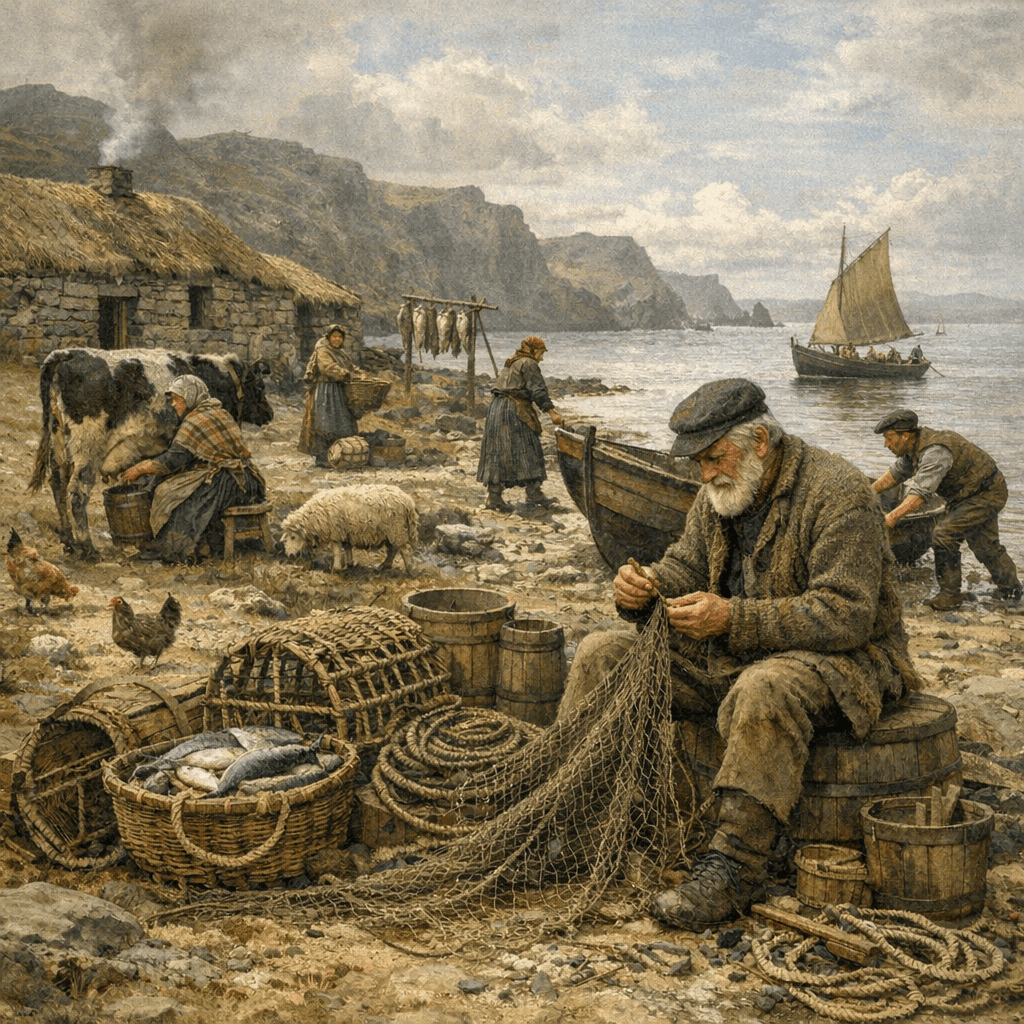
The Shetland Isles were unlike anything William had known before, not because they were islands, the Isle of Bute had shaped his earliest years, but because of their starkness and exposure. Where the Clyde’s islands were sheltered by wooded slopes and the long arm of the mainland, Shetland stood open to the full force of the North Atlantic. Treeless hills rolled toward the sea, and the wind was a constant presence, pressing against houses, sweeping across the moor, and carrying salt far inland. Life here was balanced between thin soil and deep water, and every family understood that the sea, more than the land, was the true source of survival.
With almost no timber available, large decked vessels were rare in the early half of the nineteenth century. Traditionally, Shetlanders fished from small, open boats, light enough to be hauled above the tideline when storms threatened, yet sturdy enough to face the restless northern waters. These boats were not suited to the deep-water herring fishery, but they sustained daily life. Coalfish, ling, saithe, and haddock formed the backbone of the island diet, and in lean years, coalfish in particular became the difference between hunger and survival. Fishing was not merely an occupation; it was the foundation of existence. Every croft depended on it, and every household had someone who went to sea.
The land offered what it could, but its gifts were modest. Crofters coaxed bere barley, kale, and potatoes from the peaty soil, knowing that a poor summer or a late storm could undo months of labour. The truck system bound tenants to their landlords, rents often paid not in coin but in fish, knitted stockings, or labour. It was a system that bred dependence and left families with little chance of escape, yet it persisted because there was no alternative.
Despite the hardships, Shetland’s communities were tightly knit. Isolation and weather forged bonds that were stronger than any written in law. Neighbours helped one another with planting, harvesting, and hauling boats above the tide-line before a gale. Stories and songs passed through the long winter nights, carrying memory and identity from one generation to the next. It was a place where people endured together, and where the rhythm of life was shaped by the sea’s demands.
Establishing Himself in Lerwick

Still fresh-faced yet ready for this new challenge, William settled into his new role. His first task was to establish the Fishery Office, no more than a modest rented room, a coal fire, a plain desk, and the smell of salt drifting in from the harbour. Yet from this unassuming foothold, he was expected to impose order on a trade that had long been the realm of the independent fishermen and curers. They were proud people, accustomed to managing their own affairs. Men whose fathers and grandfathers had fished by custom, not by statute, and they viewed ledgers and standards with suspicion. The arrival of a government officer with branding irons and ledgers was met with wary eyes and folded arms.
Amid the noise and bustle of the seafront, he found his footing. He moved along the quayside with a calm authority, ensuring that every stage of the curing process met the standards required for the Baltic markets, where Scottish herring competed with that from other distant ports. Under his watchful eye, the Gutter girls worked with astonishing speed, their knives flashing as they slit and sorted the fish. The Packers layered herring and salt with practised precision. Coopers hammered staves into place, the ring of iron on wood echoing across the harbour. When the cure was complete, William heated his branding irons and pressed the metal into the wood, marking each barrel with the Crown Brand and his own name, a guarantee of quality that travelled across the North Sea.
Yet his responsibilities extended beyond the curing sheds and into the restless life of the sea itself. The Fishery Bill of 1809 required that every net hold a full inch between its knots, allowing young fish to escape and ensuring the sustainability of the shoals. The rule was well-intentioned but deeply unpopular. Nets were precious, hand-twined, and prone to shrinking with use. A £40 fine hung over any man whose mesh fell short, and the threat of confiscation stung like salt in an open wound. Enforcing the regulation required tact and steel in equal measure. William carried that burden with quiet determination, standing between long-held tradition and the tightening grip of regulation.
By 1813, his position was well established. His salary, £25 a quarter, placed him just below the threshold for property-tax relief, and the Board granted him an additional allowance of ten guineas a year, backdated to 1811, to cover the costs of establishing the office. Rent, candles, cleaning, and coals were all accounted for, the latter essential not only for warming the room through Shetland’s long winters but for heating the branding irons that marked each barrel destined for export. Payments arrived at Whitsunday and Martinmas, small but steady markers that gave structure to his official life.
In his small office by the quayside, he kept meticulous records of landings and conditions, sending reports south to help distant officials understand an industry shaped by weather, tides, and local custom.
Above all, he acted as a guardian of quality, protecting the reputation of Scottish herring at a moment when the nation was trying to secure its place in demanding overseas markets.

Building a Home in the North
As his first years in Shetland pressed on, the fishermen who had once greeted him with suspicion began to nod in recognition. Merchants learned to rely on his fairness; curers trusted his judgement. A community long accustomed to its own ways gradually accepted that this man from Argyll was not there to impose change for its own sake, but to help guide the islands through a transformation already underway.
The modest office he had first set up grew into a familiar presence on the harbour, within earshot of the coopers’ steady hammering and the gulls wheeling overhead. It became a regular stopping place for merchants, customs officers, and shipowners, part of the daily life of Lerwick’s working waterfront.
William himself was becoming an established figure in the town, building friendships and taking part in its social life, his place in the community strengthening with each passing season.
His job provided stability; from this rose the beginnings of a household, the chance to develop deeper ties and his personal life began to take root in ways that would bind him to Shetland more firmly than any appointment from Edinburgh ever could.
Love and Marriage in Lerwick
It was during his first years in Lerwick that William found his attention repeatedly drawn to a young woman named Barbara Scollay, whose quiet confidence and quick smile stood out amid the bustle of the town. Their paths crossed often enough, at the harbour, in the wynds, at church, that a gentle familiarity grew between them. In time, they began a courtship, tentative at first, shaped by shy conversations and the steady warmth of shared glances. What began as a simple acquaintanceship soon deepened into a companionship that anchored William in this new place, giving his early Shetland years a sense of promise he had not expected.
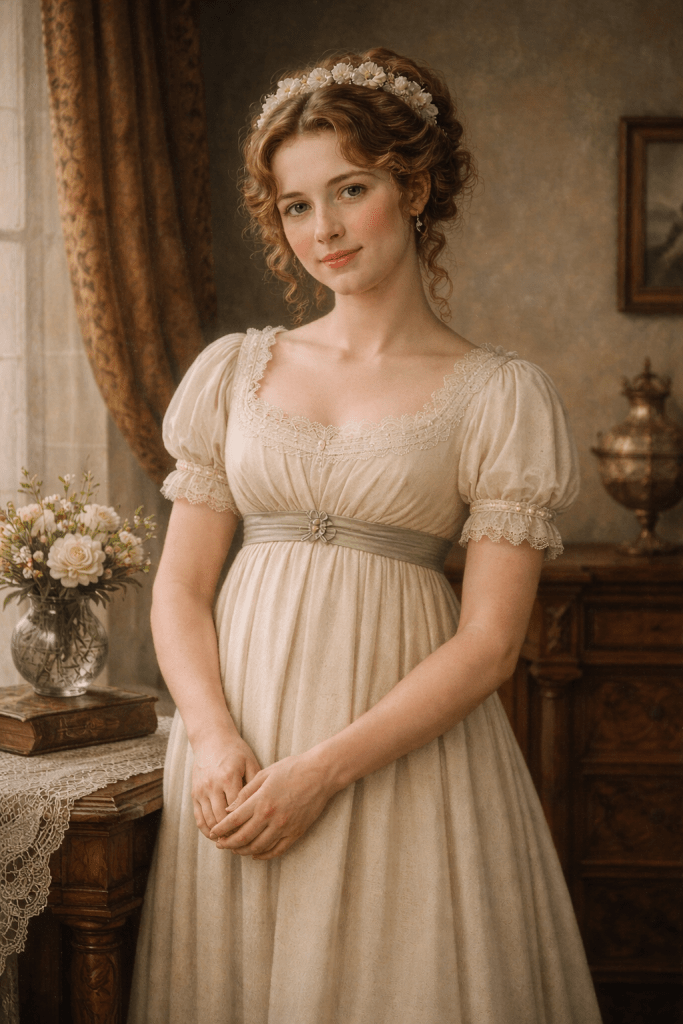
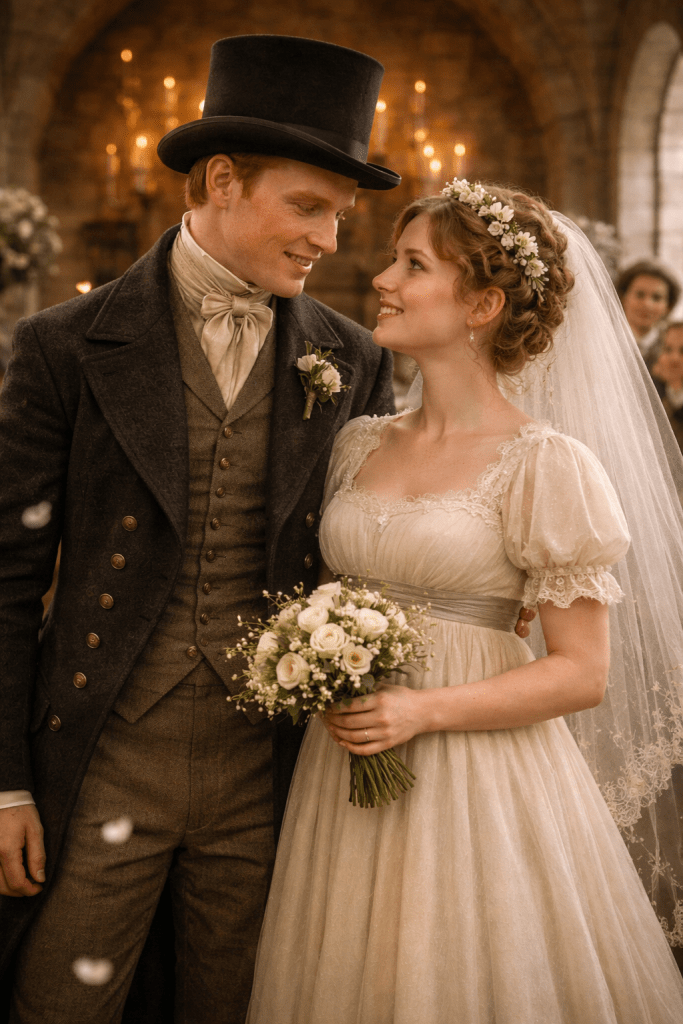

Their courtship grew steadily, and on 26 May 1812, William married twenty‑three‑year‑old Barbara in Lerwick.
Through Barbara he entered a household shaped by both loss and standing within the town: her mother, Anne Innes, had died when Barbara was just six years old, leaving her and her younger sister, Ann, as the surviving children of the marriage, while their father, Robert Scollay, a well‑established merchant, remained a familiar figure in Lerwick’s commercial life and well connected to the town’s trading families.
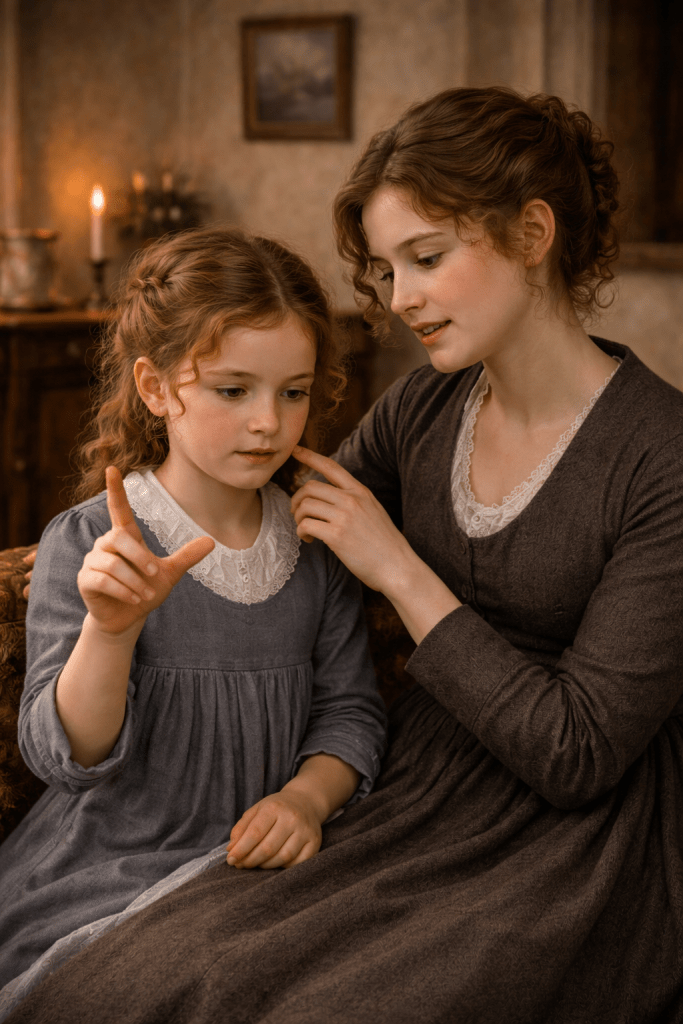
Her sister, Ann was deaf and mute, and that circumstance drew the sisters into an unusually close bond. Growing up without their mother, they relied on one another, Barbara learning to read Ann’s gestures and expressions, Ann depending on Barbara to help her cope in a world that offered little understanding. In early-nineteenth-century Shetland, where schooling and services for deaf children did not exist, family networks were the primary means of care and communication.
When the two girls were still young, their father, Robert Scollay, remarried, taking Ann Bolt, daughter of James Bolt of Cruister, as his second wife. The home in which Barbara grew up was therefore one shaped by both absence and stability: the grief of losing her mother softened by the presence of a capable stepmother and the routines of a prosperous mercantile family.
In marrying Barbara, William gained not only a partner of calm resilience but also a connection to a family whose standing and experience helped anchor his own place in Lerwick.
Her presence softened the edges of his solitary existence, turning the rented rooms, which had been little more than his workplace, into the beginnings of a home. In the evenings, when the harbour settled into its soft chorus of creaking ropes and distant voices, the two of them began to shape the small rituals of married life: homely meals, letters written to Argyll, the steady comfort of developing companionship in a place that was still, in many ways, new to him.
Duty Calls on the River Clyde 1812
As they settled into married life, Barbara soon learned she was expecting their first child. William’s work, however, continued according to the needs of the Fishery Office. In late 1812, as the northern season ended, he was instructed to travel south with the Fishery Officer from Thurso to provide additional support at the port of Greenock, which was experiencing heavy activity.
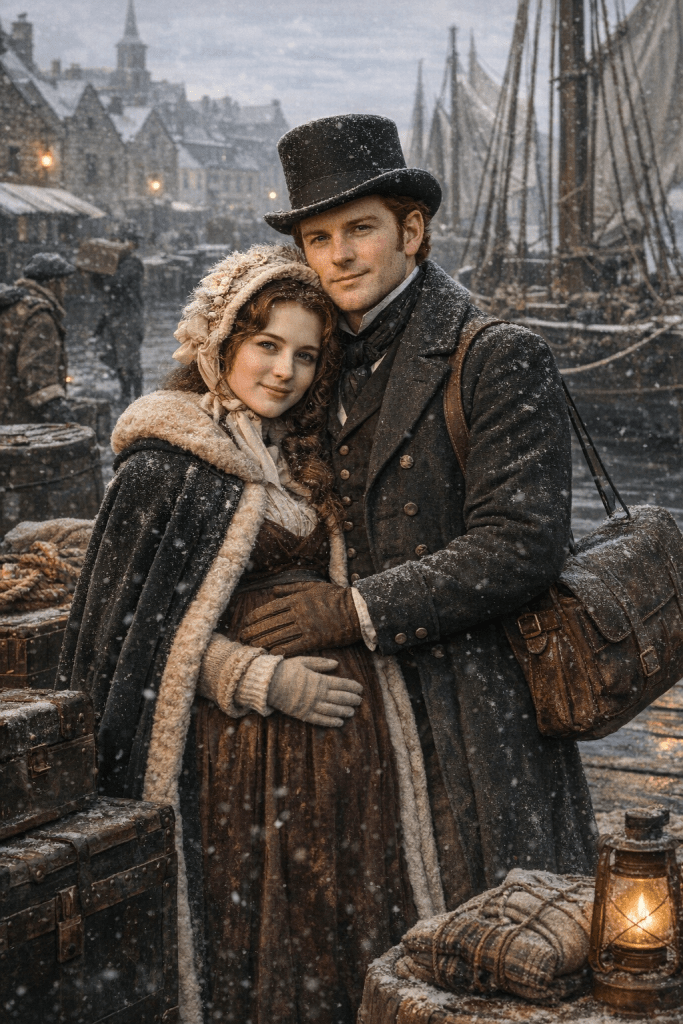
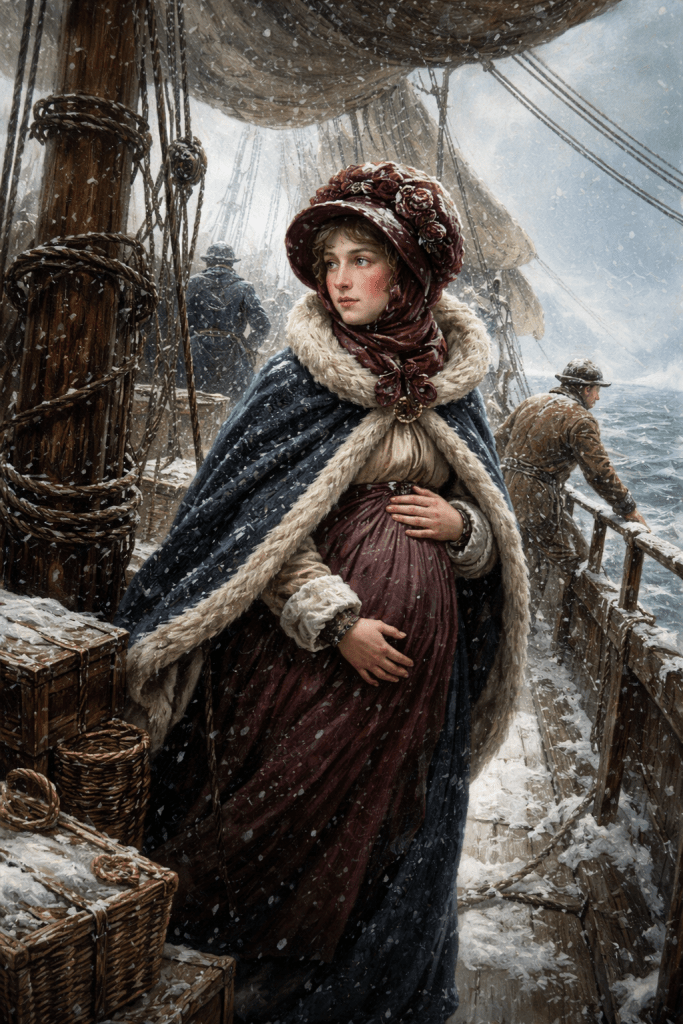
Barbara chose to accompany him. They boarded the small vessel for the mainland despite the winter conditions. The crossing was uncomfortable but typical for the season: an unsteady deck, cold winds, and a restless sea. She kept hold of the rail, aware of the strain the movement placed on her and on the child she carried.
The onward journey by sea reflected the realities of winter sailing in the northern waters. The small packet vessel that carried them south pitched and rolled through short daylight and long, restless nights. Winds funnelled down the sounds, sharp with salt and cold, and the deck was often slick with spray. When the weather allowed, she climbed carefully from the cramped cabin to take a few steadying breaths of air, grateful for the brief stillness even as the chill cut through her shawl. Below deck, the space was close and dim, shared with other passengers, their belongings, and the mingled scents of damp wool, tar, and the ever-present sea.
Despite the hardships, she continued with determination. Her decision to remain with William shaped every mile of their passage, and together they adapted to the demands of winter sailing: unpredictable winds through the Minch, cramped quarters shared with other passengers, and long hours spent watching for the next sheltered inlet. As the ship pressed on toward the Clyde and the promise of Glasgow beyond it, they faced the journey as they would the years ahead, side by side, carrying both hope and responsibility as they prepared for the arrival of their first child.
Arrival in Greenock and a Birth
Perhaps the journey south stirred something familiar in William. The shores of the Clyde were where he had first learned the rhythms of his trade, and returning now, older, responsible for a wife and child, it must have felt like stepping back into a world he half‑knew. But for Barbara, Greenock was something else entirely.
They reached Greenock in the pale light of a winter morning, the ship easing into a harbour far larger and noisier than anything Barbara had known in Lerwick. Instead of the familiar cluster of small boats and the close-knit bustle of a town where most faces were recognisable, the quayside here was crowded with dockworkers, porters, and sailors from distant places, their voices carrying over the clatter of cargo being unloaded. Smoke from shipyards and sugarhouses drifted across the waterfront, mingling with the sharper smells of tar and coal. The scale and anonymity of the place stood in marked contrast to the sheltered harbour life she had grown up with. They secured modest but warm rented rooms for the duration of their stay, and she settled into small routines, unpacking their belongings, warming her hands at the fire, listening to the muted hum of the town beyond the window, which offered a measure of steadiness as she waited for the birth.
Barbara’s labour came in March 1813, and she delivered their first child, Anne Innes Jamieson, a small, determined presence born far from the familiar surroundings of Shetland. The birth took place in their rented room rather than within the close networks of Lerwick’s harbour community, underscoring how much their circumstances had shifted.
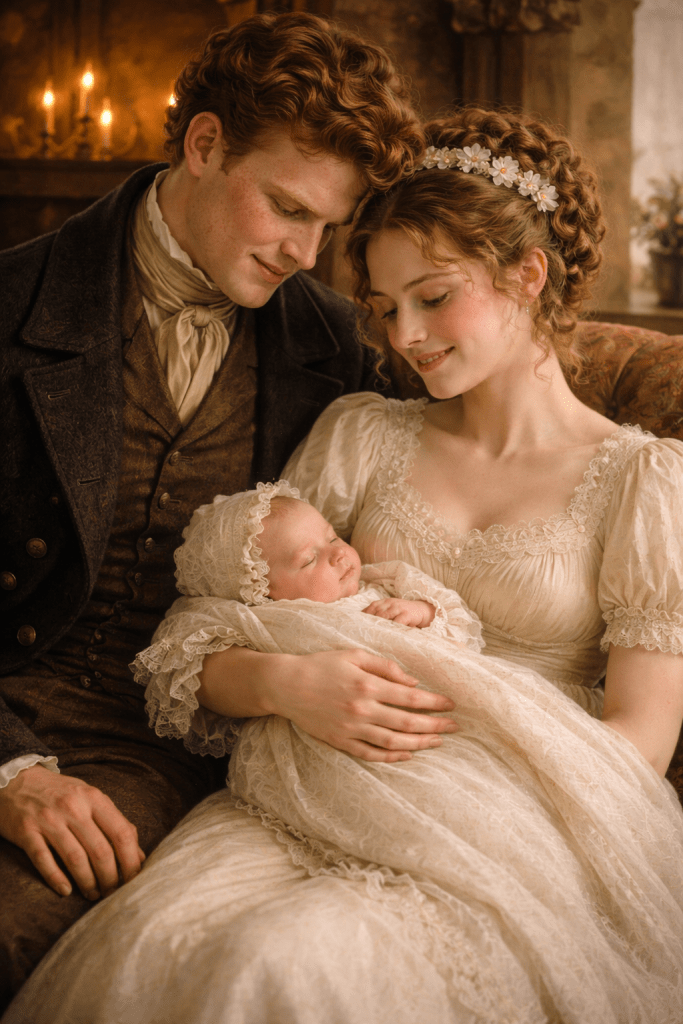
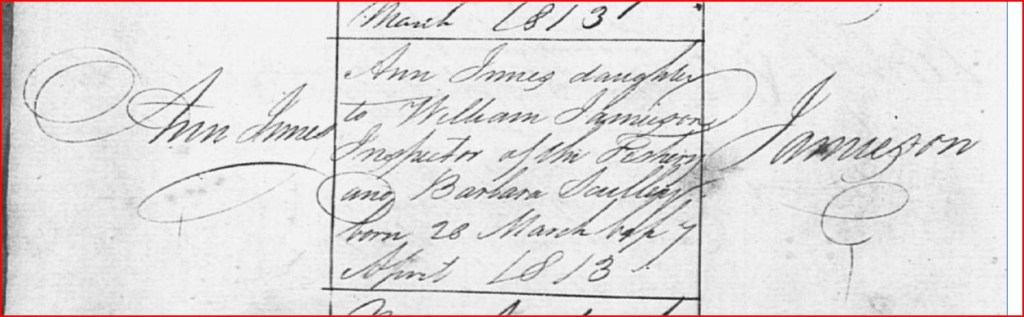
Naming the baby after Barbara’s mother, Anne Innes, was a quiet gesture of affection that tied the two families together, linking Shetland with the west of Scotland in a way that felt both tender and deliberate. Amid the noise of shipyards, the heat of the sugarhouses, and the constant movement along the Clyde, the arrival of their first child brought a steadiness that their new life had not yet offered.
In the midst of all the forces that had carried them south, this small girl created a centre of gravity around which their family life could take shape.
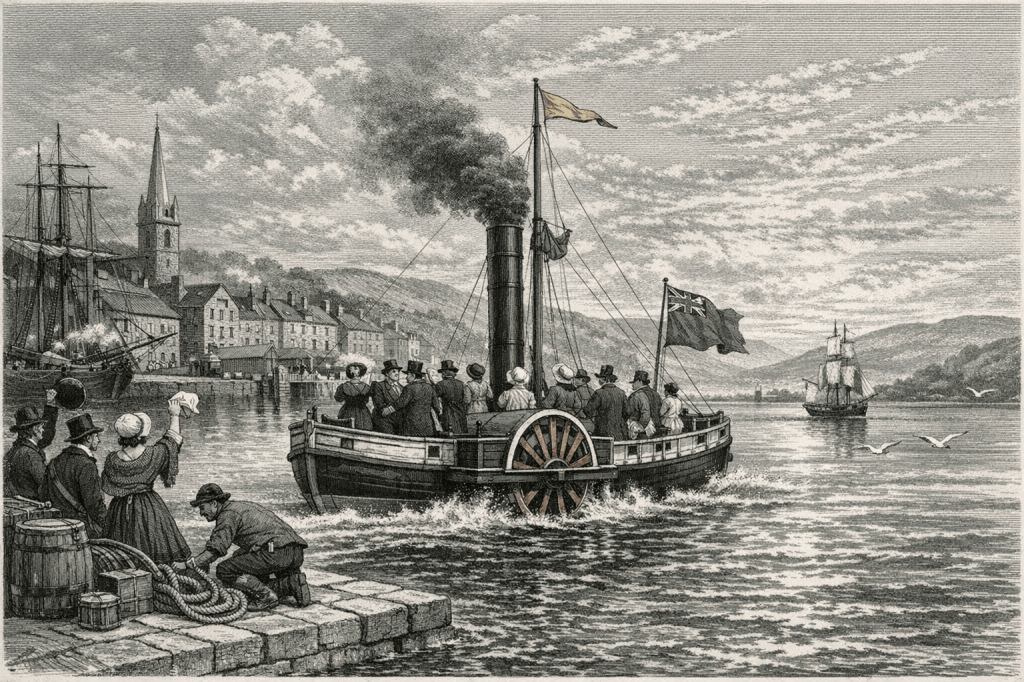
Yet even in the noise and bustle of harbour life, there were moments of relief. The new paddle steamer PS Comet, making its pioneering runs along the Clyde, opened the water in a way no vessel had before. For William, it meant that Rothesay, his family, and his childhood shores were suddenly closer than they had ever been. For Barbara, those trips across the firth held a gentler quality: quieter streets, familiar faces, and the comfort of kin who welcomed her and the baby into their fold. Each visit softened the strangeness of Greenock, giving her a sense of belonging that the restless port alone could not provide.
Under the Seal of the Fishery Board
In 1812 Greenock was a thriving port on the cusp of modernisation. Work was underway on the harbour to build new berths; the East Quay (pier added 1791) had begun to be used by the Clyde’s first steamboat service, and the pier soon became known as Steamboat Quay. The town’s growth fed directly into the herring trade: the harbour and its quays were a hub of commerce. More than half of Scotland’s salted fish exports passed through its harbour, bound for distant markets. The quayside felt like the crossroads of the world – voices from distant coasts mixing with the clank of iron hoops and the creak of timber under strain.
Yet prosperity in early-nineteenth-century Greenock carried a shadow that could not be ignored. The silver darlings of the northern seas shimmered with both prosperity and sorrow. The port’s wealth was undeniable, its quays crowded with vessels bound for every corner of the Atlantic world. Yet beneath the bustle ran darker currents: a reminder that the same tide that lifted Scottish fortunes also carried the weight of lives lived in bondage.
Much of the wealth flowing through the Clyde ports rested on an unspoken truth: Ships for the West Indies lay at anchor beside vessels from Ireland and the Baltic, their holds filling with barrels marked for plantations thousands of miles away. Plantation economies across the Atlantic relied on a cheap, durable source of protein for enslaved people, and the poorest grades of salted herring met that need.
For a Fishery Officer, the remit was narrow and precise – protect the reputation of Scottish herring in European markets. His authority ended the moment the barrels left his station, but the system he served stretched far beyond the curing yards of Scotland. The bounty scheme, the Crown Brand, and the Board’s insistence on uniform quality were all designed to strengthen Britain’s commercial position at a time when the herring trade had become a national concern.
The Board’s regulations made the trade hierarchy explicit. Cured herring were divided into strict classes, and only the best, properly gutted, salted, and packed, were eligible for the Crown Brand and the export bounty. Anything below that standard was barred from the lucrative Baltic markets.
Correspondence between the Board and Greenock merchants confirmed what those in the trade already understood. Once barrels reached the Clyde, the boundary between regulation and practice blurred. Substandard fish, repacked, hastily salted, or ungutted, were routinely sent to the plantations, where enslaved labourers received whatever protein could be supplied cheaply and in bulk. The Board did not endorse the practice, but its own classifications created the space in which it flourished.
The unsavoury fact was that fish that did not meet the grade was not put to waste but instead shipped to the plantations (not to mention the Irish!). The following letter to Greenock Merchants Thomson and Buchanan, is further evidence that this was common practice
‘Having laid before the Commissioners for the Herring Fishery your letter of the 7th inst requesting that a cargo of repacked Herrings which has been sent to to your care from Banff for exportation to the West Indies may be allowed to be export altho’ they have not been accompanied by a Certificate by a Fishery Officer that is 15 days intervened between the original curing and the repacking, and the Commisioners having taken the same into their consideration, together with a report theron by the Gent. Inspector of the West Coast: I have it on command to acquaint you, that under the particular circumstances of the case the Commissioners allow the exportation of the said herrings, provided they are in other respects such as the law permits to be sent to a place outside of Europe, and that the necessary directions on the subject have accordingly been given to the Gent. Inspector.’
Letter from the Board to Messrs Thomson and Buchanan, Greenock dated 18th Dec 1813
William carried his branding irons and ledgers with the quiet assurance of a man who understood his place in the great machinery of the herring trade. His work set him at the point where commerce, regulation, and conscience pressed against one another, and though he was only a small figure in that vast system, he could not have missed the truth beneath it: prosperity here was never free of suffering.
Homecoming
But Greenock was never meant to be a home. Their time in the bustling town passed quickly, a brief chapter shaped by work, family ties, and the demands of a trade that would soon pull them north again.
The return must have felt like a long exhale, the familiar sight of Lerwick’s harbour coming into view, the wind sweeping clean across Bressay Sound, the steadier, more human scale of island life settling around them like a known embrace. Whatever Greenock had shown them, its wealth, its energy, its shadows, it remained a chapter apart, a place of growth rather than home. Their true belonging waited in the north, where the circumstances that would shape the next stage of their family story were already falling into place.
By 1817, William was firmly established in Lerwick. His work was steady, his income reliable, and the reputation he had brought north from Argyll had settled into one of consistent trust within the community.
The town was beginning to feel like home. William and Barbara were settling into their household, their days shaped by the needs of a young family and by the steady demands of life in a community adjusting to the pressures of the herring trade. As William settled into his new role, he also began to find his place in Lerwick’s busy social and commercial life. His duties brought him into regular contact with merchants who trusted his judgement, coopers and curers who valued his practical experience, and the customs officers and clerks who shared the daily work of an increasingly active port. Through these encounters, he gathered a circle of colleagues and acquaintances, people who greeted him by name and drew him into the town’s social life.
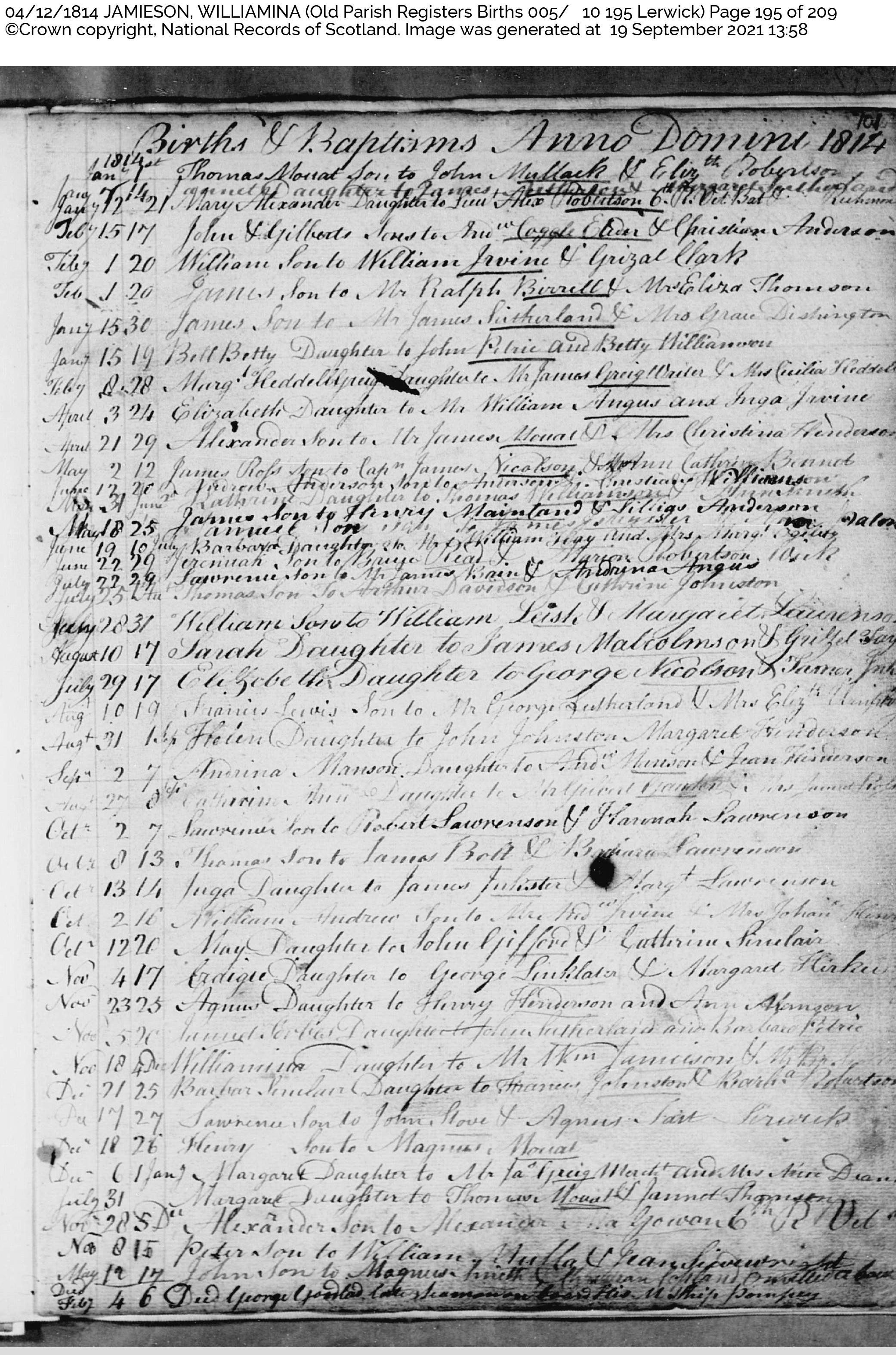
As their domestic life became more settled, their family grew as well. On 18 November 1814, Barbara gave birth to their second daughter, Williamina. The house that had once held only the two of them now carried the sounds of another child, adding a new layer of purpose to their days in Lerwick. A few weeks later, on 4 December, they brought her to be baptised, marking her place not only within the family but within the community.
Their home stood close to Barbara’s relatives, and the family formed the centre of their daily support. Her father, Robert, and her step‑mother were nearby, offering practical help and a steady presence, someone to watch the children for an hour, someone to share a meal, someone who understood the small demands of their days without needing explanation. It made the early years of raising a young family far from William’s own kin feel less daunting.
Barbara’s sister Ann, who still relied heavily on those around her, was part of this close circle. The neighbours and cousins who had known her since childhood understood her ways, and she moved easily among them. For Barbara, being close to Ann brought reassurance and continuity; caring for her had always been part of family life, and that responsibility continued naturally into her married years.
In this cluster of homes, where people stepped in and out of one another’s doorways and news travelled quickly, William and Barbara found themselves surrounded by familiar faces and dependable help. Lerwick might have been growing and changing with the demands of the herring trade, but within these family connections their days held a steadiness that anchored their young household.
A Sad Passing 1817
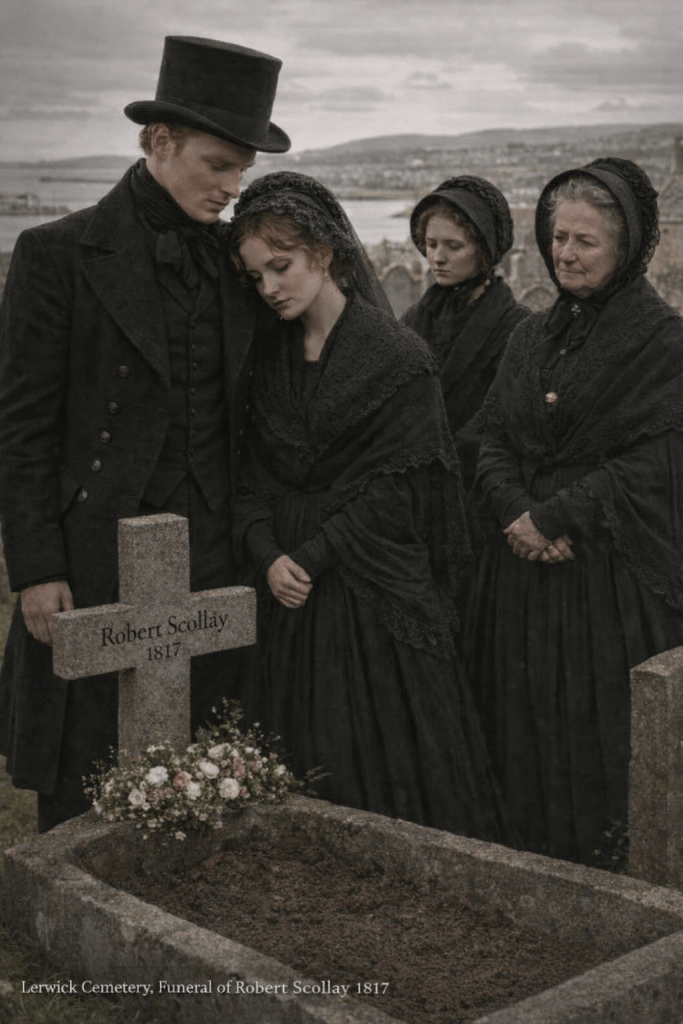
In 1817, when Barbara’s father, Robert Scollay, fell gravely ill in his fifties, he began to put his affairs in order. A month before his death, he created a Trust Estate to support those he feared might be left most vulnerable: his widow, Ann Bolt; his disabled daughter, Ann Scollay; and his grandchildren. He named William as one of the trustees, a quiet but meaningful sign of the trust he now placed in his son‑in‑law. For William, newly a father himself, the responsibility carried both practical weight and a deeper sense of belonging within the Scollay household.
Robert died on 7 May 1817, leaving his family to navigate their grief and the altered shape of life without him. His will provided support for Barbara and her children, but his deepest concern was for his daughter Ann. In early nineteenth‑century Shetland, Ann’s deafness and inability to speak meant she was viewed as dependent, and Robert took particular care to secure her future. His instructions to the trustees were explicit: she was to live in a “decent respectable family” and be treated with “tenderness and humanity.” In those few lines, a father’s voice comes through clearly, trying, in the last weeks of his life, to ensure his daughter would be cared for gently long after he was gone.
“… employ the aforesaid annuity in her favour, maintaining and supporting her in a decent, respectable family… with persons who will treat her with tenderness and humanity, and do all in their power for the improvement of her mind, particularly as respects… knowledge of the principles of… Religion…”
Last Will and Testament of Robert Scollay 1817
Robert left Barbara an annuity of £40 a year, and a lump sum of £200 for her eldest daughter, Ann Innes Jamieson, payable at her majority. The remainder of his estate was to be divided equally among William and Barbara’s younger children.
Barbara’s inheritance included the estate of her uncle, James Innes, who had been a plantation owner in Jamaica in the late eighteenth century. When James died in 1798, his assets, including enslaved people, were sold and the proceeds placed in trust. Robert had managed this fund for nearly twenty years on behalf of his wife’s family. By the time of his own death, the accumulated sum stood at £1,977 18s. 8d., to be divided between Barbara and her sister Ann, a sizeable amount at the time.
For the Jamieson family, this inheritance provided some financial security. It allowed them to maintain a comfortable household, educate their children, and withstand the uncertainties of an economy tied to the fishing seasons. It also ensured that Barbara’s deaf and mute sister, Ann, would continue to receive support.
For William, the inheritance carried social weight as well as practical benefit. It marked him as a man of substance and reinforced his standing within both the Scollay family and the wider community. In a town where reputation shaped opportunity, this new stability helped anchor him more firmly in Lerwick’s civic and commercial life.
Trouble in Anstruther
That same year, the Fishery Board faced a serious problem. Trouble had flared in the East Neuk of Fife, where the fishermen of Anstruther, Pittenweem, and the surrounding villages had reached a breaking point with the Burntisland officer. Accusations flew in both directions: the fishermen claimed the officer had refused to brand their fish; the officer insisted they were leaving their nets in the water over the Sabbath, spoiling the catch and violating the law. Tempers rose, profits were threatened, and the Board’s authority was beginning to look uncertain.
The Commissioners chose William. They needed someone who could walk into a volatile situation without making it worse. His record for fairness and steady judgment made him the officer most likely to restore order and re-establish confidence in the Board.
The assignment marked a further step in his career. He was no longer simply responsible for Lerwick; he was becoming one of the Board’s dependable problem-solvers, trusted to manage disputes and bring clarity where local relationships had broken down.
However, the assignment came at a difficult moment. Barbara was still mourning the recent death of her father, and the household was adjusting to the responsibilities of the Scollay Trust. Yet, as always, the family moved together. William packed his papers and branding irons; Barbara gathered their two young children; and the small family set out across Scotland, bound for a district that had no reason to welcome them.
Confrontation in the East Neuk
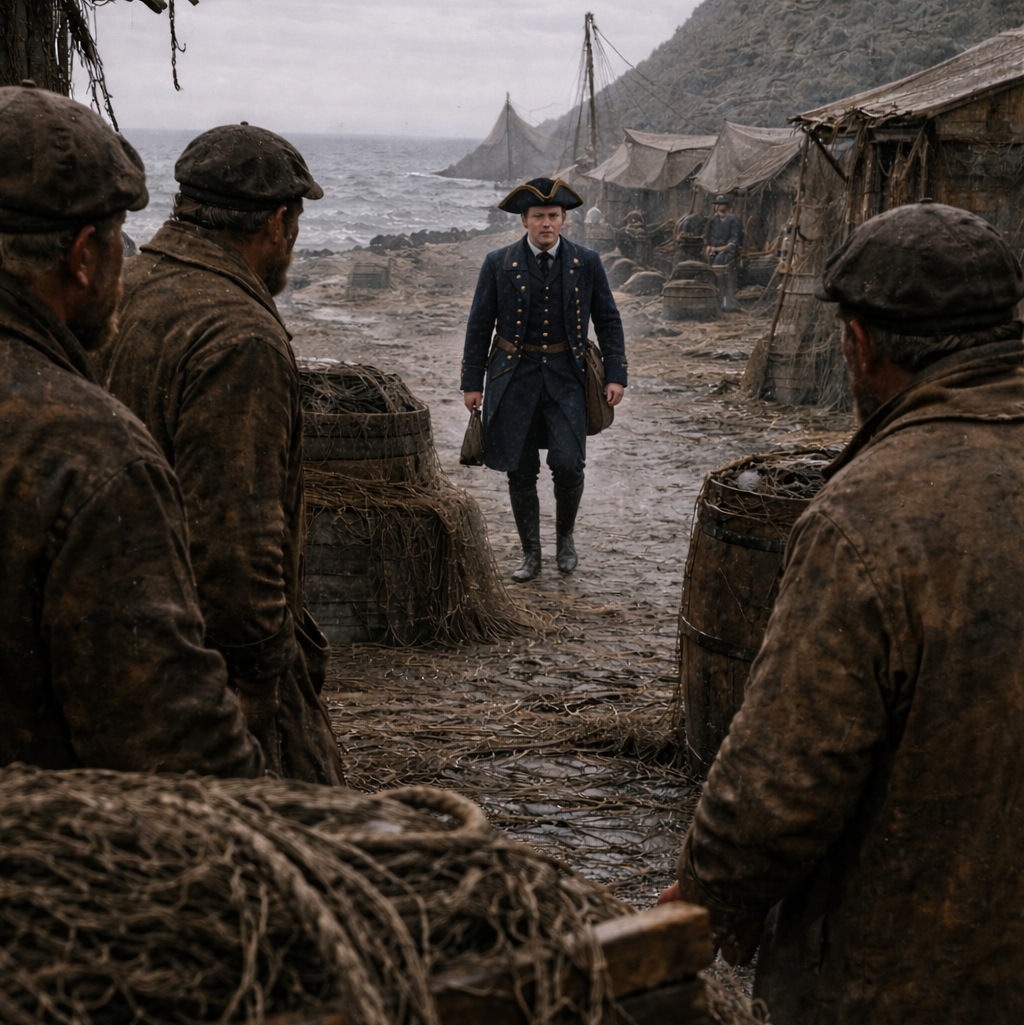
William’s arrival in Anstruther would have been noticed with interest. The East Neuk was a close community, protective of its own ways and wary of outside interference. For an officer from distant Shetland to step into a dispute that had simmered through the summer demanded tact, patience, and a steady temperament. He had already shown he could manage the tensions of fishing communities in both Lerwick and Greenock; now he was being asked to do the same in a place where he had no history to draw on and no local alliances to ease his path.
The East Neuk was not Lerwick. He was met by a community already bristling with resentment. Here, the women were the driving force of the industry, gutters, packers, negotiators, and guardians of the household purse, and they had little patience for a bureaucratic officer interfering in their men’s work. Still, he began where he always did: with the regulations, starting with net size.
It was immediately clear that these fishermen knew how to play the game. William caught on quickly. At dawn, when the boats came in, the illegal nets vanished, whisked behind sheds, slipped into lofts, or carried off by boys who disappeared into the wynds before an officer could blink. Only the compliant nets were brought forward for inspection. William saw through the performance, of course, but proving it was another matter. In one of his early reports, he acknowledged the difficulty with a wry understatement, noting that the women in some villages were “very rood”, a phrase that barely hinted at the sharp tongues and sharper elbows he encountered whenever he seized a non-compliant net.
‘ … I have no doubt that some of the fishermen here are at times in the habit of working small nets, which is out of my power to detect, as when they haul in the morning they conceal the nets, and bring their best nets in the care that they may come under the inspection of the office, and at some of the small villages here they are very rood particularly the women, which I have already experienced on seizing the above net…’ William Jamieson Officer of the fishery
William Jamieson Fishery Book Anstruther 1817
As the season wore on, the scale of the challenge became unmistakable. William’s letters to the Fishery Board grew sharper, never insubordinate, but edged with the frustration of a man trying to enforce rules in a district that met authority with suspicion. William, arriving alone and unknown, had to steer their tempers with care, balancing firmness with tact.
Beneath the surface lay a deeper grievance. The fishermen wanted their own officer, someone rooted in their communities, not a representative of the more distant Burntisland office. Yet once again, the Fishery Board proved obstinate. They refused to alter the administrative boundaries or concede to local pressure, leaving William to manage not only the practical difficulties of enforcement but the simmering resentment of men who felt overlooked and unheard.
A Dangerous Encounter
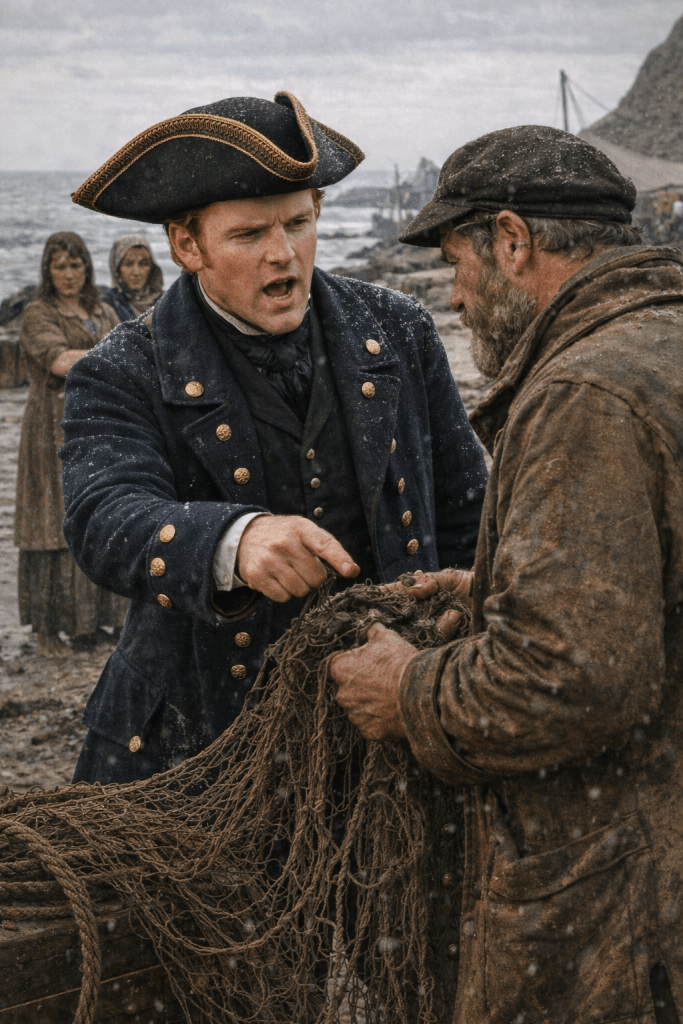
One morning in early August, the simmering hostility finally broke into open conflict. At Pittenweem, when William attempted to seize an illegal net, a fisherman named John Goldie lunged forward, trying to slash it to pieces before it could be taken as evidence.
A crowd gathered, men shouting, women pushing forward, the mood turning sharply against him. William held his ground and prevented the destruction of the net, but not without risk. In his report, he admitted that without protection, he “dare not attempt to take nets even of illegal size,” a rare acknowledgement of vulnerability from a man who seldom complained.
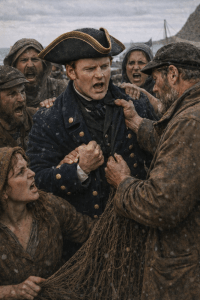
“Sir, I have herewith send you a return of one net signed by me at Pittenweem on the 11th Inst from David Anderson, fisherman, after a great dale of abuse and threatenings, particularly from one of the fishermen, John Goldie, who attempted by violence to cut the net to pieces before I should be allowed to take it, this however I prevented but not without danger of being treated in a very unbecoming manner. I therefore beg leave to state that without being armed or otherwise protected among a set of illiterate fishermen aided by an assembly of fishwives I dare not attempt to take nets even of illegal size. At present I am surprised at their using the small nets as the herring are very large and of a superior quality….”
William Jamieson Fishery Book – Anstruther 1817
William Jamieson, 1817
However, he did not retreat. Over the following days, he travelled the coast from Anstruther to St Andrews, stopping at every harbour and repeating the same instructions. Some listened; many did not. He wrote that it was “almost impossible to make them understand the regulations,” though he suspected misunderstanding was not always the problem. Even so, he assured the Board that “anything in [his] power shall not be wanted”, a quiet commitment to keep pressing until the worst practices were brought under control.
As the weeks passed, William uncovered deeper problems. In Stonhouse and nearby villages, curers were taking small herring, fish that should never have been exported, and curing them in barrels far below the legal size, some holding barely 25 gallons. Worse, the fish were being gutted without sorting, so broken or spoiled herring were packed alongside the good. These barrels, he learned, were bound for the Continent.
“…Yesterday I was informed that at Stonhose and its neighbourhood the curers are in the habit of taking the small herring (which set in this season) by a drag or trawl net hauled on shore, carting them to their closses and curing them in barrels not exceeding 25 gallons; some had been gutted without any attention to separate broken or spoiled herrings. I know not whether they intend to present their gutted herrings at any port for bounty where an officer is stationed, but I know they are intended for the Con’t (Continent), which is of itself sufficient to hurt the credit of the British fishing.”
William Jamieson, 1817William Jamieson Fishery Book – Anstruther 1817
To William, this was more than a local shortcut. Poor-quality exports from one district could damage Scotland’s standing in European markets and undermine years of work by the Board. He understood that the herring trade depended on trust, and trust relied on standards.
His time in the East Neuk showed him at his most determined: calm under pressure, unwilling to compromise, and acutely aware of the wider consequences of local practices. It was a testing ground that strengthened his reputation with the Board, confirming him as someone they could rely on in the most difficult circumstances.
A Plan for Order
For all the hostility William faced in the East Neuk, he was not entirely alone. Among the merchants and curers, men whose livelihoods depended on the reputation of their product, he found a small but important circle of allies. They were as frustrated as he was by the fishermen’s evasions. Every hidden net, every undersized mesh, every shortcut taken at sea threatened the quality of the herring they packed and sold. If standards slipped, their profits would slip with them.
“…Yesterday I was round the whole coast from Anstruther to St Andrews and give all the directions and information in my power. It is almost impossible to make them understand the regulations required, and some of them will not be instructed. Mr Nicolson has been at very great trouble and pains instructing them (even by their own confession) and still they are much at a loss. I expect in a little time to see all these careless practices done away as anything in my power shall not be wanted that I can attend to…”
William Jamieson Fishery Book – Anstruther 1817
William Jamieson, 1817
It was in conversation with these men, in smoky curing yards and cramped counting rooms, that a practical idea began to take shape. The problem, William realised, was not simply the nets themselves but the moment of inspection. On land, the fishermen could hide anything. At sea, they could not.
He proposed a straightforward solution: send men out among the fleet while the nets were shot. Inspect the gear where it was being used, not where it could be concealed. The curers agreed at once; they wanted order restored as much as he did.
In a letter to the Board, he set out the plan with the same steady resolve he had shown throughout the summer:
“…If I had to be here and to employ men occasionally so as to go amongst the fleet, when their nets are shot, it would be the effectual way to put a stop to them… the curers are very desirous that such should take place. I shall leave this matter for the Honourable Board to determine. In the meantime, I shall exert myself to the utmost of my power to detect nets of illegal size if they come under my eye.”
Extract of a letter from Wm Jamieson to the Fishery Board
It was the voice of a man who refused to be intimidated or worn down by resistance. He saw clearly what needed to be done and was prepared to stand alone if necessary, relying on his authority, his sense of duty, and a firm belief that the fishery could be better than what he had found in the East Neuk.
By the end of the season, the mood in the East Neuk had shifted. The same fishermen who had once shouted at William across the harbour now grudgingly acknowledged that he had been fair. The curers, who had watched the summer’s disorder with growing alarm, recognised that it was his persistence and calm refusal to be intimidated that had restored order. When they petitioned the Fishery Board to appoint him as their permanent officer, it was a striking endorsement from a district that had met him with suspicion only months earlier.
The Board agreed. William became the first officer entrusted with two stations, Lerwick and Anstruther, an unusual arrangement and a measure of the regard in which he was now held. What had begun as a temporary assignment had become a defining chapter in his professional life.
A Growing Family
Although Lerwick remained their true home, William’s new responsibilities meant the family now divided their lives between Shetland and Fife. With his role in the East Neuk established, they found a second base in the little town of Anstruther. Its tight wynds, busy harbour, and constant hum of work became the backdrop to the next stage of their lives. Their household grew quickly: Margaret Barry Jamieson was born on the 3rd Feb 1819 and baptised on 2nd March, followed by Barbara Mary Jamieson born on the 11th April 1821 and baptised on 29th April. The East Neuk, once a place of conflict and uncertainty, became a place of family routine and new challenges.
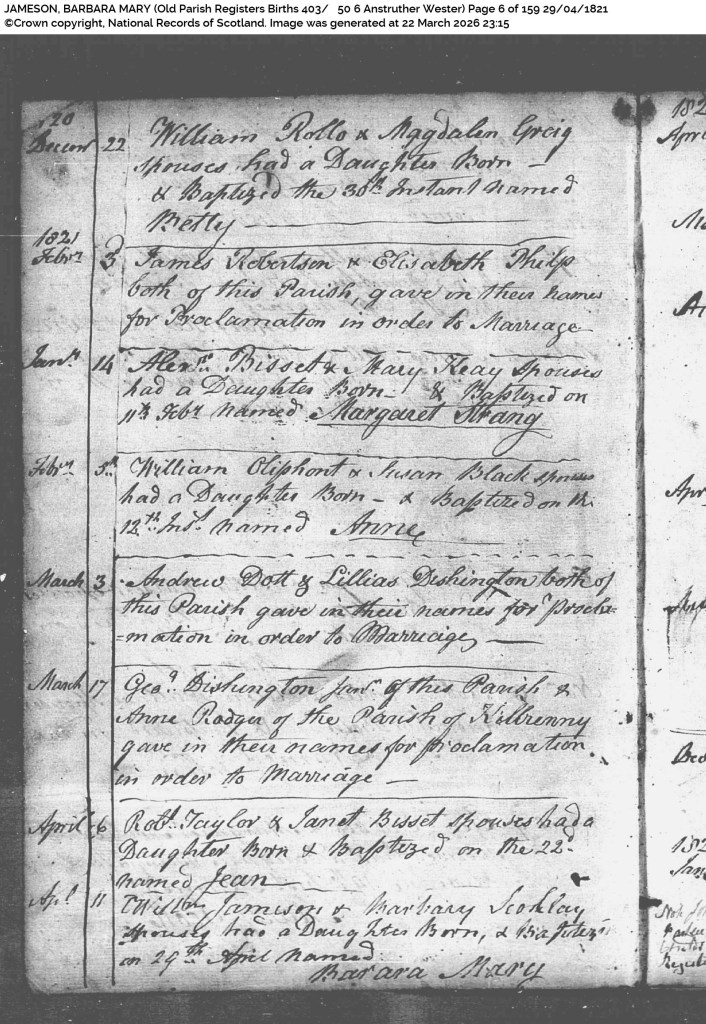
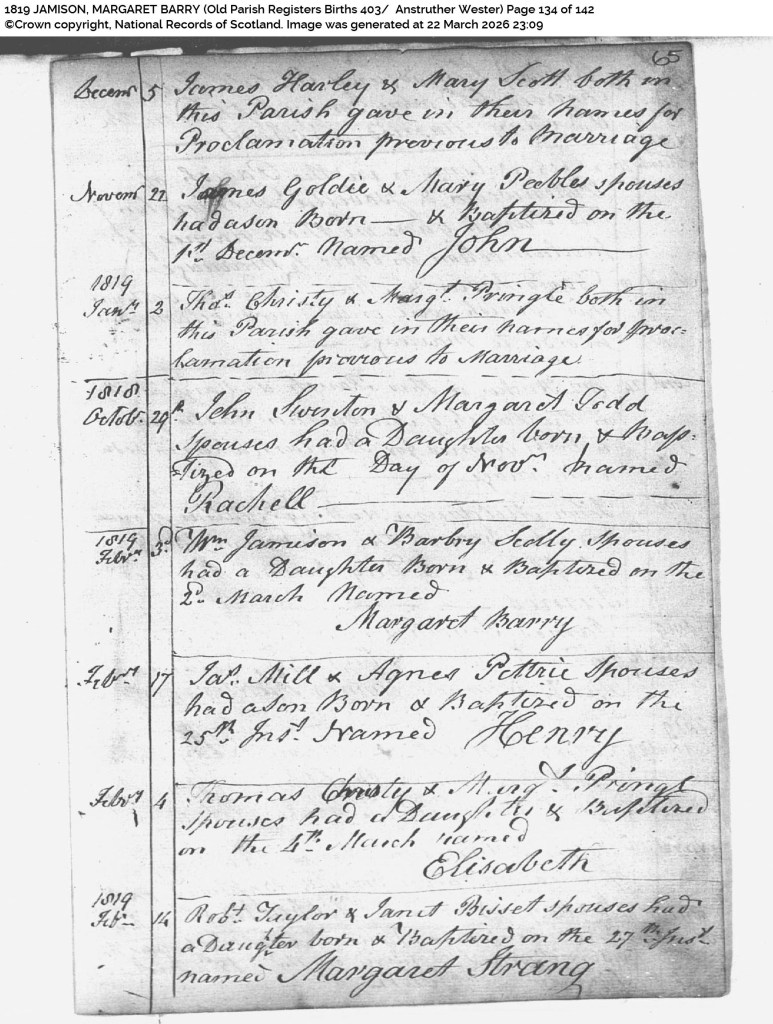
Yet even as the family settled into this new rhythm, the pull of Shetland never loosened. William’s work in Anstruther had broadened his responsibilities, but it also sharpened the Board’s awareness of how vital the northern district had become. Each season brought fresh reports from the islands, of swelling fleets, crowded stations, and the growing pressures of a trade that was beginning to outstrip its old structures. What had once been a remote posting was now emerging as one of the most strategically important fisheries in Scotland, and William’s steady presence in both regions placed him squarely at the heart of the Board’s deliberations.
Principal Officer for Shetland 1821
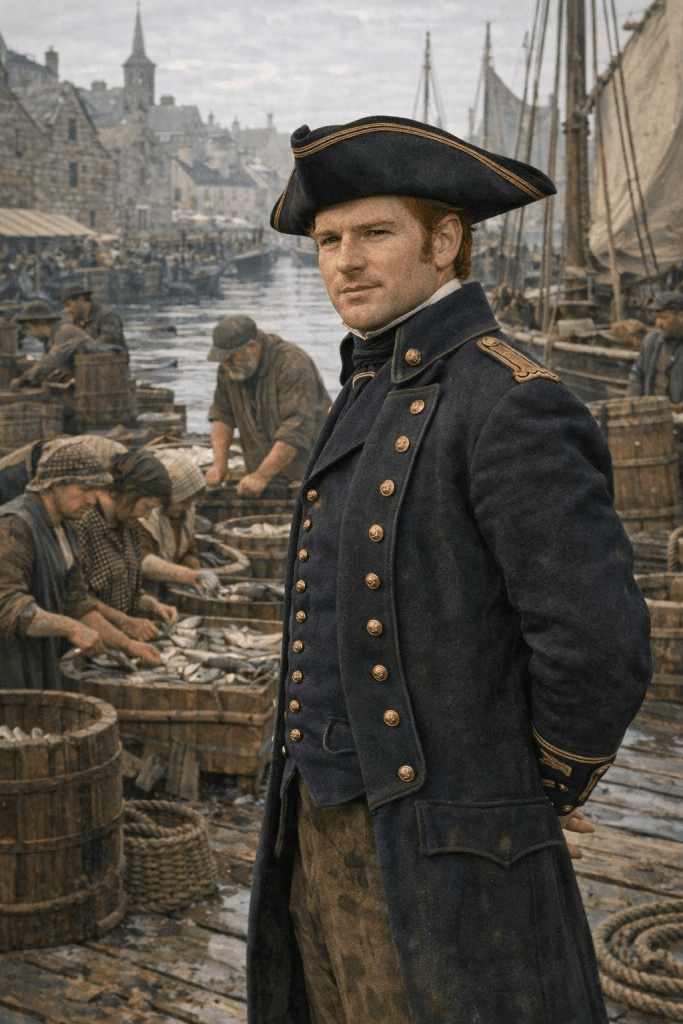
By 1821, William’s reputation was secure. His years of service between Lerwick and Anstruther had shown the Board that he was reliable, steady, and capable of restoring order in difficult districts. At the same time, Shetland’s herring trade was expanding rapidly, its importance to the national fishery increasing with each season. The islands needed stronger oversight, and the Board responded by authorising four new officers for the district.
At the centre of this reorganisation stood William. Experienced, respected, and already deeply rooted in the community, he was appointed “Principal Officer for Shetland”, placing him at the head of the Islands’ fishery administration. This was a significant promotion that placed him at the head of the entire district. His acceptance letter was formal and measured, but beneath its careful phrasing lay a quiet pride:
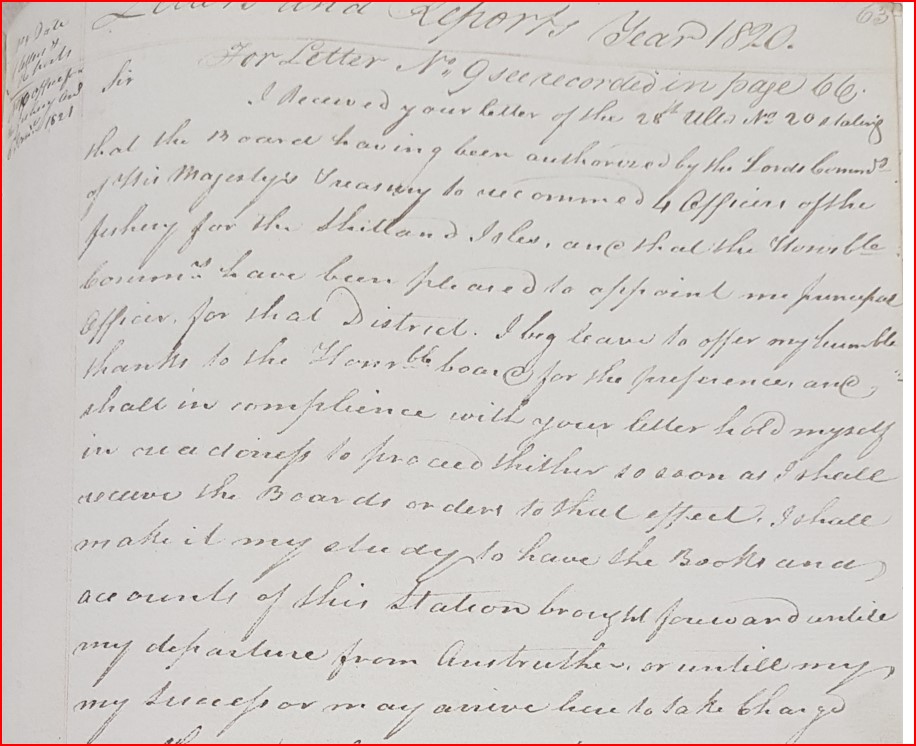
“Sir, For letter No. 9 see page 66. I received your letter of the 28th ulto, N0.20 stating that the Board having been authorised by the Lord’s Commissioners of his Majesty’s Treasury to recommend four officers of the Fishery for the Shetland Isles, and that the honourable Commissioners have been pleased to appoint me as the Principal Officer for that district. I beg leave to offer my humble thanks for their preference and shall in compliance with your letter hold myself in readiness to proceed thither so soon as I shall receive the Board’s orders to that effect. I shall make it my study to have the books and accounts of this station brought forward untill my departure from Anstruther, or untill my successor may arrive to take charge.”
William Jamieson, Anstruther Fishery Book 1820
With the letter dispatched, the path ahead was clear. The move back to Shetland was not a simple return but a homecoming shaped by years of experience gained elsewhere. Anstruther had given the family stability and a second foothold, yet the pull of the islands, its familiar harbours, its restless summer fleets, its tight‑knit communities, remained constant. Now, with his new authority and responsibilities, William was prepared to resume his place at the centre of the district he knew better than any other. The journey north would carry him back to the people and waters that had defined his early career, it would also mark the beginning of a new chapter: one in which he no longer served as a solitary officer on the edge of the Board’s attention, but as the man entrusted with guiding the entire Shetland fishery through a period of rapid change.
For the family, the prospect of returning to Shetland stirred a mixture of anticipation and quiet upheaval. Anstruther had become familiar, its narrow wynds, its neighbours, the routines that had shaped the births of their young daughters, but the Shetland was still home in a deeper sense. Margaret and Barbara were too young to understand the change, yet the household moved into a gentle flurry of preparation: clothes mended for the journey, trunks repacked, small possessions wrapped carefully for the sea crossing. Margaret Barry Jamieson, now a lively toddler, clung to her mother’s skirts as Wilhelmina sorted linens and set aside the few comforts that would ease the transition north. Friends and neighbours called at the door with farewells and small tokens, aware that the family’s time in the East Neuk had been only a chapter, not a destination. As the date of departure drew closer, the house took on that familiar air of temporary disorder that accompanies every move, an outward sign of the inward shift as they readied themselves to return to the islands that had shaped the beginning of their married life.
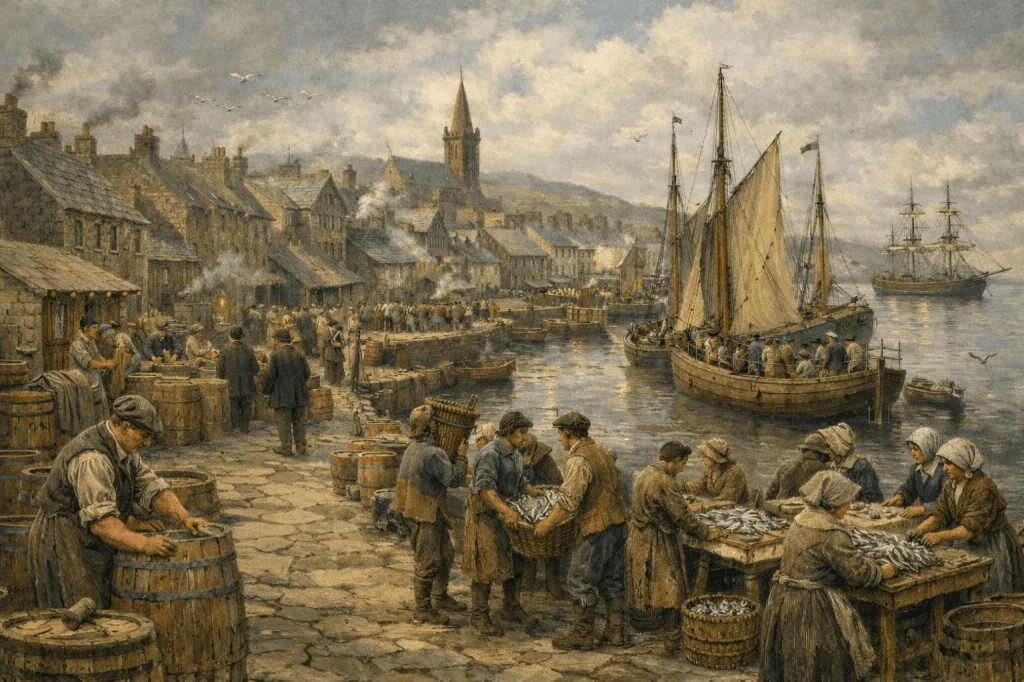
For William and his family, the change in Lerwick was unmistakable the moment they stepped ashore. The familiar shoreline had thickened with new buildings, coopers’ yards, curing houses, timber sheds, and the freshly whitewashed offices of ambitious merchants. Boats crowded the harbour in numbers that would have been unthinkable a decade earlier, their masts rising in dense thickets above the water. The air itself felt altered: sharper with salt, heavier with smoke, and threaded with the constant movement of men, barrels, and fish. What had once been a modest northern town was fast becoming the nerve centre of a thriving industry, and William returned not to the quiet Lerwick of his early service, but to a place humming with expectation. His new role placed him at the heart of this transformation, responsible for bringing order and oversight to a district whose growth showed no sign of slowing.. The powerful firm of Hay & Ogilvy—merchants, bankers, and major investors in the fishery had become the engine of this transformation. Their influence radiated across the islands. In 1822, they helped establish the Shetland Bank, becoming major shareholders and fuelling a new sense of commercial confidence.
Lerwick, once a modest northern harbour, was beginning to imagine itself as a centre of trade. The shoreline and the town were being reshaped by the demands of a growing industry. New sheds stood beside older buildings, piers pushed farther into Bressay Sound, and merchants invested in additional lodberries -stone-built stores – that allowed cargo to be unloaded directly from the boats.
Summer brought a marked increase in activity: the harbour filled with vessels from across the coast, and the foreshore became a working landscape of barrels, boats, and labour. Seasonal workers arrived in significant numbers, many of them young women from Banffshire, Caithness, and Moray, whose presence signalled the start of the curing season. Taverns and temporary lodgings filled quickly, and the narrow streets carried the sound of unfamiliar voices and the steady traffic of people and goods.
As Principal Officer for Shetland, William stood at the centre of this clamour. The Fishery Office sat at the heart of a thriving industry. His responsibilities expanded with the arrival of each fleet. Each season brought opportunity, but it also brought scrutiny. A single spoiled shipment could damage the reputation of Scottish herring; a single lapse in oversight could undermine the trust on which the bounty system depended. William’s work now stretched from Lerwick to the outlying stations, from the bustling quayside to the quiet counting rooms where merchants tallied their profits. He was no longer simply an officer enforcing rules; he was the figure who held together the practical workings of a rapidly expanding industry. His name, pressed into thousands of barrels, travelled across the North Sea as a guarantee of quality.
Troubled Times
For a time, life in Lerwick seemed to settle into a steady rhythm. William had returned to Shetland with a secure post, a respected title, and a growing family. The herring trade was flourishing, and the Jamiesons appeared to be part of the confident new chapter unfolding across the islands. Yet beneath this surface of prosperity, the pressures of the 1820s were beginning to make themselves felt.
William’s responsibilities were heavier than ever. The boom brought more boats, more barrels, more disputes, and more scrutiny. As Principal Officer, he was expected to maintain order in a rapidly expanding industry, and any lapse, real or imagined, would fall squarely on him. At home, Barbara managed a busy household in a town changing faster than anyone could keep pace with. The Jamiesons were respected, but they were also visible. In a small community, reputations were easily shaped, and news travelled quickly.
It was in this atmosphere of constant work and quiet strain that the first signs of difficulty began to appear.
An Unfortunate Night
For all his diligence and respectability, William carried a weakness that those closest to him understood too well: when he drank heavily, his temper could ignite with startling force. It was a flaw that had never before threatened his position, but in 1823, it would bring him to the brink of scandal.
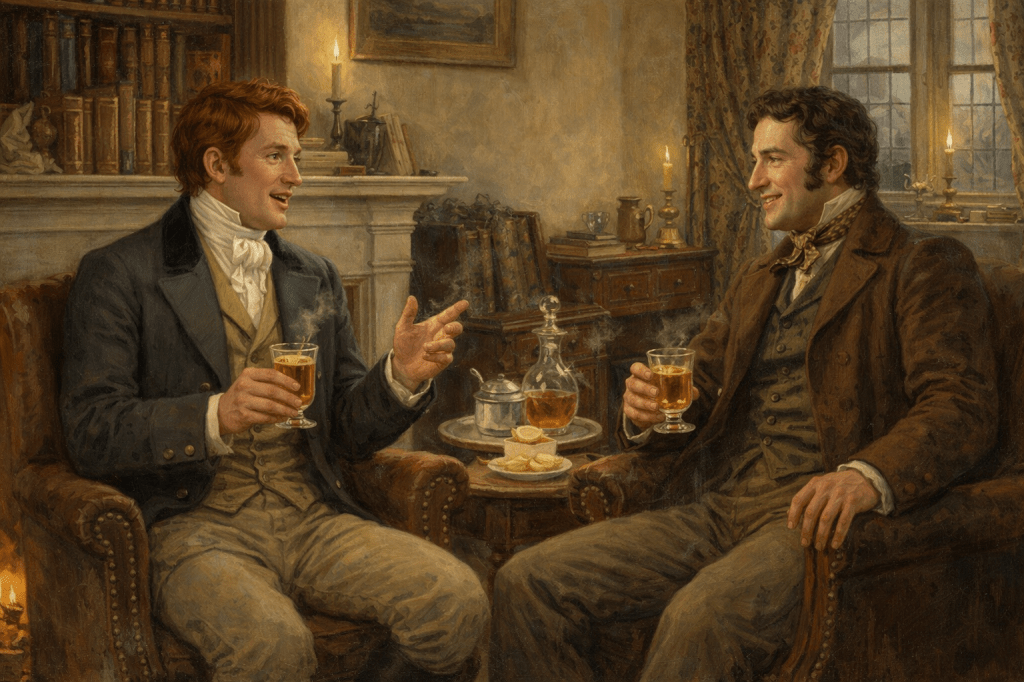
On the afternoon of Thursday 27th of March, William visited his neighbour and friend, Dr Arthur Edmonston. The doctor was a brilliant but volatile figure, an accomplished physician and naturalist, yet also a man who seemed to attract controversy. As Alistair Hamilton later wrote, Edmonston was “a colourful character” who had “fallen foul of the law” more than once, even facing a libel suit from the Procurator Fiscal. He was clever, combative, and never far from trouble.
That day had started out amicably. The two men spent the afternoon drinking together, the conversation easy at first. As evening settled in, they shared a potluck supper and several glasses of toddy. But somewhere between the warmth of the fire and the bottom of the glass, the mood changed. A remark about religion, its exact phrasing lost to time, struck William the wrong way. Offended, he pressed the point, his voice rising, his temper sharpening. Edmonston, equally stubborn, withdrew from the room and instructed his maid to show his guest out. However, William remained, brooding over the slight.

Edmonston, who had already retired to his rooms to change for bed, came down once more to confront his guest. This time, he returned armed with his fowling piece. Whether he meant to intimidate William or simply to reassert control is impossible to know.
The moment Dr Arthur Edmonston reappeared with his fowling piece, the fragile boundary between irritation and danger collapsed. Two men, both proud, both fuelled by drink, now faced one another in a narrow Lerwick room where tempers had already been sharpened by hours of argument. William, affronted and unsteady, refused to leave. Edmonston, armed and equally inflamed, confronted him with a weapon that should never have entered a domestic quarrel. Whether he meant to frighten William, to assert dominance, or simply to end the argument by force of presence, the gesture was reckless.
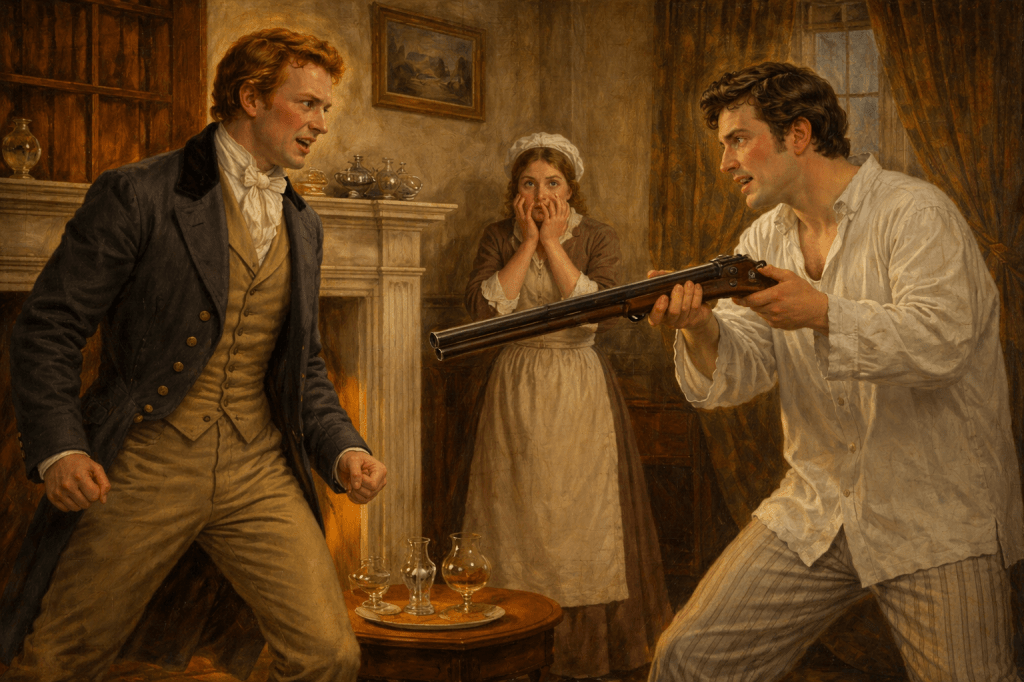
The sight of the gun snapped whatever patience William had left. In a sudden, furious movement, he seized the weapon and hurled it into the drawing room. The moment shattered the last of their restraint. They grappled, two drunk, irritable men locked in a foolish struggle, and in the chaos, they both tumbled down the stone steps. Edmonston suffered the worst of it. Bruised, shaken, and unable to rise, he lay where he fell until the maid, terrified, ran for help. The sheriff officer and his son arrived quickly, and together with William, now sobered by shock, they carried the injured doctor to his bed.

When William finally stumbled out into the night, the damage was already done, and the outcome was unmistakable: a respected Fishery Officer and a prominent physician had descended into a drunken altercation that left both men humiliated and the household in uproar. In a town as small as Lerwick, where every window was an ear and every doorway a witness, the story travelled faster than either man could sober up.
The Aftermath
The Sheriff Officer reported the incident to the Procurator Fiscal, who, in turn, reported it to the Sheriff of Orkney, and, for a brief, dangerous moment, it seemed that the men might face a public trial. But the case collapsed almost immediately. Both men had been too drunk to give reliable testimony, and Edmonston had already seen the witness statements, making a fair examination impossible. The Sheriff dismissed the matter before it reached court.
By morning, the affair had hardened into something more dangerous than gossip. Edmonston, stung by the insult and unwilling to let the matter rest, lodged a formal complaint. His version of events cast William as the aggressor, a man who had overstayed his welcome, refused to leave when asked, and behaved with drunken violence. William, for his part, offered his own account, insisting that he had been provoked, that Edmonston had escalated the situation by producing a firearm, and that he himself had been threatened. Each man believed himself wronged. Each believed the other was at fault. And both were too proud, too angry, and too compromised to retreat.
The Fishery Board could not ignore the matter. William’s position depended on public trust, and any hint of misconduct threatened not only his reputation but the integrity of the office he held. The Commissioners demanded an explanation. William, still raw from the encounter, wrote defensively, insisting that he had been provoked and that Edmonston’s behaviour had been outrageous. But the tone of his letter betrayed the strain he was under. The Board, accustomed to his steady professionalism, now saw a man shaken, embarrassed, and struggling to contain the consequences of a single night’s folly.
In Lerwick, the affair divided opinion. Some sided with William, recalling his years of fair dealing and the respect he had earned, and noting the Doctor’s argumentative nature. Others whispered that the doctor’s account rang true, that William’s temper, long rumoured, seldom witnessed, had finally broken through the surface. The truth lay somewhere between the two, tangled in pride, drink, and the combustible personalities of both men. But in the eyes of the Board, perception mattered as much as fact. A Fishery Officer could not afford scandal.
Grief in the Wake of Scandal
The Edmonston affair, a single night of drink and temper, did not end William’s career but left a bruise that did not fade quickly. His judgement, once trusted implicitly, was quietly reassessed. Barbara, who was heavily pregnant with their fifth child at the time, faced the strain of a household suddenly thrust into public scrutiny. The inheritance that had once secured their comfort could not shield them from the consequences of reputation.
Her baby arrived just weeks later. A boy, Neil Jamieson, named for William’s father, was born on 8 May 1823. The child was christened in Lerwick parish Church on the 17th June 1823.

His arrival was a bright spot in a decade that would be marked by sorrow, a small and precious reassurance amid the unsettled talk that followed the incident. The Jamieson family, so recently buoyed by prosperity and position, now found themselves navigating a new and unsettling uncertainty. The scandal had shaken the household, but the years that followed brought quieter and far more personal griefs. William and Barbara endured losses that would have tested any family. What had begun as a decade of promise, new appointments, a growing household, and a rising place in Lerwick’s changing world was interrupted by a sequence of heartbreaks that touched them deeply.
The First Loss: Baby Robert
Their grief began with the death of their infant son, Robert Scollay Jamieson. Born on 23 July 1826 and baptised just two days later on 25 July, his hurried christening suggested he had been frail from the first. In a community where infant deaths were tragically common, the Jamiesons nevertheless. felt the full, particular sting of a life ended before it had begun. For Barbara, who had already known bereavement in her youth, the pain must have reopened old wounds; for William, the loss compounded the public strain left by the Edmonston affair and made private sorrow harder to bear.

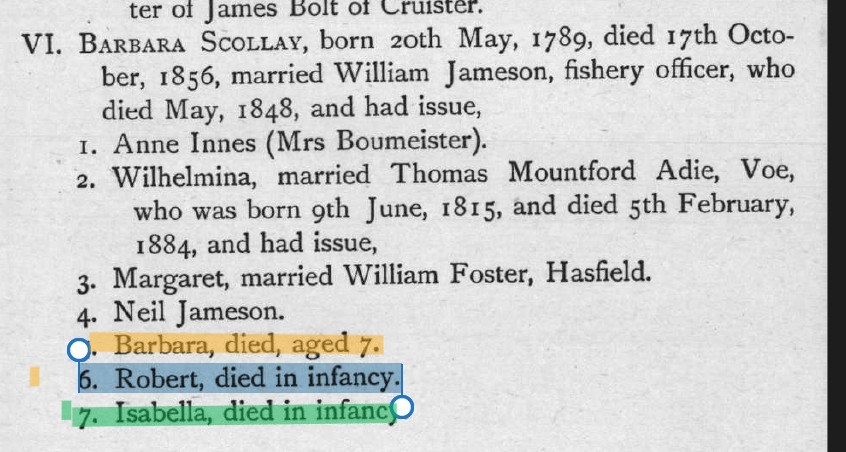
This is a passage from the County Families of Zetland Islands by Francis J Grant, noting that William and Barbara had seven children, three of whom died in childhood.
Inside the house, the signs of mourning were small and domestic. Neighbours called with condolences and loaves, ministers offered prayers, and the household tried to keep its routines intact, meals prepared, accounts kept, duties fulfilled, while an absence settled into the rooms where a child’s presence had briefly been imagined. Grief in Lerwick was both communal and intimate: sympathy was sincere but never wholly private, and every kindly visit also reminded the family of what they had lost.
Yet the death of baby Robert was not an isolated misfortune but the first in a sequence that would hollow the decade. A fragile hope returned with the birth of Isabella Harriot Jamieson in January 1828, only for that hope to be cut short when their daughter Barbara Mary died in August 1828, and baby Isabella followed in January 1829. Three children buried within a few years, three small graves in Lerwick soil, each loss carried its own weight, and together they formed a sorrow that touched every part of family life. For William, already balancing public duty and the pressures of a rapidly expanding fishery, these tragedies added a quiet heaviness to his days and altered the tenor of both his work and his home. For Barbara, the repeated bereavements were deeply wearing, shaping the household’s mood and the way they moved through the world thereafter.


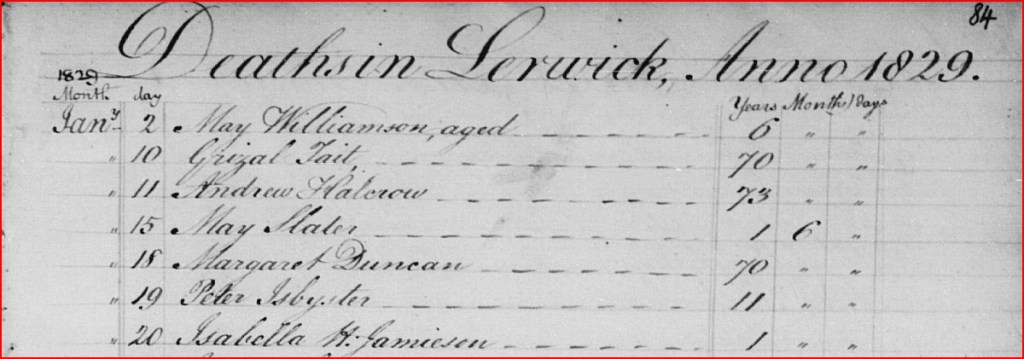
Infant and childhood mortality were heartbreakingly common in early nineteenth-century Shetland, where harsh weather and limited medical care took their toll. But knowing this does not diminish the human cost. For Barbara, the repeated losses must have been deeply wearing. For William, already balancing public duty and the pressures of a growing fishery, these tragedies added a quiet heaviness to his days.
Through these difficult years, he maintained the demanding work of the fishery, steadily rebuilding his reputation and upholding the standards that Shetland’s reputation depended upon. It was not stoicism so much as necessity; the work did not pause, and neither could he.
These years marked a turning point. The Jamiesons had been touched by grief, but they were not undone by it. What followed was a slow rebuilding: the shaping of a household around their surviving children, the steadying of William’s career in the 1830s, and the quiet resilience that allowed the family to find its footing again in a Shetland that continued to change around them.
The 1830s – The Boom Years
The 1830s opened on a Shetland that was transforming almost as quickly as the Jamieson family itself. Lerwick, once a modest settlement clustered around the harbour, was now widely regarded as the capital of the islands. The shift was symbolic as much as practical: proclamations that had long been read at the gates of Scalloway Castle were now delivered from the Market Cross on Commercial Street. Power, commercial, administrative, and cultural, had moved east.
For William, still serving as Principal Officer, this change was unmistakable. The town around him was growing in confidence, and so too were the families who had weathered the hardships of the previous decade. After the losses of the late 1820s, the Jamiesons entered the new decade with a quieter, more fragile hope.
The new decade also brought moments of joy that must have felt especially precious in the Jamieson household after so much trouble and sorrow. Their surviving daughters were now young women, and the family’s connections within Shetland society deepened as the children began to make their own lives.
Williamina’s Marriage, 1834
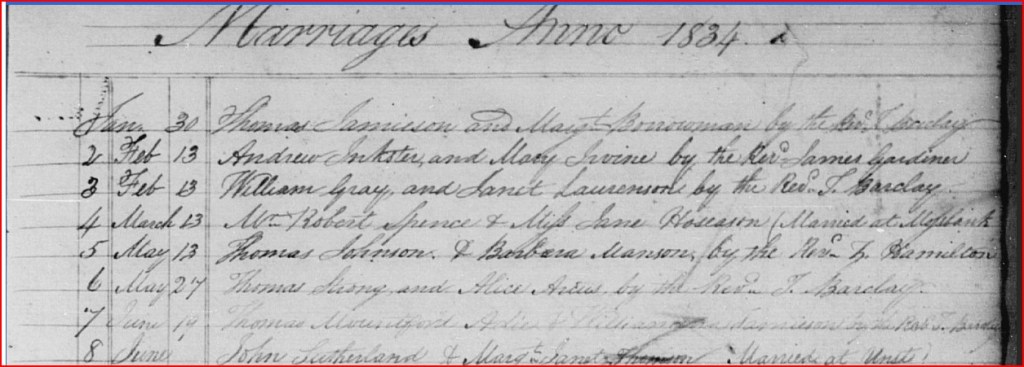
In 1834, William and Barbara’s daughter, Williamina, married Thomas Mountford Adie, a man whose ambitions matched the energy of the decade. Thomas had established a thriving business, T.M. Adie and Co, in Voe, in 1830. The company employed around 400 fishermen, a remarkable enterprise in the islands, and he also operated a successful hosiery business. His marriage to Williamina linked the Jamiesons to one of the most dynamic commercial families in Shetland.
The marriage banns were posted in Delting, and the ceremony marked a turning point: the first of William and Barbara’s children to marry, the first to step into a future shaped by the new Shetland economy.
Ann’s Marriage, 1836
Two years later, in 1836, their eldest daughter Ann Innes married Dr Johannis Gerardus den Bouvermeister, known locally as John. A surgeon by profession, he brought a measure of stability and respectability to the family, an alliance that would have been welcomed after the turbulence of the previous decade.

These marriages were more than family milestones. They signalled that the Jamiesons, despite their grief, remained firmly connected to Shetland’s rising professional and commercial class.
Even as the family rebuilt itself, William’s professional responsibilities continued to grow. His reports on the state of the Shetland fishery were included in the 1837 Report from the Commissioners, Volume 22, placing his observations before the highest authorities overseeing the British herring trade.
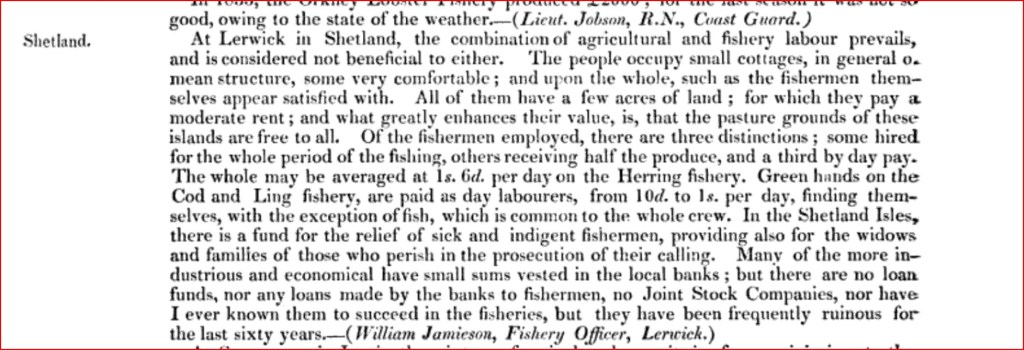

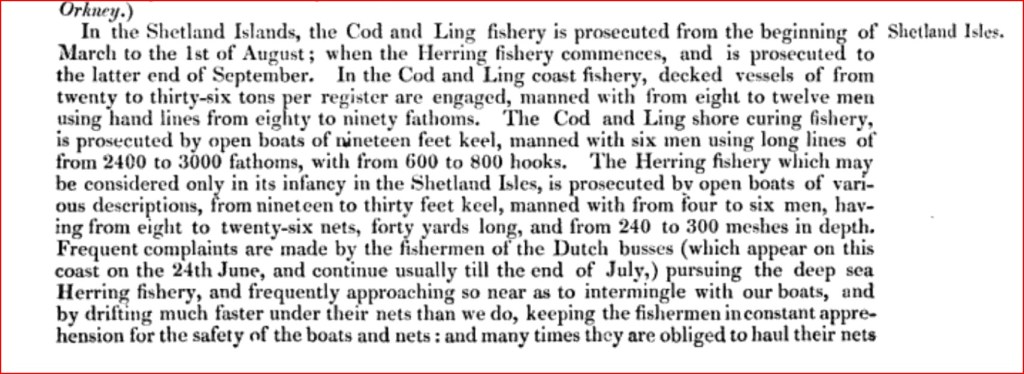
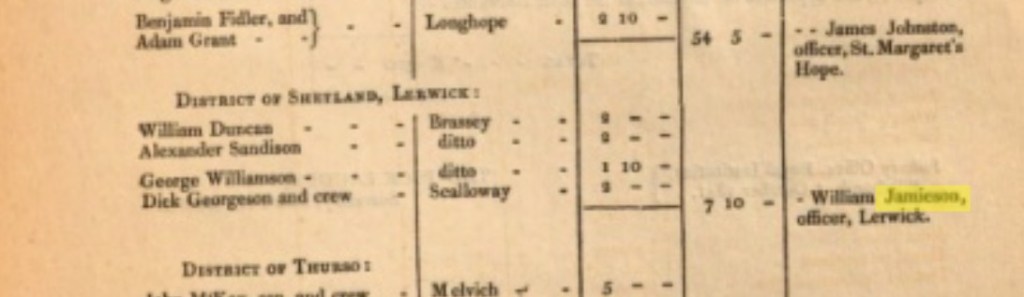
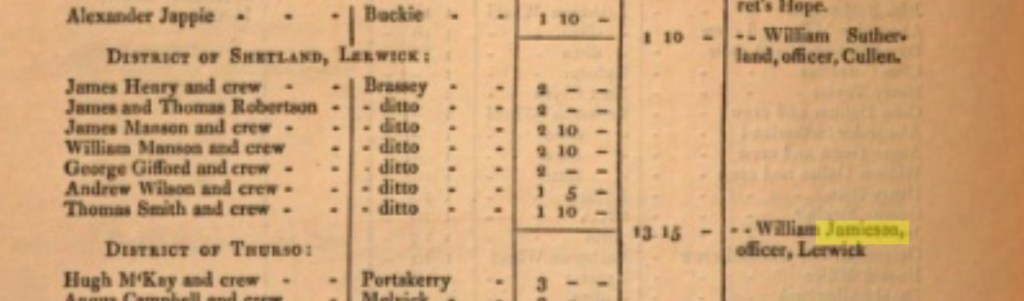
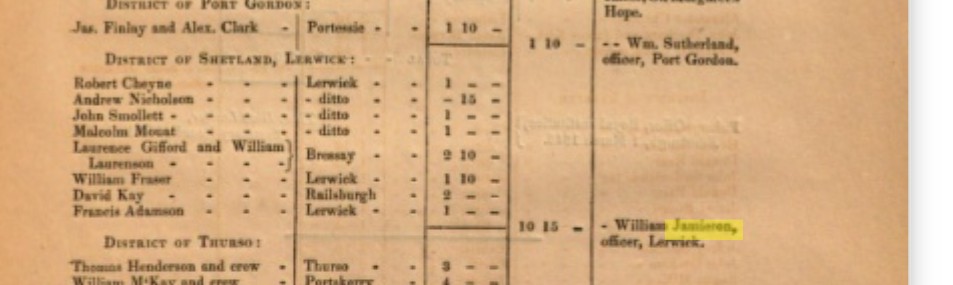
Those reports reveal a fishery still finding its footing. Despite the heavy investment of the 1820s, the new docks, curing yards, and expanding fleet, Shetland’s industry was far from mature. The Dutch bussers continued to fish in Shetland waters, often to the frustration of local fishermen who saw them as competitors with deeper experience and better equipment. The tension between traditional Shetland methods and the more sophisticated continental fleets was a recurring theme in William’s assessments.
His work required diplomacy, firmness, and a clear understanding of the broader forces shaping the northern fishery. The boom years had brought prosperity, but they had also brought complexity, and William, with decades of experience behind him, remained at the centre of it.
Collapse of the Shetland Bank 1839

By the end of the 1830s, the Jamiesons were no longer the young couple who had settled in Lerwick two decades earlier. They were parents of married daughters, grandparents in waiting, and established figures in a town that had grown from a modest harbour into the commercial centre of Shetland. But the decade also brought disruption. The sudden collapse of the Shetland Bank in 1839 sent shockwaves through the local economy, unsettling credit, constraining trade, and revealing how dependent the herring industry had become on fragile financial support.
The failure of the bank accelerated pressures already building within the fishery. The scale of the industry, larger fleets, expanding curing yards, and the annual influx of seasonal labour, was beginning to outstrip Shetland’s limited infrastructure. Prices swung sharply from year to year, and the balance between profit and loss grew increasingly uncertain for merchants, curers, and fishermen alike.
For William, the collapse struck at the centre of his working world. As Principal Officer, he was responsible for maintaining standards in an industry now contracting around him. The work still demanded diligence, but the context had changed: tighter margins, fewer resources, and a community adjusting to a trade no longer buoyed by easy credit or predictable returns.
Holding Steady

As the 1840s unfolded, the downturn in the fishery touched every household in Shetland, and the Jamiesons were no exception. Lerwick was adjusting to leaner years, but William and Barbara continued to rely on the familiar patterns of work, kinship, and community that had shaped their lives for more than two decades.
For William, the changing industry coincided with a natural slowing of pace. He was no longer the young officer who had once walked the quayside with unbroken energy. His work still mattered, and he carried it out with care, but he now leaned more on experience than stamina, aware that he was entering the later chapters of his working life.
At home, Barbara remained the steady centre of the family. Their children were moving into adulthood, the household was now lively with grandchildren, and their ties to both the Scollay and Jamieson kin networks held firm. The inheritance from her father and uncle provided a measure of security, easing the strain of uncertain seasons and allowing the family to maintain a quiet stability.
On 26 October 1842, the family gathered to mark the marriage of William’s only surviving son, Neil, then nineteen and employed as a clerk in Lerwick, to Mary Hunter. Shortly after the wedding, the couple left for Edinburgh, where Neil took up work as a Shipping Clerk in Leith, continuing the family’s long association with maritime trade. The occasion brought William and Barbara a mixture of pride in their son’s steady employment and a quiet poignancy born of the losses they had endured; Neil’s move to the mainland also reflected a wider pattern of young men seeking opportunities in larger ports, and it subtly shifted the family’s daily life as one more household member made his way beyond Lerwick.
As the years turned and the pace of life around him slowed William continued to hold his footing in the town that had been his home for the last three decades.
These years became a period of adjustment rather than decline, a time to balance duty with age and experience with changing circumstances. The future of the fishery was uncertain, but the quieter pace of the decade allowed him to turn his attention more toward home, where his children were now stepping into lives shaped by both the opportunities and the limitations of island life.
As the decade drew to a close, those gentler rhythms became the backdrop to William’s final years. His world had narrowed to the familiar lanes of Lerwick, the steady presence of Barbara, and the growing families of his children. On 27th May 1848, William passed away at the age of 68, closing a life that had carried him from the shores of Argyll to a place of responsibility and belonging in Shetland. News of his death travelled beyond the islands, and the Greenock Advertiser recorded it in its edition of 6 June 1848. His obituary read:
“At Lerwick, on the 27th ult., William Jamieson, Esq., principal officer of the fisheries, the duties of which office he discharged with integrity for a long series of years, being one of the oldest officers in the service.”
“Obituary,” Greenock Advertiser, 6 June 1848, p. 3 of 4

After William’s burial, Barbara moved quietly into the role she had long held within the family: a steady presence supporting the busy lives of her children. Her daughter Williamina’s household, in particular, demanded much of her time. By 1851, Williamina already had seven surviving children, and when her youngest, little Wilhelmina Adie, was born that year, Barbara was there to help nurse the new baby. The Adie home in Delting was crowded and lively. Although Williamina’s husband, Thomas Adie, was a successful merchant, the family still lived in a cramped rented property. “You have no idea,” he wrote in one letter, “how we are packed together in the uncomfortable place we occupy.” In time, he would solve the problem by commissioning a new house to be built in Voe, where he and Williamina would go on to raise a remarkable total of thirteen children.
Barbara, however, did not live to see the new home completed. Her health had been declining for some time, and by the mid‑1850s she was living quietly on Commercial Street, no longer able to manage the full demands of the household. By then, her son Neil, and his wife, Mary, had returned to Lerwick, and it fell to them to care for her in those final years. The long‑standing burdens of grief, age, and illness had taken their toll, and on 17 October 1856, Barbara, then aged 67, died of chronic liver failure. She was laid to rest beside William in Lerwick Cemetery, reunited with the husband whose life had been so closely bound to her own. Her passing did not go unnoticed: the Inverness Advertiser carried a brief notice, recording her death with the quiet formality typical of the time:
“At Commercial Street, Lerwick, on the 16th ult., Mrs JAMIESON, relict of the late Mr Jamieson, Fishery Officer in Zetland.”
Inverness Advertiser 1856

William and Barbara’s Legacy
William and Barbara left no grand monuments, but the spirit of their lives endured in the generations that followed. William had come north from Argyll; Barbara was rooted in Shetland, shaped by a Lerwick merchant household and the quiet demands of kinship. Together they built a life marked by steady work, reliability, and a strong sense of responsibility, to family, to community, and to the changing fishery that framed their days.
Looking back across the span of their lives, their story is one of perseverance rather than prominence. They faced scandal, shifting fortunes, and the deepest sorrows a household can bear, yet they continued to meet each change with measured resilience. Their children carried those qualities forward: some remained in Shetland, their lives unfolding across the familiar landscapes, while others built new futures beyond its shores. Through each branch of the family, the values William and Barbara lived by, reliability, kinship, and the ability to adapt as circumstances changed, continued to echo. Their legacy may not be dramatic or widely recorded, but it endures in the quiet strength passed from one generation to the next, and in the lives shaped by their example.
Citations
- Commissioners for the Herring Fishery. Report by the Commissioners for the Herring Fishery. [London]: The Commissioners.
- Crown Office precognitions, 1823 – Precognition against William Jamieson for the crime of assault
- Last Will and Testament of Robert Scollay 1817 – Ref CC17/5/6 Orkney and Shetland Commissary Court
- Fishery Books for Anstruther: 2017 – 2021
Websites
Shetland Maritime Heritage Project

